


NEET PG Admission 2026: Complete Guide to Eligibility, Counselling, Fees and Seat Allotment
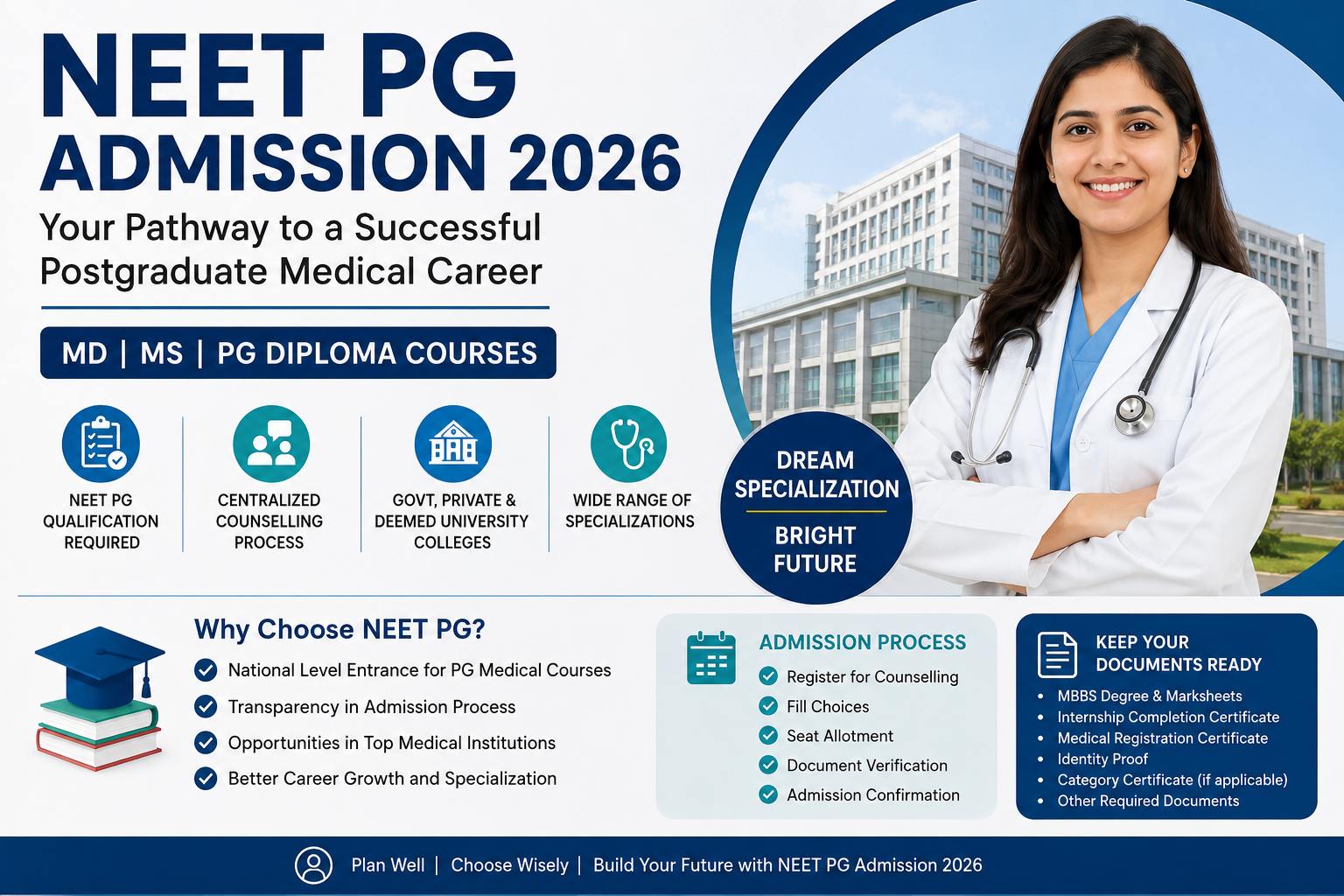
Getting admission to a postgraduate medical course is an important step for MBBS graduates who want to build a specialised career in medicine. In India, NEET PG is the major entrance examination used for admission to postgraduate medical programmes such as MD, MS and PG Diploma courses in recognised medical institutions.
For many medical graduates, the admission process can appear complicated because it involves the entrance examination, results, counselling registration, choice filling, seat allotment, document verification and fee payment. Understanding every stage in advance can make the process more organised and help candidates make better decisions while selecting a postgraduate medical college.
This guide explains the NEET PG Admission 2026 process, including eligibility, counselling, important documents, seat categories, fees, choice filling and other important points that candidates should know before applying.
What Is NEET PG Admission?
NEET PG Admission is the process through which eligible medical graduates compete for postgraduate medical seats in India. The examination is used for admission to various MD and MS programmes offered by government medical colleges, private medical colleges, deemed universities and other participating institutions, subject to the applicable rules.
Admission is primarily based on the candidate's performance and rank in NEET PG, followed by the relevant counselling process. Candidates who qualify the examination need to participate in counselling to obtain a postgraduate medical seat.
The counselling process is generally conducted through the appropriate authorities for different categories of seats. All India Quota seats and certain institutional categories are handled through national-level counselling, while state authorities conduct counselling for seats falling under their jurisdiction.
NEET PG Admission 2026: Courses Available
NEET PG provides an opportunity to pursue postgraduate medical specialisations after completing an MBBS degree.
Some of the commonly preferred MD specialisations include:
- MD General Medicine
- MD Paediatrics
- MD Radiodiagnosis
- MD Dermatology
- MD Anaesthesiology
- MD Psychiatry
- MD Pathology
- MD Respiratory Medicine
- MD Radiotherapy
- MD Pharmacology
- MD Microbiology
- MD Anatomy
- MD Physiology
- MD Biochemistry
Popular MS programmes include:
- MS General Surgery
- MS Orthopaedics
- MS Obstetrics and Gynaecology
- MS Ophthalmology
- MS Otorhinolaryngology
The availability of courses and seats differs from one medical college to another. Candidates should therefore review the seat matrix before making their final choices.
Eligibility Criteria for NEET PG Admission
Candidates should meet the prescribed eligibility requirements before applying for postgraduate medical admission.
Generally, an applicant must have an MBBS degree or a provisional MBBS pass certificate recognised under the applicable medical education regulations. The candidate should also possess permanent or provisional registration with the relevant medical registration authority.
Completion of the required internship is another important requirement. Candidates must complete their compulsory rotating internship by the deadline specified for the particular admission session.
Because eligibility rules and important dates can change, applicants should carefully check the official information bulletin and counselling notifications applicable to their admission year.
NEET PG 2026 Counselling Process
Qualifying NEET PG is only one part of the admission process. Candidates must also participate in counselling.
The general counselling process can be understood through the following stages:
Step 1: NEET PG Examination
Candidates first appear for the NEET PG examination according to the prescribed schedule.
Step 2: Declaration of Result
After the examination, the result and rank information are released. Candidates can use their performance to understand their potential options during counselling.
Step 3: Counselling Registration
Eligible candidates must register for the counselling process applicable to the seats they wish to pursue. Registration normally requires personal, academic and examination-related information.
Step 4: Choice Filling
Candidates select colleges and postgraduate specialisations according to their preferences. This is one of the most important stages because the final allotment depends on factors such as rank, category, seat availability, eligibility and choices submitted.
Step 5: Seat Allotment
The counselling authority processes the submitted choices and publishes the seat allotment result.
A candidate may receive a seat according to merit, reservation provisions, available seats and the choices entered during counselling.
Step 6: Reporting to the College
After accepting an allotted seat, the candidate must complete the required admission formalities within the specified period. This may include document verification, payment of fees and physical or online reporting, depending on the counselling instructions.
Types of Seats Available Through NEET PG Counselling
NEET PG seats are available through different categories and counselling authorities.
All India Quota Seats
A portion of postgraduate seats in government medical colleges is generally available under the All India Quota, subject to applicable rules. Candidates from different states can compete for these seats according to the counselling regulations.
State Quota Seats
State counselling authorities manage the seats available under the relevant state quota. Eligibility requirements can vary between states, particularly regarding domicile and other conditions.
Management Quota Seats
Private medical colleges may have seats under management categories. Candidates seeking these seats still need to meet the prescribed eligibility and NEET PG qualification requirements.
The term "direct admission" is sometimes used by candidates and admission consultants when referring to management-category or institution-specific admission routes. However, it should not be interpreted as admission without the required NEET PG qualification where NEET PG is mandatory.
Deemed University Seats
Deemed universities have their own postgraduate medical seats and participate in the applicable counselling system. Candidates interested in deemed university colleges should carefully compare tuition fees, specialisations, infrastructure and other admission conditions.
NRI Category Seats
Certain institutions may offer seats under NRI or NRI-sponsored categories, subject to applicable regulations. Documentation and fee requirements for such seats can differ from regular categories.
Documents Required for NEET PG Admission
Candidates should keep their documents prepared before counselling begins. The exact requirements can vary depending on the counselling authority and category.
Commonly required documents may include:
- NEET PG admit card
- NEET PG result or scorecard
- MBBS degree certificate
- MBBS marksheets
- Internship completion certificate
- Medical registration certificate
- Valid identity proof
- Passport-size photographs
- Category certificate, where applicable
- Domicile certificate, where applicable
- Migration certificate, if required
- Disability certificate, where applicable
- NRI or sponsorship documents, where applicable
- Counselling registration documents
Candidates should ensure that names, dates of birth and other details are consistent across their documents.
NEET PG Fees Structure
The cost of postgraduate medical education varies significantly depending on the type of institution, course and seat category.
Government medical colleges generally have comparatively lower tuition fees. Private medical colleges can have substantially higher fees, particularly for clinical branches. Deemed universities may also have a higher fee structure.
Candidates should not consider tuition fees alone when selecting a college. Other expenses may include hostel charges, examination fees, university charges, security deposits, miscellaneous institutional fees and living expenses.
Before accepting a seat, candidates should carefully review the official fee structure issued by the concerned college or counselling authority.
How to Choose a Medical College After NEET PG?
Selecting a postgraduate college is an important career decision. A candidate should evaluate several factors rather than choosing a college only because of its name.
Consider the Specialisation
The first priority should be the branch. Candidates should understand whether they want a clinical, surgical, diagnostic or non-clinical specialisation.
Review Patient Load
For clinical and surgical branches, patient exposure is extremely important. A college with a strong patient load can provide valuable practical experience during residency.
Check Infrastructure
Candidates should review the availability of laboratories, operation theatres, intensive care facilities, diagnostic departments and other essential infrastructure.
Consider Faculty
Experienced faculty members can contribute significantly to academic development, clinical learning and professional growth.
Compare Fees
Private and deemed medical colleges can have considerable differences in tuition fees. Candidates should calculate the complete financial commitment before confirming admission.
Look at Location
The location of the institution can influence living expenses, accessibility, accommodation and overall residency experience.
Importance of Choice Filling in NEET PG Counselling
Choice filling is one of the most important parts of the counselling process. Candidates should prepare their preferences before the choice-filling window opens.
Instead of selecting colleges randomly, candidates can create a priority list based on:
- Preferred branch
- College reputation
- Clinical exposure
- Patient load
- Faculty
- Infrastructure
- Fee structure
- Location
- Hostel facilities
- Future career opportunities
Candidates should also understand the difference between a preferred branch in a moderate college and a less-preferred branch in a highly reputed college. The right decision depends on individual career goals.
NEET PG Seat Allotment and Upgradation
During counselling, a candidate may receive a seat based on merit, category, available seats and submitted preferences.
Depending on the counselling rules, candidates may have options such as accepting the seat, participating in subsequent rounds or choosing an upgradation option.
Candidates should read the instructions carefully before selecting any option. Missing a reporting deadline or failing to complete a required step can affect the allotted seat.
What Does Direct NEET PG Admission Mean?
The phrase "direct NEET PG admission" is commonly searched by medical graduates looking for alternatives to highly competitive government seats.
However, candidates should understand an important distinction. Recognised postgraduate medical admission generally requires NEET PG qualification wherever NEET PG is the prescribed entrance route.
In practical terms, direct admission may refer to admission through a management category, private medical college or another permitted seat category after satisfying the required eligibility and counselling conditions. It does not normally mean bypassing the NEET PG requirement.
Candidates should be cautious of anyone promising a recognised MD/MS seat without meeting the prescribed eligibility requirements.
Common Mistakes to Avoid During NEET PG Counselling
A few avoidable mistakes can create problems during admission.
Candidates should avoid:
- Waiting until the last day to register
- Entering choices without researching colleges
- Ignoring the official seat matrix
- Failing to check fee structures
- Uploading incorrect documents
- Missing reporting deadlines
- Assuming that every private college has the same fee structure
- Confusing management quota admission with admission without NEET PG
- Accepting a seat without understanding the fee and academic conditions
- Relying solely on unofficial counselling information
Keeping track of official notifications is one of the safest ways to avoid unnecessary complications.
Career Opportunities After MD or MS
Completing an MD or MS opens several professional opportunities for medical graduates. Depending on their specialisation, doctors may work in hospitals, clinics, medical colleges, research institutions and healthcare organisations.
Many graduates also choose to pursue super-specialisation through courses such as DM or MCh, while others enter clinical practice, academics, research or healthcare administration.
The career path depends heavily on the chosen specialisation, individual interests, clinical skills and professional goals.
Final Words
NEET PG Admission 2026 is an important milestone for MBBS graduates planning to specialise in medicine. The process involves much more than simply securing a good examination rank. Candidates must understand eligibility requirements, counselling procedures, seat categories, college choices, fee structures and reporting formalities before accepting a postgraduate seat.
A well-planned approach can make the counselling process considerably easier. Candidates should prepare their documents early, research colleges carefully, create a realistic preference list and follow the instructions issued by the relevant counselling authorities.
Most importantly, students should remember that recognised MD/MS admission cannot simply be obtained by bypassing the prescribed entrance and counselling requirements. Whether a candidate is targeting a government college, private medical college, deemed university or management-category seat, eligibility and applicable admission rules must be satisfied.
With careful planning and informed decision-making, NEET PG can become the first major step towards a successful postgraduate medical career.

 English
 Arabic
 French
 Spanish
 Portuguese
 Turkish
 Dutch
Dutch
 Italiano
 Russian
 Romaian
 Portuguese (Brazil)
 Greek
Greek
