


Next-Gen Supply Chains Turn to Digital Twins as Global Market Hits USD 485.95 Billion
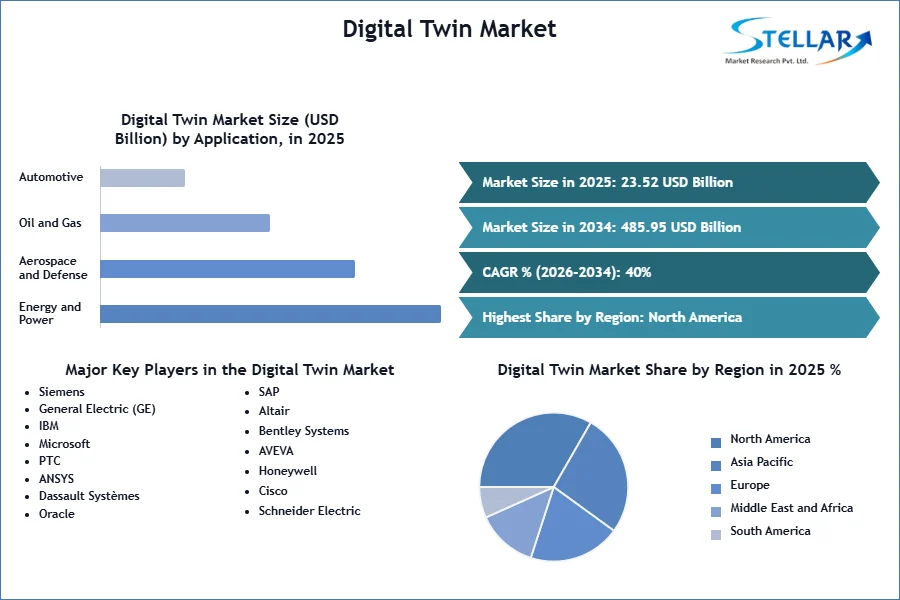
The global Digital Twin Market was valued at USD 23.52 Billion in 2025 and is projected to expand at a Compound Annual Growth Rate (CAGR) of 40.0% through the forecast period (2026–2034), reaching nearly USD 485.95 Billion by 2034, according to a comprehensive intelligence report by Stellar Market Research.
Driven by the rapid scaling of Industry 4.0, hyper-connected Industrial Internet of Things (IIoT) networks, and advanced predictive maintenance models, digital twins are rapidly evolving from experimental engineering concepts into indispensable enterprise operating environments.
Enterprise Operational Optimization Drives Digital Twin Expansion
The global digital twin market is undergoing a structural shift. Organizations across manufacturing, aerospace, healthcare, energy, and automotive are migrating from isolated physical asset tracking to real-time, bi-directional virtual modeling. Digital twins allow enterprises to construct dynamic, software-based mirrors of physical objects, workflows, and complex ecosystems using continuous streams of sensor data.
By running scenario planning and predictive stress tests inside virtual replicas, companies are drastically reducing unplanned equipment downtime—which historically costs global industrial enterprises billions annually—while shortening product engineering cycles and optimizing cross-facility supply chains.
Key Findings from the Report
-
Exponential Revenue Growth: The global market will expand over twenty-fold from its 2025 base of USD 23.52 Billion to USD 485.95 Billion by 2034.
-
Product Digital Twin Dominance: The Product Digital Twin segment secured the largest revenue share, driven by demand in the automotive, consumer electronics, and machinery sectors to optimize virtual prototyping.
-
Predictive Maintenance Takes Lead: By application, predictive maintenance accounts for the highest market share and fastest trajectory as asset-heavy industries aggressively target operational downtime reduction.
-
Cloud Deployments Accelerate: Cloud-hosted digital twin platforms represent the fastest-growing deployment model due to lower upfront capital investments, flexible compute scaling for complex simulations, and seamless remote monitoring capabilities.
-
North American Leadership: North America dominated the global landscape in 2025 with a 36% market share, supported by robust Industry 4.0 spending in the United States.
-
APAC Emerges as High-Growth Engine: Asia-Pacific is registering rapid expansion, driven by smart factory modernizations across China, South Korea, Japan, and Taiwan.
For further information, click the following link:https://www.stellarmr.com/report/req_sample/Digital-Twin-Market/1606
Market Drivers and Restraints
Market Drivers
-
Accelerated Industry 4.0 & Smart Factory Integration: Modern factory floors are adopting intelligent automation frameworks. Digital twins provide the foundational software layer to connect physical hardware, robotics, and cloud ERP systems into a unified operational dashboard.
-
Proliferation of IIoT Connectivity: Global investments in IoT infrastructure—with billions of connected sensors deployed globally—provide the granular, low-latency telemetry needed to feed accurate digital twin simulations.
-
Enterprise Shift to Predictive Maintenance: Industrial operators are abandoning reactive repair schedules in favor of AI-driven predictive asset management, using virtual models to detect structural failure points before physical breakdowns occur.
Market Restraints
-
High Initial Capital Expenditure & Integration Complexity: Merging legacy industrial operational technology (OT) with modern cloud IT infrastructure presents significant architectural complexity and steep upfront onboarding costs.
-
Cybersecurity & Data Privacy Vulnerabilities: Because digital twins rely on continuous, continuous data exchange between real-world sensors and software platforms, they enlarge the enterprise attack surface, exposing systems to potential data breaches and malicious interventions.
Technology, Regulation, and Sustainability Trends
-
Generative AI & Machine Learning: Modern digital twin architectures are integrating generative AI models to run autonomous "what-if" simulations, allowing systems to recommend real-time operational adjustments without direct human engineering input.
-
Blockchain for Sensor Data Integrity: Enterprise adopters are leveraging distributed ledger technology to verify the accuracy and chain-of-custody of incoming IIoT data stream feeds, shielding digital twin decision engines against compromised telemetry.
-
ESG & Sustainability Compliance: Amid tightening international carbon disclosure regulations, digital twins are increasingly deployed to track scope 1 and scope 2 emissions, simulate energy consumption patterns, and model green building performance before physical construction begins.
Regional Insights
-
North America: The region captured approximately 36% of global revenue in 2025. Market dominance is anchored by the United States, where industrial giants, automotive OEMs, and defense suppliers spend heavily on smart manufacturing, immersive visualization, and cloud computing.
-
Asia-Pacific: APAC represents the fastest-growing regional market over the forecast period. Rapid industrial expansion in China, strong semiconductor manufacturing investments in Taiwan and South Korea, and government-backed smart factory initiatives in Japan and India are driving unprecedented demand for system-level digital twin implementations.
-
Europe: Supported by European Union green transition targets and urban planning programs (such as Destination Earth), European adoption is heavily concentrated around urban-scale digital twins, smart grid management, and automotive engineering across Germany, France, and the UK.
Recent Industry Developments
-
Unilever & Accenture (2026): Partnered to deploy AI-enabled digital twins across Unilever's global manufacturing network, reducing production bottlenecks and automating line adjustments.
-
Siemens Energy (2025): Launched an advanced system-level digital twin platform specifically engineered for complex power generation assets, including natural gas, steam, and hydropower installations.
-
GE Vernova (2025): Introduced an AI-powered analytics upgrade across its digital twin utility suite, enhancing real-time fault prediction and grid reliability for utility-scale power operations.
-
Microsoft & Rockwell Automation (2025): Expanded their strategic cloud alliance to integrate generative AI and IoT data pipelines into cloud-native industrial digital twin models for smart factories.
-
ANSYS Inc. (2025): Released enhanced physics-based simulation solvers designed to integrate seamlessly into connected digital twin environments for real-time aerospace and automotive structural stress monitoring.
Competitive Landscape
The global digital twin market is characterized by strategic consolidation, hardware-software convergence, and deep technology alliances. Top technology providers are continuously integrating artificial intelligence, physics simulation engines, and edge-to-cloud connectivity into standard SaaS delivery models. Key industry players detailed in the report include:
-
Microsoft Corporation
-
Rockwell Automation, Inc.
-
Ansys, Inc.
-
IBM Corporation
-
Siemens AG
-
Dassault Systèmes SE
-
PTC Inc.
-
GE Vernova
-
Hexagon AB
Companies are prioritizing strategic partnerships, product enhancements, and vertical-specific digital twin modules (e.g., healthcare, smart cities, clean energy) to solidify their global market positioning.
For further information, click the following link:https://www.stellarmr.com/report/req_sample/Digital-Twin-Market/1606
Analyst Commentary
"Digital twin technology has officially crossed the threshold from a forward-looking visualization tool to a foundational operational architecture," stated a Senior Research Analyst at Stellar Market Research. "What we are seeing through 2034 is a shift from isolated asset twins toward fully interconnected system twins. Organizations are no longer just asking what happened or what is happening—they are using AI-infused virtual replicas to automatically dictate operational outcomes, optimize energy consumption in real time, and protect capital assets before failure occurs."
Future Outlook
Through the 2026–2034 forecast period, the digital twin ecosystem will be defined by autonomous control systems, urban-scale smart city deployments, and standardized data interoperability. As edge computing lowers data transmission latency and generative AI models become standard features within enterprise software suites, digital twins will become the primary management interface across the physical industrial landscape.
About Stellar Market Research
Stellar Market Research is a multifaceted market research and consulting company with professionals from several industries. Some of the industries we cover include medical devices, pharmaceutical manufacturers, science and engineering, electronic components, industrial equipment, technology and communication, cars and automobiles, chemical products and substances, general merchandise, beverages, personal care, and automated systems. To mention a few, we provide market-verified industry estimations, technical trend analysis, crucial market research, strategic advice, competition analysis, production and demand analysis, and client impact studies.
Address
Phase 3, Navale IT Zone, S.No. 51/2A/2, Office No. 202, 2nd floor, Near, Navale Brg, Narhe, Pune, Maharashtra 411041
Email
sales@stellarmr.com
Mobile
+91 9607365656

 English
 Arabic
 French
 Spanish
 Portuguese
 Deutsch
 Dutch
Dutch
 Italiano
 Russian
 Romaian
 Portuguese (Brazil)
 Greek
Greek
