Businesses today rely heavily on technology to manage daily operations, communicate with employees, organize information, and complete repetitive tasks. However, many companies find that standard software does not completely match their unique requirements. This is where internal tools development becomes valuable.
Internal tools are custom software solutions designed specifically for employees and internal business processes. They can help organizations automate routine work, manage data, improve collaboration, and make everyday operations more efficient.
What Is Internal Tools Development?
Internal tools development is the process of designing and building custom software for use within a company. Unlike customer-facing applications, internal tools are primarily created to support employees and business operations.
For example, a company may need a custom dashboard that allows managers to monitor sales, an automated reporting system that generates daily reports, or an internal platform that helps employees manage projects.
Common examples of internal tools include:
- Employee dashboards
- Internal admin panels
- Reporting systems
- Workflow automation tools
- Inventory management systems
- Data management platforms
- Employee management tools
- Project tracking systems
- Customer support dashboards
- Internal communication tools
The main goal is to make internal processes simpler, faster, and more organized.
Why Do Businesses Need Internal Tools?
Every business has its own processes and requirements. Generic software can provide useful features, but it may include unnecessary functions or lack the specific features a company needs.
Internal tools allow businesses to create software around their actual workflows. Instead of forcing employees to adapt to complicated software, companies can develop tools that fit the way their teams already work.
For example, if a marketing company spends several hours every week creating performance reports manually, it could develop an internal reporting tool that collects data and generates reports automatically.
This can save time and allow employees to focus on more valuable tasks.
Benefits of Internal Tools Development
1. Increased Productivity
One of the biggest benefits of internal tools is improved employee productivity. Custom tools can simplify complicated workflows and reduce the amount of time employees spend searching for information or completing repetitive tasks.
When employees can access everything they need from one system, they can complete their responsibilities more efficiently.
2. Workflow Automation
Many business processes involve repetitive tasks. These tasks may include entering data, generating reports, sending notifications, updating records, or processing information.
Internal tools can automate many of these activities. Automation reduces manual work and allows employees to spend more time on important business activities.
3. Better Data Management
Businesses often work with large amounts of information. Managing this information through spreadsheets or multiple disconnected systems can become difficult.
A custom internal tool can centralize important business data in one place. Employees can access authorized information more easily, while managers can get a clearer view of business operations.
4. Reduced Human Errors
Manual processes can lead to mistakes, especially when employees repeatedly enter or transfer data.
Internal tools can automate calculations, data transfers, validations, and other processes. This can reduce the possibility of human errors and improve the accuracy of business information.
5. Customized Features
Another major advantage is customization. Businesses can develop features according to their exact requirements.
For example, a company may require a dashboard with specific filters, automated notifications, custom reports, or special user permissions. These features can be included in the internal tool based on the organization's needs.
Types of Internal Tools
Different businesses require different types of internal software. Some common categories include administrative tools, reporting platforms, workflow systems, and employee management applications.
Employee Management Tools
These tools can help companies manage employee information, attendance, tasks, schedules, and other internal processes.
Reporting and Analytics Tools
Reporting tools collect business information and present it in dashboards, charts, or reports. Managers can use these insights to understand performance and make better decisions.
Workflow Management Tools
Workflow tools help employees organize processes and track tasks from beginning to completion.
Data Management Tools
These applications help businesses collect, organize, update, and access internal information from a centralized platform.
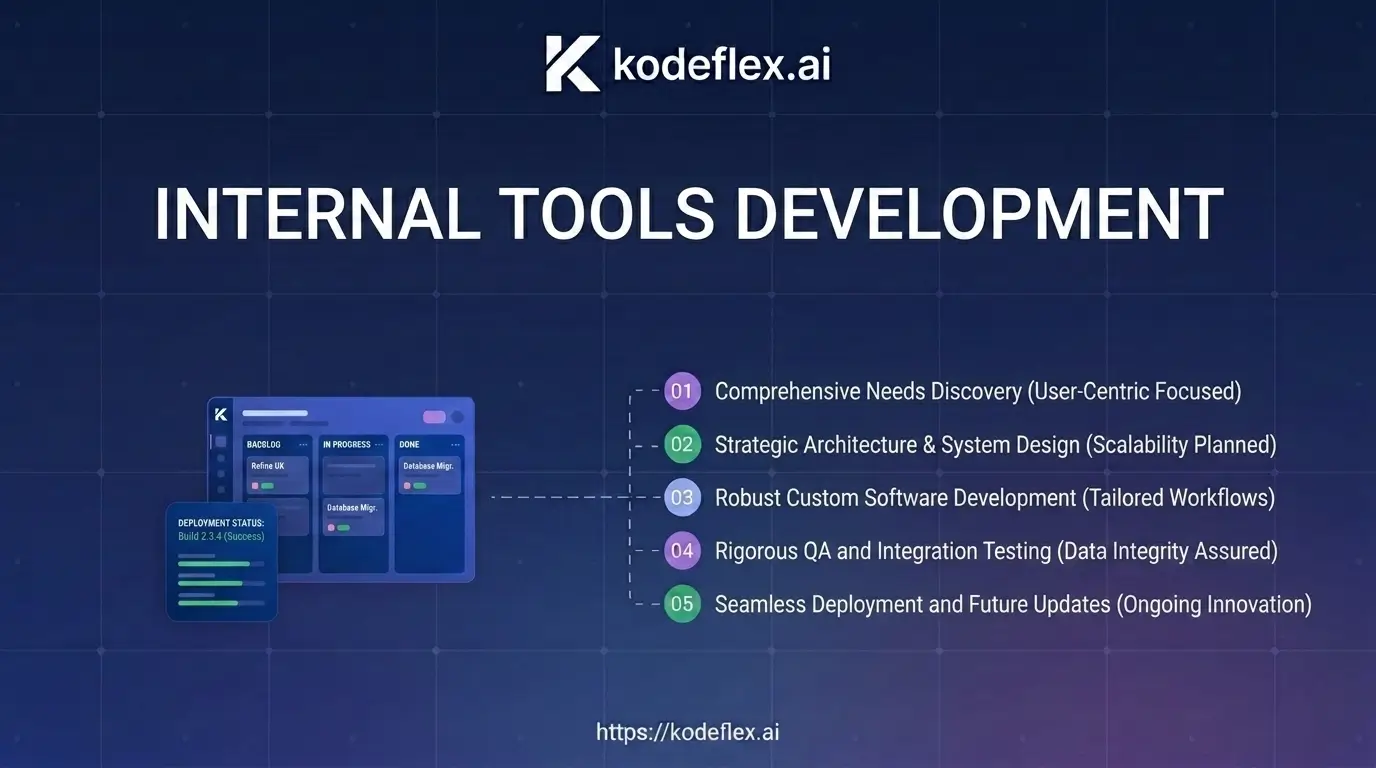
How Internal Tools Development Works
Successful internal tools development usually starts with understanding the business problem.
The first step is requirement analysis. The development team works with stakeholders to understand current processes, challenges, and desired results.
The next step is planning and design. Developers decide which features are required and how users will interact with the application.
After planning, developers begin the development stage, where the actual software is built. Depending on the project, this may involve frontend development, backend development, databases, APIs, authentication, and integrations.
Once the tool is developed, it goes through testing. Testing helps identify bugs, security issues, usability problems, and other technical concerns.
After successful testing, the application can be deployed for internal users. However, development does not necessarily end at deployment. Businesses may need regular maintenance, security updates, improvements, and new features as their requirements change.
Security Considerations
Security is extremely important when developing internal tools because these applications may contain sensitive business information.
Companies should consider authentication, authorization, secure data storage, access controls, backups, and regular security updates.
Different employees may also require different levels of access. For example, an administrator may have access to information that regular employees should not be able to view.
A well-designed internal system should therefore provide appropriate permissions and protect business data from unauthorized access.
Internal Tools and Business Growth
As a business grows, its internal processes often become more complex. A system that worked for a small team may become inefficient when the company expands.
Internal tools can evolve with the organization. Businesses can add new features, integrate additional systems, improve automation, and support larger teams.
This makes custom internal software a useful long-term investment for organizations with complex or specialized workflows.
Choosing the Right Development Approach
Before starting an internal tools project, businesses should clearly identify the problem they want to solve.
It is important to avoid building unnecessary features. A simple tool that solves an important problem can often provide more value than a large application filled with features employees rarely use.
Businesses should also consider scalability, security, usability, maintenance, integration requirements, and future growth.
Employee feedback can be especially useful because the people using the tool every day understand the workflow challenges better than anyone else.
Conclusion
Internal tools development helps businesses build custom software that improves internal operations and supports employee productivity. From workflow automation and reporting dashboards to data management and employee systems, internal tools can solve many operational challenges.
By identifying specific business problems and developing solutions around real workflows, organizations can reduce manual work, improve data accuracy, automate repetitive processes, and make better use of their resources.
As businesses continue to adopt technology, custom internal tools can provide the flexibility needed to improve operations and support sustainable growth.




 English
 Arabic
 French
 Spanish
 Portuguese
 Deutsch
 Turkish
 Dutch
Dutch
 Italiano
 Romaian
 Portuguese (Brazil)
 Greek
Greek
