


AI-Assisted Accessibility Testing: The New Trend Transforming Accessibility Testing Services in 2026
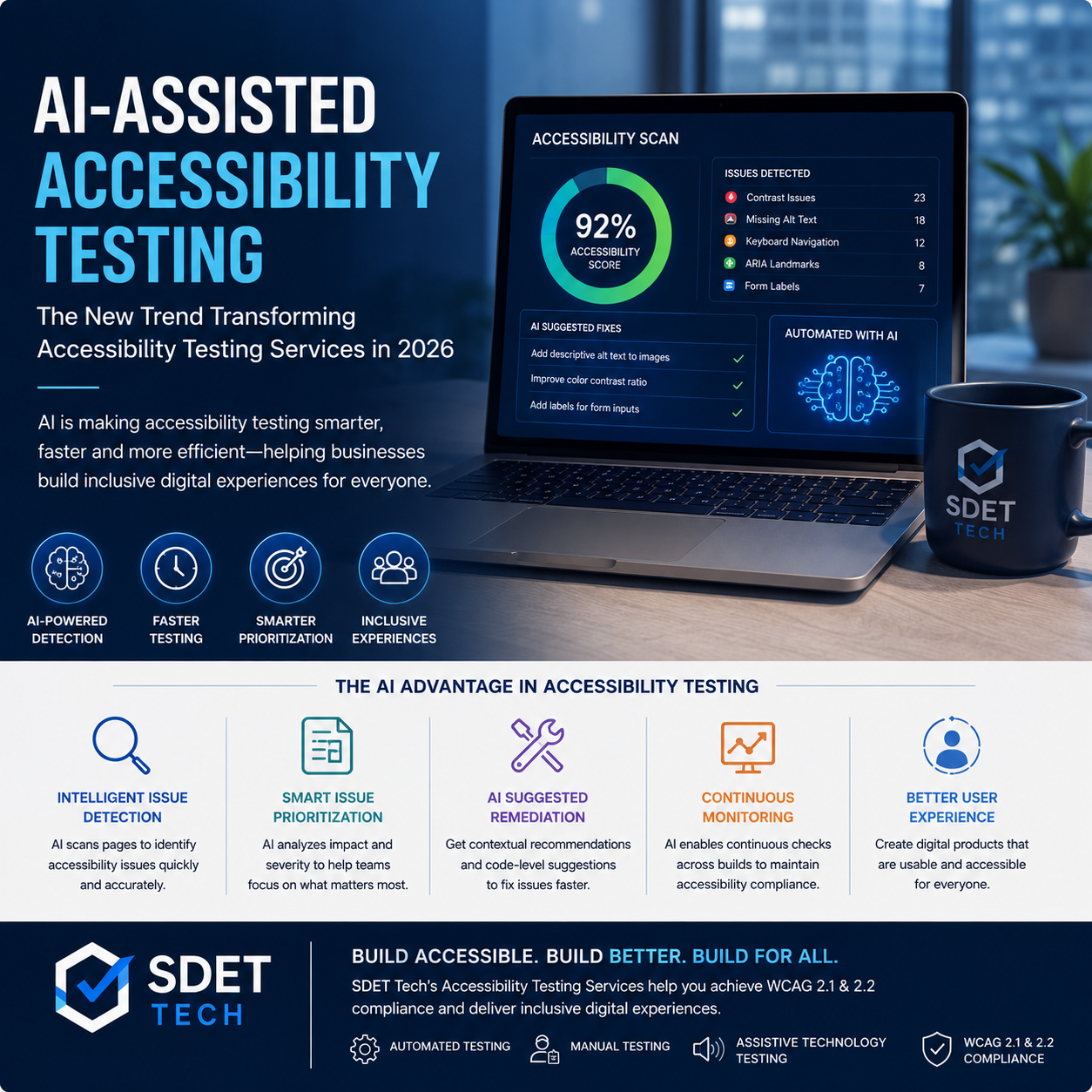
Digital accessibility is becoming a bigger priority for businesses as websites and applications become more complex. In 2026 one of the most important developments in accessibility testing services is the growing use of artificial intelligence to support accessibility audits and testing workflows.
Recent industry research shows that a large majority of organizations are already using AI to improve digital accessibility. AI is being used for accessibility issue detection and test case creation and remediation support and content accessibility.
However AI is not replacing accessibility professionals. Instead it is becoming a powerful addition to automated accessibility testing and manual accessibility testing.
How AI Is Changing Accessibility Testing
Traditional automated accessibility tools are effective at identifying repeatable technical issues. These can include missing form labels and insufficient colour contrast and certain ARIA errors and missing alternative text.
AI can take this process further by analyzing patterns and grouping related accessibility issues and helping teams prioritize findings. It can also assist developers by suggesting potential fixes and generating accessibility-focused test cases.
This makes AI-powered accessibility testing particularly useful for large websites and applications where thousands of pages and components need to be evaluated.
The biggest advantage is efficiency. Testing teams can identify common issues faster and focus their expert attention on more complex accessibility problems.
Why Automated Testing Alone Is Not Enough
Despite rapid advances in AI accessibility testing tools cannot determine every aspect of accessibility.
Some accessibility requirements depend on context and human judgement. For example an automated system may determine that an image has alternative text but cannot always determine whether that alternative text actually communicates the right meaning.
Similarly a tool may identify keyboard-related technical issues without fully understanding whether a user can successfully complete an important workflow.
Industry guidance continues to emphasize the importance of combining automation with manual testing and assistive technology evaluation.
This makes hybrid accessibility testing one of the most practical approaches for businesses in 2026.
Combining AI With Manual Accessibility Testing
A modern accessibility testing service can combine automated scanning with manual expert review and assistive technology testing.
Automated tools can identify common WCAG issues quickly. Accessibility experts can then validate complex findings through keyboard testing and screen reader testing and real user workflows.
Testing with technologies such as NVDA and JAWS and VoiceOver can reveal problems that automated tools cannot fully understand.
This combination provides better coverage while reducing the time required for repetitive accessibility checks.
WCAG 2.2 Is Becoming More Important
Another important trend is the growing adoption of WCAG 2.2 as an accessibility testing baseline. WebAIM expects WCAG 2.2 to increasingly become the standard referenced in procurement and accessibility evaluation during 2026.
Businesses should therefore ensure their accessibility testing services evaluate their digital products against the appropriate WCAG requirements rather than relying only on automated accessibility scores.
What This Means for Businesses
The future of accessibility testing is not simply about using more automation. It is about using technology intelligently while retaining human expertise.
Businesses can use AI to accelerate accessibility audits and identify potential issues and support remediation. Manual testing can then validate user experience and assistive technology compatibility.
This approach can help organizations improve WCAG compliance and reduce accessibility barriers and create more inclusive digital experiences.
For businesses looking to modernize their accessibility strategy SDET Tech provides comprehensive accessibility testing services combining automated testing and manual evaluation and assistive technology testing. SDET Tech helps organizations identify accessibility gaps and validate WCAG 2.1 and 2.2 requirements and receive actionable remediation guidance.
The future of accessibility testing is becoming smarter and faster. But the goal remains the same: building digital experiences that genuinely work for everyone.

 English
 Arabic
 French
 Spanish
 Portuguese
 Deutsch
 Turkish
 Dutch
Dutch
 Italiano
 Russian
 Romaian
 Greek
Greek
