


GST on Machinery Purchase: Input Tax Credit, Refund Eligibility and Business Planning
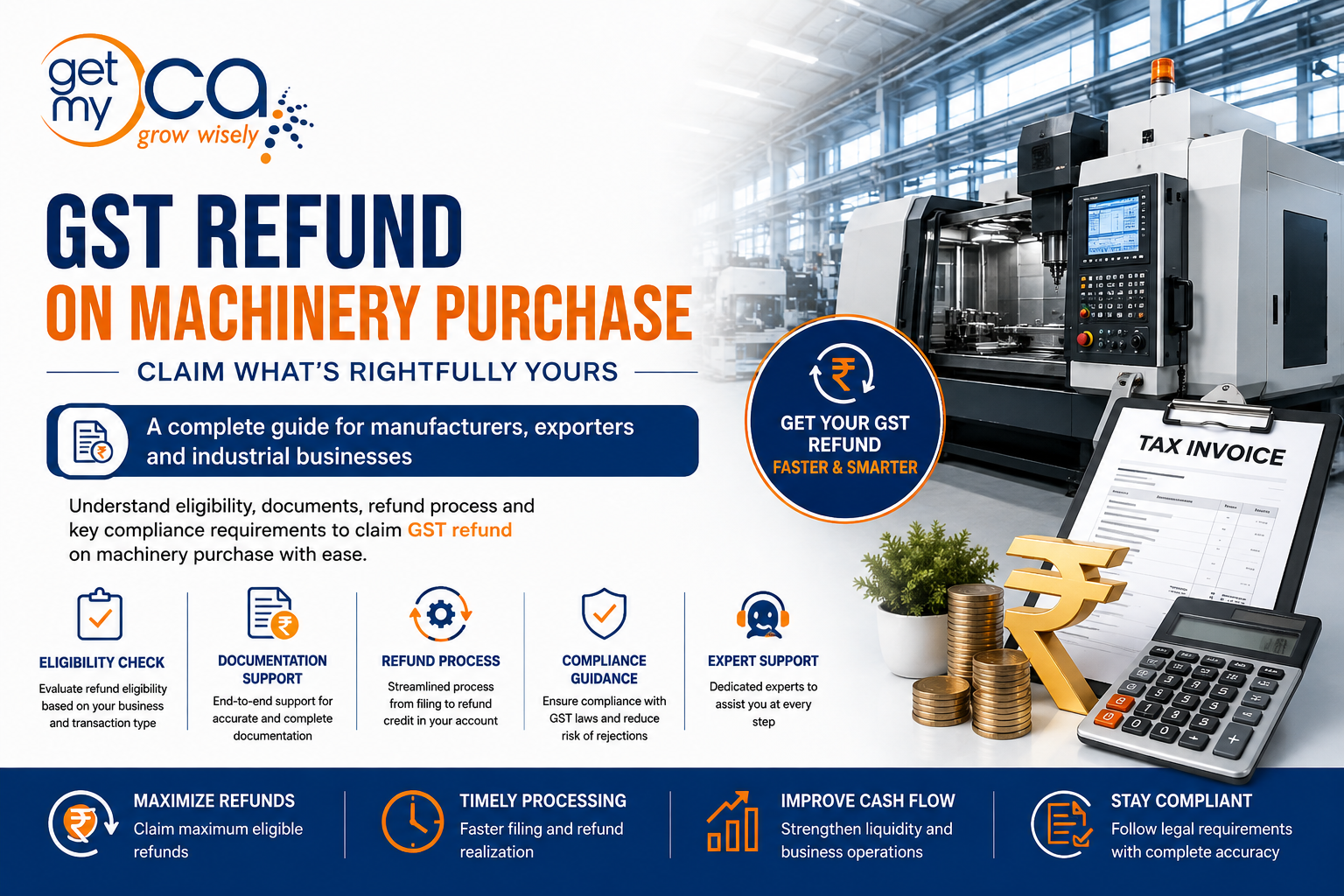
Machinery purchases are often among the largest investments made by manufacturing and industrial businesses. Whether a company is expanding production capacity, replacing old equipment, or introducing automation, the GST component on machinery can represent a significant amount.
Businesses evaluating a GST Refund on Machinery Purchase should first understand that GST paid on machinery does not automatically become refundable in cash. The tax treatment depends on input tax credit eligibility, the nature of outward supplies, the applicable refund category, and the conditions prescribed under GST law.
How Is GST on Machinery Generally Treated?
When eligible machinery is purchased for business use, GST charged on the invoice may be considered for input tax credit, subject to applicable conditions and restrictions.
Input tax credit can generally be used against eligible output GST liability. A cash refund, however, is available only in situations specifically permitted under the GST framework.
Therefore, businesses should keep two concepts separate:
- Availability of input tax credit
- Eligibility to claim a GST refund
Having input tax credit in the electronic credit ledger does not by itself mean that the entire balance can be claimed as a refund.
Why Should Manufacturers Review GST Before Purchasing Machinery?
A high-value machinery purchase can significantly affect working capital.
Before completing the transaction, a manufacturer should evaluate:
- Total machinery cost
- GST charged by the supplier
- Input tax credit eligibility
- Expected output tax liability
- Nature of domestic and export supplies
- Applicable refund provisions
- Financing requirements
- Documentation needed for the transaction
Reviewing these areas before purchase can help businesses understand the actual tax and cash-flow impact of the investment.
Importance of Correct Tax Invoices
The machinery supplier's tax invoice is an important supporting document for input tax credit and related GST compliance.
Businesses should verify details such as:
- Supplier GSTIN
- Purchaser GSTIN
- Invoice number and date
- Description of machinery
- Taxable value
- GST rate and amount
- Place of supply, where relevant
- Other prescribed invoice particulars
Incorrect or incomplete invoice information can create reconciliation issues later.
Input Tax Credit Reconciliation
Machinery invoices should be reconciled with the business's GST records before relying on the corresponding input tax credit.
Businesses should check whether the transaction has been properly reported and whether the credit satisfies the applicable conditions.
Regular reconciliation helps identify:
- Missing invoices
- Incorrect GSTIN details
- Tax amount differences
- Duplicate entries
- Supplier reporting issues
- Accounting mismatches
For high-value capital goods, resolving these issues early can prevent complications during future compliance or refund proceedings.
When Can Refund Eligibility Become Relevant?
Refund eligibility depends on the type of business transaction and applicable GST provisions.
For example, certain exporters and businesses operating under other specifically permitted refund situations may need to evaluate accumulated eligible input tax credit. Machinery-related credit may form part of the broader credit position where legally permitted, but the treatment should be reviewed according to the specific refund category.
Businesses should avoid assuming that the purchase of expensive machinery alone creates a refund entitlement.
GST Planning for Export-Oriented Manufacturers
Export-oriented businesses often have different working-capital considerations because GST may accumulate on eligible inward supplies while outward supplies can have a different tax treatment.
A manufacturer planning significant machinery investment should therefore review:
- Existing input tax credit
- Projected machinery GST
- Export turnover
- Domestic turnover
- Refund category
- Relevant-period calculations
- Supporting export records
This helps businesses understand the machinery purchase as part of their complete GST position rather than as an isolated transaction.
Documents Worth Maintaining
Machinery-related transactions should have a clear documentation trail.
Relevant records may include:
- Machinery tax invoice
- Purchase order
- Supplier agreement
- Payment proof
- E-way bill, where applicable
- GST return records
- Input tax credit reconciliation
- Import documents, where relevant
- Installation records
- Accounting ledger entries
The documentation required for an actual refund application will depend on the applicable refund category.
Machinery Purchase and Business Cash Flow
GST planning can also be relevant to project financing.
For example, a business purchasing expensive machinery may need to account for the timing difference between paying GST to a supplier, taking eligible input tax credit, utilizing that credit, and receiving any refund that may legally be available.
This timing can affect:
- Working capital
- Loan requirements
- Project budgets
- Cash-flow forecasts
- Expansion schedules
Tax planning should therefore form part of the broader financial planning for major capital expenditure.
Avoid These Common Mistakes
Manufacturers should avoid several common assumptions:
- Every machinery purchase qualifies for a cash GST refund
- The entire input tax credit balance is always refundable
- Documentation can be prepared only when a refund is filed
- Invoice mismatches do not matter
- Machinery GST can be evaluated separately from overall business supplies
Accurate treatment requires reviewing the complete transaction and applicable GST provisions.
Accessing Broader Compliance Information
Businesses researching GST, machinery investment, taxation, registrations, and other compliance matters can also refer to informational resources published by GetMyCA to understand related business and regulatory concepts.
However, the GST treatment of a machinery transaction should always be assessed according to the facts of the particular business and the relevant legal provisions.
Conclusion
GST paid on machinery can represent a substantial amount for manufacturers and industrial businesses, but input tax credit and cash refund are two different concepts.
Before making a major machinery investment, businesses should examine credit eligibility, invoice accuracy, refund conditions, GST return reconciliation, and cash-flow implications. Proper planning and organized documentation can make machinery-related GST compliance easier to manage.

 English
 Arabic
 French
 Spanish
 Portuguese
 Deutsch
 Turkish
 Dutch
Dutch
 Italiano
 Russian
 Portuguese (Brazil)
 Greek
Greek
