


Starting a Pilot Career in India: Training, DGCA Exams, Costs and Career Planning
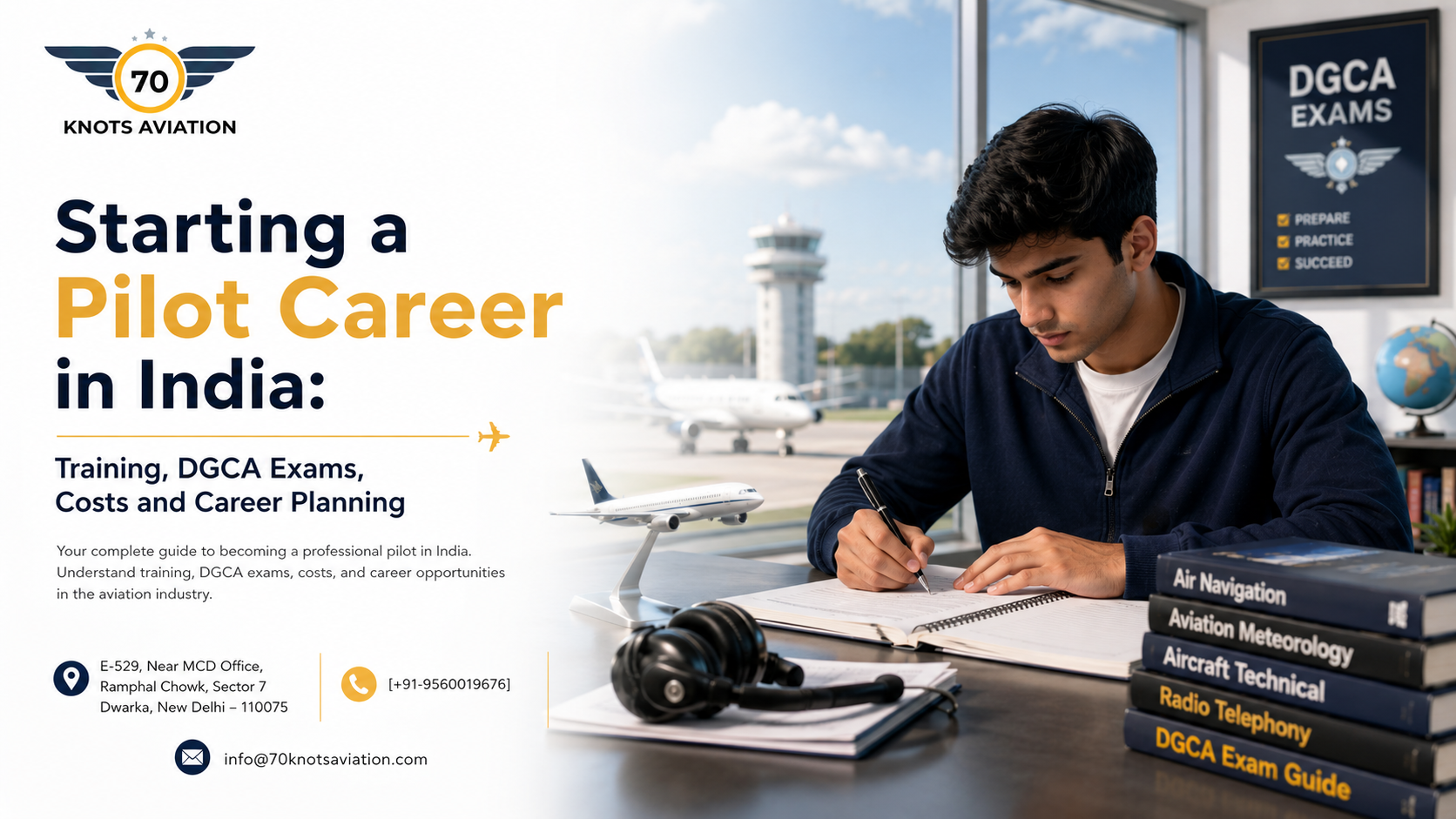
A career in aviation can be exciting, challenging, and highly rewarding for students who are interested in aircraft, technology, travel, and professional responsibility. However, becoming a pilot is a structured process that requires academic preparation, medical fitness, theoretical knowledge, practical flight training, and licensing.
Many students start researching aviation immediately after school but are unsure about where to begin. Questions about eligibility, examinations, training expenses, flying hours, and choosing an appropriate aviation institute are common.
Understanding the complete pathway before starting training can help aspiring pilots make better decisions. From learning about How to become a pilot to preparing for DGCA examinations and estimating the overall training budget, every stage deserves careful consideration.
70Knots Aviation supports students who are exploring aviation education and pilot-training preparation by helping them understand the different stages involved in pursuing a professional aviation career.
Is Pilot Training the Right Career Choice?
Before enrolling in a pilot training programme, students should understand what the profession actually involves.
Flying an aircraft is only one part of a pilot's responsibilities. Professional pilots must understand aircraft systems, weather, navigation, aviation regulations, communication procedures, operational planning, and safety practices.
The profession also requires discipline and continuous learning. Pilots need to maintain their knowledge and skills throughout their careers because aviation procedures, technology, and operational environments continue to evolve.
Students who enjoy technical subjects, structured environments, teamwork, communication, and decision-making may find aviation particularly interesting.
How to Become a Pilot in India
One of the first questions students ask is How to become a pilot after completing school.
The exact pathway depends on the licence and career objective, but students planning a professional flying career generally need to work through several important stages.
1. Complete Your Educational Requirements
Students should first ensure that they satisfy the applicable educational requirements for pilot training. Physics and Mathematics are particularly important for students pursuing professional pilot training.
If a student does not have the required subjects, they should investigate the recognised options for fulfilling the academic requirement before beginning the licensing process.
2. Understand Aviation Medical Requirements
Medical fitness is another important part of pilot training. Aviation medical standards are different from ordinary health checks because pilots need to meet specific requirements relevant to flight operations.
Students should understand the applicable medical requirements early rather than treating medical certification as an afterthought.
3. Begin Ground Training
Ground training introduces students to the theoretical side of aviation.
Depending on the training stage, students may study areas such as air navigation, meteorology, air regulations, aircraft technical knowledge, and communication procedures.
A strong theoretical foundation can make practical flight training easier because students understand the principles behind the procedures they perform in an aircraft.
4. Prepare for DGCA Examinations
Theoretical examinations are an important part of the professional pilot pathway in India. Students need consistent preparation and a good understanding of aviation concepts.
Rather than studying only shortly before examinations, students should develop a regular study schedule and revise important concepts repeatedly.
5. Complete Practical Flight Training
After developing the required theoretical foundation, students undertake practical flight training.
During flight training, students gradually learn aircraft handling, take-off and landing procedures, navigation, communication, emergency procedures, and other essential flying skills under appropriate supervision.
6. Complete Licensing Requirements
Once the required training, examinations, flying experience, and other applicable conditions are fulfilled, students can progress toward the relevant pilot licence.
The journey does not necessarily end there. Students who want to pursue airline careers may need additional training, qualifications, and preparation depending on their career path.
Understanding DGCA Pariksha
For aspiring pilots in India, DGCA Pariksha is an important part of the theoretical preparation process.
Students should approach aviation examinations differently from ordinary school examinations. Aviation subjects involve regulations, technical concepts, calculations, procedures, and terminology that require both understanding and practice.
A well-organised study routine can make examination preparation more manageable.
Students can divide their preparation into three stages:
Concept building: Understand the fundamental principles and terminology.
Practice: Solve questions and work through calculations or scenarios relevant to the subject.
Revision: Regularly review previously studied topics to retain important information.
Students should also keep track of the applicable syllabus and examination requirements rather than relying on outdated study material.
Important Subjects for Aspiring Pilots
Aviation education covers several specialised subjects. While the exact requirements depend on the licence and regulatory framework, students may encounter topics such as:
Air Navigation
Navigation teaches students how pilots determine position, plan routes, calculate relevant information, and monitor a flight.
Aviation Meteorology
Weather can significantly affect flight operations. Students learn about atmospheric conditions, weather systems, visibility, wind, clouds, and other meteorological factors relevant to aviation.
Air Regulations
Pilots must operate according to established aviation regulations and procedures. Understanding these rules is essential for safe and professional operations.
Technical Knowledge
Aircraft systems and technical concepts help pilots understand the machines they operate. Students gradually learn about aircraft components, systems, performance, and operational considerations.
Communication
Clear communication is essential in aviation. Students learn appropriate aviation communication procedures and terminology as part of their preparation.
Understanding Pilot Training Cost in India
Financial planning is one of the most important aspects of pilot training.
The pilot training cost in india can vary considerably because there is no single expense that applies to every student.
Factors affecting the overall cost may include:
- Training organisation
- Number of flying hours
- Aircraft type
- Fuel expenses
- Instructor charges
- Ground training
- Examination fees
- Medical examinations
- Licensing-related expenses
- Accommodation
- Food and living expenses
- Transportation
- Additional flying requirements
Students should therefore avoid comparing institutes only by looking at the initial advertised fee.
A more useful approach is to create a complete estimated budget that includes both training and personal expenses.
Why Additional Flying Hours Can Affect the Budget
Not every student progresses at exactly the same pace. Some students may require additional practice to become comfortable with particular flying skills.
If additional flying hours are required, the overall training expense can increase. Students should therefore keep a reasonable financial buffer when planning their aviation education.
How to Evaluate a Pilot Training Institute
Searching online for the Best pilot training institute in India can produce many different results. However, students should not select an institute solely because it uses the word "best" in its marketing.
Instead, prospective students should investigate the actual training environment.
Check the Training Programme
Understand how ground classes and practical training are organised. A clearly structured programme can help students plan their education more effectively.
Ask About Faculty
Teaching quality matters, particularly for technical aviation subjects. Students should understand who will teach them and how academic support is provided.
Understand the Flight Training Arrangement
Students should know where practical flight training will take place, what aircraft are used, and how flying schedules are managed.
Ask for a Detailed Fee Structure
A transparent fee structure allows students and parents to plan their finances more accurately.
Ask specifically about expenses that may not be included in the initial package.
Look at Student Support
Pilot training involves more than classroom lessons and flying. Students may need guidance regarding documentation, examinations, scheduling, and other stages of their aviation journey.
Why Choosing the Right Training Environment Matters
Aviation training requires concentration and consistency. Students spend considerable time learning theoretical concepts and developing practical skills.
The right training environment should encourage students to ask questions and develop a strong understanding of aviation rather than simply focusing on completing the course.
Students should also learn to take responsibility for their own progress. Even with experienced instructors, regular self-study and preparation remain important.
Preparing Financially for an Aviation Career
Pilot training represents a significant investment, so financial planning should begin before enrolment.
Parents and students can prepare a budget covering:
Training expenses: Ground classes, flying, instructors, and related charges.
Examination expenses: Applicable examination and study-related costs.
Living expenses: Accommodation, food, transportation, and daily requirements.
Additional training: Possible extra flying or preparation requirements.
It is also useful to maintain some financial flexibility for unexpected expenses.
Having a realistic budget can prevent financial pressure from interrupting training.
Building a Professional Mindset
Students sometimes believe that technical ability alone is enough to become a successful pilot. In reality, professional aviation requires a combination of knowledge, skills, discipline, and attitude.
Aspiring pilots should develop:
- Strong communication skills
- Situational awareness
- Time-management abilities
- Technical understanding
- Decision-making skills
- Professional discipline
- Teamwork
- A commitment to safety
These qualities become increasingly important as students progress through their aviation education.
How 70Knots Aviation Supports Aspiring Students
70Knots Aviation is focused on aviation education and helping students understand the preparation involved in pursuing a pilot career.
Students considering aviation can seek guidance about different stages of the training pathway, theoretical preparation, examination requirements, and other important considerations before making a major career decision.
For someone researching How to become a pilot, having a clear understanding of the process can make the journey easier to plan.
70Knots Aviation encourages students to approach pilot training with realistic expectations. Aviation can be an exciting career, but it also requires dedication, financial planning, consistent study, and practical skill development.
Frequently Asked Questions
What is the first step in becoming a pilot?
The first step is understanding whether you meet the applicable educational and medical requirements. Students should then research the licensing pathway and training options relevant to their career goals.
How difficult is DGCA Pariksha?
The difficulty can vary from student to student. Aviation examinations involve technical concepts and require consistent preparation. A structured study routine and proper understanding of the subjects can help students prepare effectively.
What is included in the pilot training cost in india?
Costs can include ground training, flight training, instructor charges, examinations, medical requirements, licensing expenses, accommodation, and other related expenses. The exact amount depends on the training programme and individual circumstances.
How should I find the Best pilot training institute in India?
Students should compare institutes based on training quality, faculty, flight-training arrangements, infrastructure, fee transparency, student support, and overall suitability rather than relying solely on online claims or advertisements.
Can I become a pilot immediately after Class 12?
Students can begin the pilot-training pathway after meeting the applicable educational and other eligibility requirements. However, becoming a professional pilot involves multiple stages, including theoretical preparation, examinations, practical training, and licensing.
Does pilot training require both theory and practical flying?
Yes. Professional pilot training involves theoretical knowledge as well as practical flight experience. Both components are essential for developing competent and responsible pilots.
Take the First Step With the Right Information
Aviation can provide an exciting professional pathway for students who are prepared to commit themselves to continuous learning and disciplined training. However, the decision to become a pilot should be based on proper research rather than assumptions.
Understanding How to become a pilot, preparing for DGCA Pariksha, estimating the pilot training cost in india, and carefully evaluating training organisations can help students make more informed decisions.
70Knots Aviation provides aviation education and preparation support for students who want to understand the pilot-training pathway and begin their journey with greater clarity.
Contact 70Knots Aviation
70Knots Aviation
E-529, Near MCD Office, Ramphal Chowk, Sector 7 Dwarka, New Delhi – 110075
Website: https://70knotsaviation.com/
Phone: +91-9560019676
Email: info@70knotsaviation.com

 Arabic
 French
 Spanish
 Portuguese
 Deutsch
 Turkish
 Dutch
Dutch
 Italiano
 Russian
 Romaian
 Portuguese (Brazil)
 Greek
Greek
