


The Digital Factory Blueprint: The Industrial Automation Services Market Platform
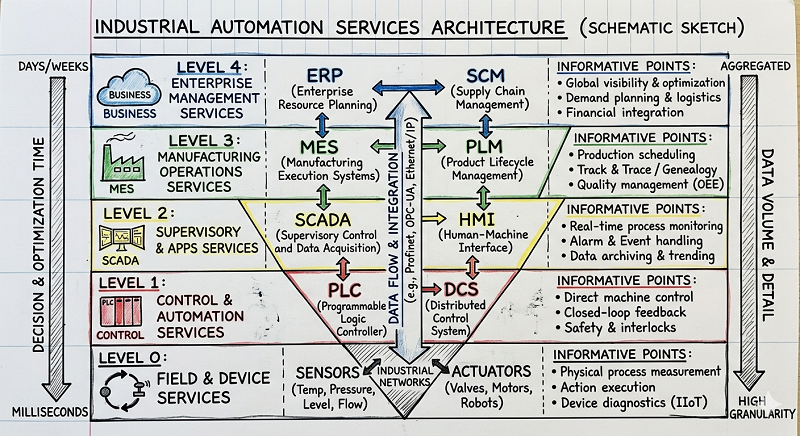
The Hierarchical Platform: The Automation Pyramid
To understand the technology platform that industrial automation services are built upon, it is essential to understand the classic "automation pyramid." This model describes the hierarchical layers of technology in a typical factory, and the services provided often map directly to these layers. The foundational Industrial Automation Services Market Platform begins at Level 0, the Field Level, which consists of the physical sensors and actuators on the factory floor. Level 1 is the Control Level, dominated by Programmable Logic Controllers (PLCs) and Programmable Automation Controllers (PACs). These are the ruggedized industrial computers that execute the real-time control logic for machines and processes. Service providers spend a significant amount of time programming and commissioning these PLCs. Level 2 is the Supervisory Level, which includes SCADA (Supervisory Control and Data Acquisition) systems and Human-Machine Interfaces (HMIs). This platform layer provides operators with a graphical overview of the entire process, allowing them to monitor performance and issue high-level commands. Services at this level involve designing the HMI screens and configuring the SCADA system. This hierarchical platform, from sensor to supervisor, forms the traditional core of industrial automation.
The Convergence Platform: MES and ERP Integration
The classic automation pyramid is evolving as the lines between the factory floor (Operational Technology, or OT) and the enterprise business systems (Information Technology, or IT) begin to blur. A critical platform in this convergence is the Manufacturing Execution System (MES), which sits at Level 3 of the pyramid. The MES acts as the bridge between the real-time control world of the PLCs and the transactional world of the business. It manages the execution of production orders, tracks work-in-progress, collects detailed data on production quality and performance, and provides genealogy and traceability for products. A major and highly complex service offering is the integration of the MES platform with the company's Enterprise Resource Planning (ERP) system (Level 4), such as SAP or Oracle. This integration is vital. It allows production orders from the ERP to be sent down to the factory floor, and it allows real-time production data from the MES to be sent back up to the ERP for inventory management, cost accounting, and business planning. Providing the services to implement and integrate this critical MES platform is a high-value and highly specialized segment of the market.
The Digital Transformation Platform: The IIoT and Cloud Layer
The most modern and transformative layer of the platform is the one that supports Industry 4.0 and digital transformation. This is the Industrial Internet of Things (IIoT) and Cloud platform. This layer transcends the traditional pyramid, creating a new pathway for data to flow from the factory floor directly to the cloud for advanced analysis. The platform consists of IIoT gateways that securely collect data from PLCs and sensors, and a cloud-based IoT platform (such as AWS IoT, Microsoft Azure IoT, or Siemens' MindSphere). This cloud platform provides the tools for storing massive amounts of time-series data, performing advanced analytics, and building machine learning models. The services associated with this platform are among the fastest-growing in the industry. They include designing the IIoT architecture, configuring the data collection, developing custom dashboards for data visualization, and creating predictive maintenance algorithms that can forecast equipment failures. This platform is what enables the shift from simple automation to intelligent, data-driven manufacturing, providing insights that can dramatically improve efficiency and create new business models.
The Service Delivery Platform: Remote Access and Augmented Reality
As the nature of industrial automation services shifts from one-off projects to ongoing operational support and optimization, the platform used to deliver these services is also evolving. A key component of the modern service delivery platform is secure remote access technology. This allows service engineers to remotely and securely connect to a customer's automation systems from anywhere in the world to troubleshoot problems, perform software updates, and monitor performance. This dramatically reduces travel costs and enables much faster response times. Another emerging and powerful platform tool is Augmented Reality (AR). A service provider can use AR to enhance the capabilities of an on-site technician. The technician can wear AR glasses, and a remote expert can see what they see, providing guidance by overlaying digital instructions, diagrams, and annotations directly onto the technician's real-world view of the equipment. This "see-what-I-see" solution is incredibly powerful for complex repairs and for training, effectively allowing a senior expert to be in multiple places at once. This evolution of the service delivery platform is making the provision of automation services more efficient, scalable, and effective.
➤ Latest Market Intelligence from Market Research Future:

 English
 Arabic
 French
 Spanish
 Portuguese
 Deutsch
 Turkish
 Italiano
 Russian
 Romaian
 Portuguese (Brazil)
 Greek
Greek
