


The Science Behind 7-OH Vapes: A Look at Formulation and Stability
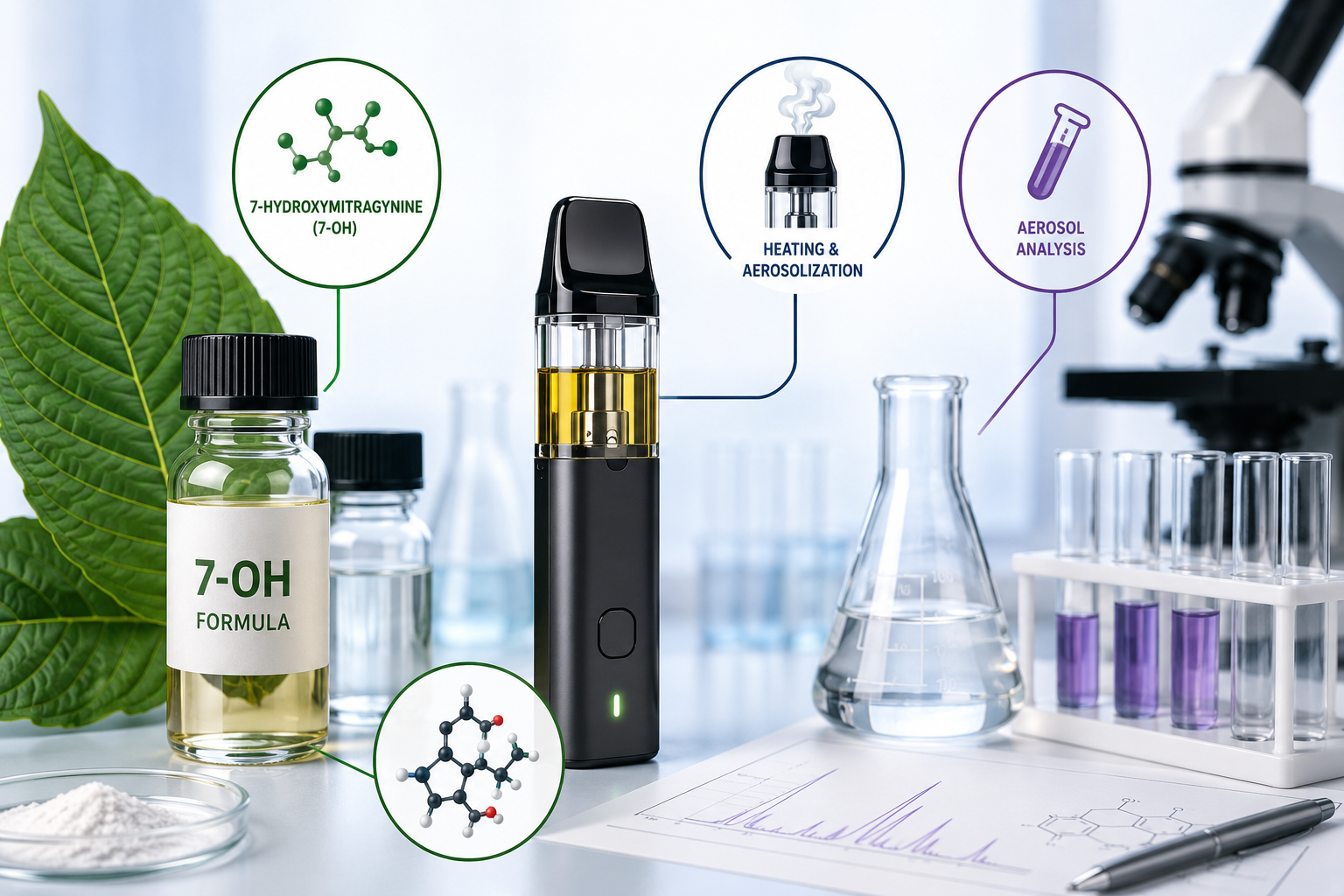
7-hydroxymitragynine, commonly called 7-OH, is a kratom-associated alkaloid that has received increasing scientific attention. While naturally occurring 7-OH is present only in trace amounts in kratom leaf, concentrated products have created a very different area of research.
Vape formulations introduce additional questions because the material is exposed to heat before being converted into an aerosol. This makes chemical composition, stability, degradation, and aerosol characterization important areas for researchers.
What Is 7-OH?
7-OH is one of the alkaloids associated with Mitragyna speciosa, the botanical species commonly known as kratom. Mitragynine is generally the major alkaloid in natural kratom, while 7-OH occurs naturally at much lower concentrations.
Researchers have studied 7-OH because of its strong interaction with the mu-opioid receptor. However, concentrated 7-OH products can be chemically different from traditional kratom leaf, meaning research on ordinary botanical kratom cannot automatically be applied to concentrated formulations.
Why Formulation Matters
A vape product is not simply an alkaloid in isolation. A formulation can contain multiple chemical components, including the principal active compound, carrier materials, flavoring substances, and potentially other kratom-related compounds.
Recent research examining nonswallowed kratom-derived products found substantial variation among commercially available products. Several vaping products contained 7-OH, while others contained mitragynine extracts, mitragynine pseudoindoxyl, or additional cannabinoids.
This variation makes it difficult to describe every 7-OH vape using one standardized chemical profile.
What Does Chemical Stability Mean?
Chemical stability refers to the ability of a compound to maintain its original chemical structure under particular conditions.
Temperature, light, oxygen, solvent composition, pH, and storage time can all influence stability. For an alkaloid-containing formulation, researchers may therefore examine whether the original compound remains unchanged during storage and whether new compounds appear over time.
Recent analytical research has identified 7-OH degradation and oxidation products in commercial products, demonstrating why stability testing is an important part of chemical characterization.
Heat Creates Another Research Question
Vaping introduces a factor that ordinary kratom powder does not experience in the same way: rapid heating followed by aerosol generation.
Researchers need to distinguish between the composition of the original liquid or formulation and the composition of the aerosol produced after heating.
Potential research questions include:
-
Does the concentration of 7-OH change during heating?
-
Does the compound remain chemically intact?
-
Are degradation products generated?
-
Do formulation ingredients react with one another?
-
Does device temperature influence the resulting aerosol?
-
Are the compounds detected in the starting material also present in the inhaled aerosol?
These questions require controlled laboratory testing rather than assumptions based on the composition of the original formulation.
Storage Stability Is Also Important
Stability does not only concern what happens during vaping. A formulation can potentially change while sitting in storage.
Research on e-cigarette liquids has demonstrated that flavoring chemicals can undergo chemical changes over extended storage periods, with temperature and light exposure influencing degradation. Researchers identified processes including oxidation, hydrolysis, and condensation in some tested formulations.
These findings come from e-cigarette formulations generally and should not be interpreted as proof that the same reactions occur in every 7-OH product. They do, however, demonstrate why stability testing is important for complex inhalation formulations.
How Scientists Study Stability
Analytical chemistry provides the tools needed to investigate these questions.
Techniques such as high-performance liquid chromatography (HPLC), liquid chromatography-mass spectrometry (LC-MS), and mass spectrometry can be used to measure compounds before and after controlled storage or exposure conditions.
Researchers can compare samples to determine whether:
-
The original 7-OH concentration changes
-
Additional compounds appear
-
Oxidation products develop
-
The formulation becomes chemically inconsistent
-
Different batches have different compositions
A 2026 study of commercial 7-OH products found substantial discrepancies between some labeled and measured concentrations and detected several oxidized byproducts. More than 98% of the analyzed 7-OH-labeled products showed characteristics consistent with a semisynthetic origin.
Why Aerosol Testing Is Different
Testing the liquid before it is heated does not necessarily provide a complete picture of what is generated during vaping.
For scientific research, aerosol analysis can provide additional information about the compounds that actually become airborne after heating. Researchers can compare the starting formulation with the resulting aerosol and investigate whether chemical changes occur.
This distinction is particularly important because inhalation bypasses the digestive system and can produce a different exposure pathway from orally consumed products.
A recent study of nonswallowed kratom-derived products emphasized that clinical, safety, and pharmacokinetic information for products that bypass first-pass metabolism remains limited.
The Importance of Product Variability
One challenge in researching 7-OH vapes is that commercial products may not be standardized.
Different products can vary in:
-
Alkaloid concentration
-
Additional ingredients
-
Flavoring composition
-
Device design
-
Heating characteristics
-
Packaging
-
Label accuracy
This means that research involving one formulation cannot necessarily be generalized to every product described as a "7-OH vape."
What Current Research Does Not Establish
Despite growing scientific interest, there are still major gaps in knowledge.
There is limited controlled research specifically examining the long-term effects of inhaled 7-OH formulations, the composition of their aerosols, and the consequences of repeated exposure.
The FDA currently warns that concentrated 7-OH products have not been demonstrated to be safe or effective for any use and recommends that consumers avoid them.
Therefore, laboratory findings about receptor activity or chemical stability should not be interpreted as evidence that a particular vaping formulation is safe.
Why Analytical Testing Matters
Analytical testing is particularly important for emerging products because the name on a package does not establish its exact chemical composition.
Independent testing can help determine whether the measured concentration matches the label and whether unexpected compounds are present.
The recent finding of differences between labeled and measured 7-OH concentrations demonstrates the importance of validated analytical methods and batch-specific characterization.
For researchers, these measurements are essential for producing reproducible results.
Final Thoughts
The science behind 7-OH vapes involves much more than the presence of 7-hydroxymitragynine.
Researchers must consider the complete formulation, chemical stability, storage conditions, heating, aerosol composition, degradation products, and route of exposure.
Current research has shown that commercial 7-OH products can vary considerably in their chemical composition and that 7-OH can undergo chemical changes under certain conditions.
At the same time, important questions about the chemistry and safety of inhaled 7-OH formulations remain unanswered.
The most useful direction for future research is therefore product-specific analytical testing combined with controlled stability, aerosol, pharmacokinetic, and toxicological studies. This approach can help distinguish established chemical findings from assumptions about an emerging and poorly standardized product category.

 English
 Arabic
 French
 Spanish
 Portuguese
 Deutsch
 Turkish
 Dutch
Dutch
 Russian
 Romaian
 Portuguese (Brazil)
 Greek
Greek
