


7-OH Vapes and Alkaloid Research: What to Know
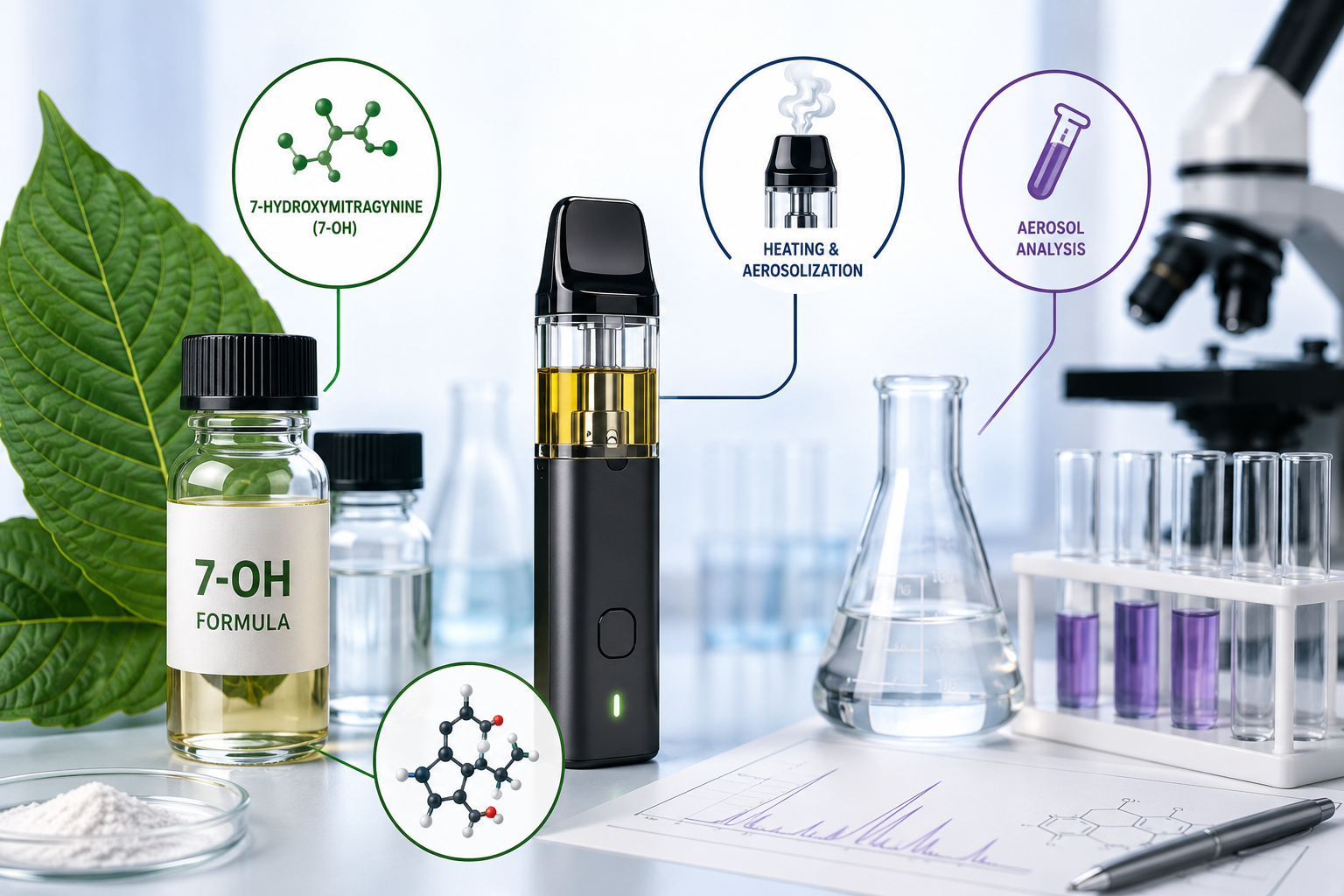
7-hydroxymitragynine, commonly called 7-OH, is a kratom-associated alkaloid that has become an increasingly important subject of chemical, pharmacological, and toxicological research. While 7-OH occurs naturally in Mitragyna speciosa (kratom), researchers distinguish naturally occurring trace amounts from concentrated products containing substantially higher levels.
Vape formulations add another dimension to this research because heating can potentially change the chemical composition of an alkaloid-containing formulation before it becomes an inhaled aerosol.
Understanding 7-OH and Kratom
Kratom contains more than 40 identified alkaloids. Mitragynine is generally the predominant alkaloid, while 7-OH occurs naturally at much lower concentrations. Other alkaloids include paynantheine, speciogynine, and speciociliatine.
The presence of multiple compounds makes traditional kratom chemically different from products formulated primarily around concentrated 7-OH. Research findings involving ordinary kratom leaf therefore should not automatically be applied to concentrated 7-OH products.
Why Researchers Are Studying 7-OH
7-OH has attracted attention because of its activity at the mu-opioid receptor. Preclinical research has demonstrated opioid-like pharmacological properties, while regulatory agencies have expressed concerns about its potential for dependence and other serious adverse effects.
The FDA specifically distinguishes concentrated 7-OH products from the trace amounts naturally present in kratom leaf and currently advises consumers to avoid products containing concentrated 7-OH.
This distinction is important when discussing research because the chemical profile of a concentrated product may be substantially different from that of botanical kratom.
What Makes Vaping Different?
Most traditional kratom research has involved orally consumed botanical material or extracts. Vaping introduces a different route of exposure.
A vape formulation is heated to create an aerosol, which means researchers need to consider not only the ingredients in the original formulation but also what happens to those ingredients during heating.
A recent analysis of commercially available nonswallowed kratom-derived products identified 33 vaping products. Most contained 7-OH, while some contained combinations involving kratom extracts, mitragynine pseudoindoxyl, or intoxicating hemp cannabinoids.
This variation demonstrates that "7-OH vape" does not necessarily describe one standardized formulation.
Alkaloid Stability and Heating
One of the major research questions is whether kratom alkaloids remain chemically stable during aerosol generation.
Alkaloids can undergo chemical transformations under particular environmental conditions. Researchers have identified compounds associated with oxidation and other chemical changes involving the mitragynine family.
A 2026 study of commercial 7-OH products found significant differences between some labeled and measured concentrations and identified chemical artifacts associated with the stability and transformation of 7-OH.
However, stability results from laboratory experiments cannot automatically predict what happens in every commercial vaping device.
Why Aerosol Chemistry Matters
Testing the original liquid or formulation provides only part of the picture.
When a formulation is heated, researchers may need to compare the chemical composition before and after aerosol generation. This can help determine whether the original alkaloids remain present, whether their concentrations change, or whether additional compounds appear.
A 2026 toxicology review highlighted potential concerns about thermal degradation of kratom alkaloids and emphasized the need to characterize vaping products before and after heating.
This area remains underdeveloped, making product-specific testing particularly important.
The Importance of Analytical Testing
Modern analytical chemistry provides several ways to characterize alkaloid-containing products.
Techniques such as HPLC, UHPLC, LC-MS, and mass spectrometry can help researchers identify and quantify individual compounds.
Testing can investigate:
-
7-OH concentration
-
Mitragynine concentration
-
Other alkaloids
-
Potential impurities
-
Oxidation products
-
Degradation products
-
Differences between labeled and measured concentrations
Recent research has found notable discrepancies between label claims and measured 7-OH levels in some commercial products.
These findings demonstrate why chemical characterization is important when interpreting research involving commercial products.
Traditional Kratom vs. Concentrated 7-OH
The distinction between traditional kratom and concentrated 7-OH is central to current research.
Natural kratom contains a broad mixture of alkaloids whose concentrations can vary naturally. Concentrated products may contain substantially higher levels of a particular alkaloid and can have a chemical profile that differs from the original plant.
One recent analysis found products marketed as kratom with 7-OH concentrations far outside typical natural-leaf profiles and chemical characteristics inconsistent with authentic kratom leaf.
Consequently, researchers should identify the actual chemical composition of the material being studied rather than relying solely on the product category or marketing terminology.
What Researchers Still Need to Understand
There are significant gaps in the scientific literature surrounding inhaled 7-OH and kratom-derived products.
Important research areas include:
-
Aerosol chemistry
-
Thermal degradation
-
Respiratory toxicity
-
Pharmacokinetics following inhalation
-
Long-term exposure
-
Dependence and withdrawal
-
Interactions with other ingredients
-
Contamination and manufacturing byproducts
A recent study noted that clinical, safety, and pharmacokinetic data for nonswallowed kratom-derived products remain extremely limited.
This lack of evidence makes it difficult to draw reliable conclusions about the long-term effects of vaping these compounds.
Regulatory Attention
7-OH has also become a significant regulatory issue in the United States.
In July 2026, the FDA reported that the DEA had begun a temporary scheduling process involving 7-OH above a proposed threshold, as well as several synthetic kratom-related compounds.
The regulatory discussion specifically distinguishes concentrated 7-OH products from natural kratom leaf. Because regulations can change, researchers and businesses should verify the current requirements applicable to their jurisdiction.
Final Thoughts
Research into 7-OH vapes and kratom alkaloids is still developing.
The key scientific distinction is between naturally occurring kratom chemistry and concentrated formulations containing elevated levels of 7-OH or other related compounds. Vaping introduces additional variables because heating may alter the chemical composition before inhalation.
Current research has identified significant variation among commercial products and raised questions about alkaloid stability, thermal degradation, aerosol composition, and potential contaminants.
More controlled research is needed before scientists can fully characterize the risks and pharmacological properties of inhaled 7-OH products. For now, careful analytical testing and a clear separation between established evidence and unresolved questions remain essential when evaluating this emerging category.

 English
 French
 Spanish
 Portuguese
 Deutsch
 Turkish
 Dutch
Dutch
 Italiano
 Russian
 Romaian
 Portuguese (Brazil)
 Greek
Greek
