


Total Blackout Blinds for Bedrooms and Light Sensitive Rooms
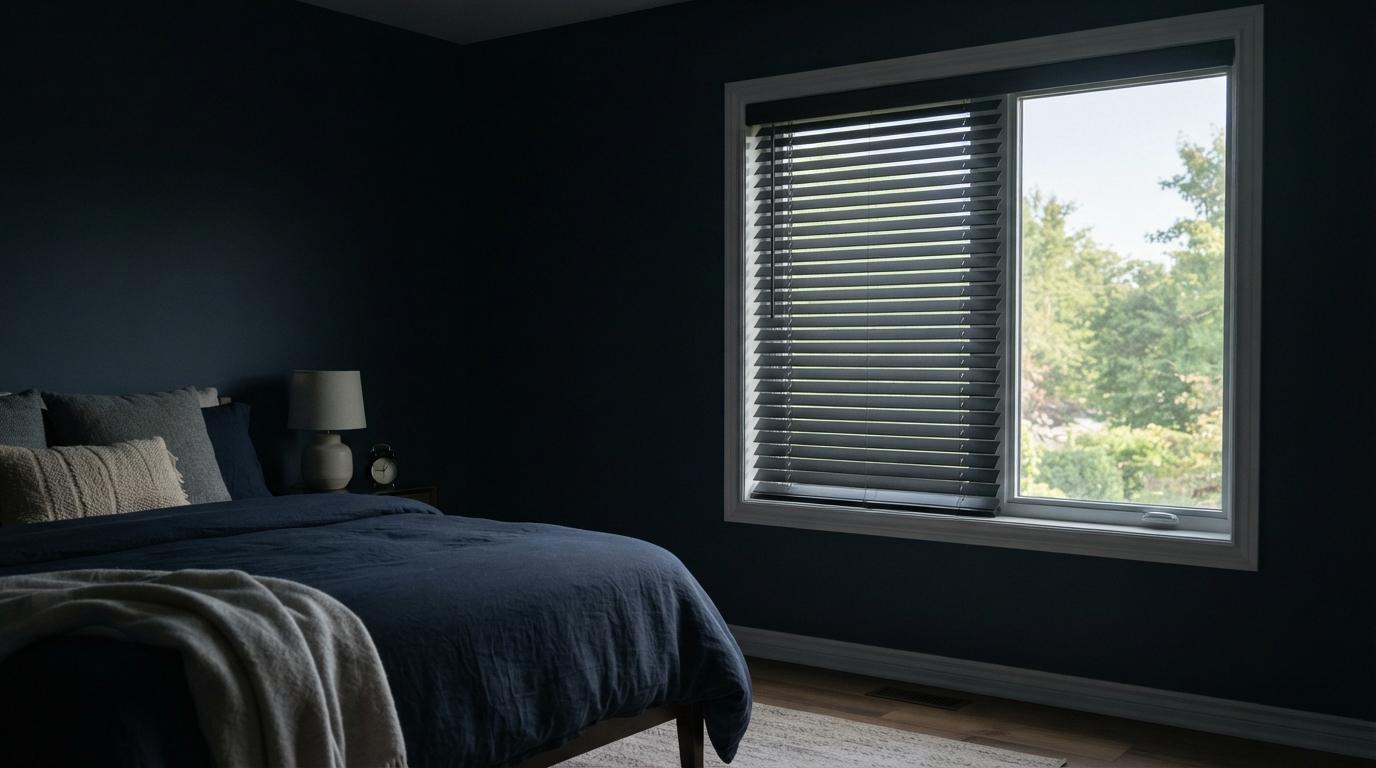
If your bedroom is still bright after the curtains are closed, the problem may not be the fabric itself. Light can enter around the edges of a blind, through gaps between the window and covering, or from street lighting outside. Total blackout blinds take a different approach by treating the window as a whole, helping create a genuinely darker room rather than simply reducing the amount of daylight.
For some people, that distinction matters.
A bright bedroom can be inconvenient when you want to sleep late on a summer morning. For shift workers and other daytime sleepers, it can make resting during daylight hours particularly difficult. Parents may also want better control over light in a nursery, while anyone sensitive to artificial light may simply prefer a darker sleeping environment.
The right window covering won't solve every sleep problem. But controlling the light entering a room is a practical place to start.
What are total blackout blinds?
Total blackout blinds are designed to minimise light entering a room far more effectively than conventional blinds.
A standard blackout blind may use an opaque fabric that prevents light passing directly through the material. That's useful, but it doesn't necessarily mean the room will be completely dark. The remaining light can come from the sides, above or below the blind.
This is where the design of the surrounding frame and seals becomes important.
A system that fits closely to the window can reduce the small openings through which daylight normally escapes into the room. In other words, effective blackout is about the entire window covering, not just the fabric.
This makes total blackout systems particularly relevant for bedrooms and other spaces where even small amounts of light can be distracting.
Why does bedroom light matter?
Light is one of the environmental cues involved in the body's sleep-wake cycle. That's why darkness is naturally associated with night-time rest, while daylight helps signal that it's time to be awake.
You don't need a pitch-black room to sleep well, of course. People have different preferences, and sleep quality depends on much more than window coverings. Noise, temperature, stress, routine and comfort all play a part.
Still, unwanted light can be an irritating variable that is relatively easy to control.
Consider a bedroom facing a street with bright lamps outside. Or a room that catches direct sunlight at five in the morning during summer. Someone working nights may have an even bigger challenge: their preferred sleeping hours can overlap with the brightest part of the day.
For these situations, improving light control can make the room feel more suitable for sleep.
Total blackout blinds vs ordinary blackout blinds
The terms are sometimes used interchangeably, but there's a practical difference worth understanding.
| Feature | Conventional blackout blind | Total blackout system |
|---|---|---|
| Blocks light through fabric | Usually | Yes |
| Reduces daylight | Yes | Yes |
| Addresses light around edges | Depends on design | Designed specifically to minimise gaps |
| Suitable for daytime sleeping | Often useful | Particularly suited to strong light control |
| Privacy | Generally good | Can provide a more enclosed window |
| Made-to-measure option | Available | Often central to the system design |
| Installation | Varies | Some systems use no-drill installation |
The important point isn't the label. It's how the blind deals with the complete window opening.
If the main source of frustration is a glowing strip of light around an otherwise dark blind, changing to another opaque fabric alone may not solve the problem.
Where are total blackout blinds most useful?
Bedrooms are the obvious application, but they're not the only one.
1. Main bedrooms
Early morning sunlight can be welcome when you want to wake naturally. It isn't quite as welcome when you've been working late or simply want to sleep longer.
A closer-fitting blackout system can give you greater control over when daylight enters the room.
2. Children's bedrooms and nurseries
Young children often sleep at different times from adults, including during daylight hours.
A darker room can make the nursery or child's bedroom feel more consistent between daytime and night-time sleep periods. Parents may also value privacy and a simple window covering without loose hanging cords.
3. Rooms used by shift workers
Night-shift workers have an unusual relationship with daylight. Their "night" may begin when everyone else is starting their day.
For someone sleeping at 9am or 2pm, ordinary curtains may leave too much daylight in the room. Stronger blackout can help turn a bright room into a more suitable sleeping space.
4. Home offices
A darkening blind isn't only about sleep.
Direct sunlight can create glare on monitors, making a home office uncomfortable during parts of the day. Being able to control the light can make screens easier to view and give the room more flexibility.
5. Light-sensitive rooms
Some spaces simply benefit from precise light control. A media room, guest room or room facing a brightly lit road may be more comfortable when outside light can be reduced substantially.
The overlooked problem: light gaps
This is often where people discover that "blackout" doesn't necessarily mean "dark".
Imagine a blind covering the centre of a window perfectly. Now picture a narrow strip of daylight along each side. In a dark bedroom, those strips can look surprisingly bright.
The same thing can happen above the blind or underneath it.
That's why measurements matter.
Made-to-measure blackout blinds are designed around the individual dimensions of a window rather than relying solely on standard sizes. The aim is a closer fit, which can help reduce unwanted gaps and improve the overall blackout effect.
It's a small detail with a big practical consequence.
Does a no-drill system make a difference?
For renters, homeowners who don't want to damage their window frames, or anyone looking for a simpler installation, no-drill blinds can be an attractive alternative to traditionally fixed window coverings.
Not every window is the same, though. The suitability of a no-drill system depends on the window, frame and installation method, so measurements and the manufacturer's fitting instructions should always be checked before choosing one.
The broader advantage is flexibility. A blackout solution doesn't necessarily have to involve drilling holes into the surrounding structure.
For people who move home frequently or simply prefer reversible improvements, that's worth considering.
Blackout can also affect comfort beyond light
A window is one of the weaker points in many rooms from a thermal perspective. Glass can feel cold in winter and allow solar heat to build up during warmer weather.
Some blackout systems are designed with additional layers or frames intended to help reduce heat transfer. They may also dampen some outside noise.
These features shouldn't be confused with full acoustic or thermal insulation. A blind isn't going to turn a street-facing bedroom into a soundproof room.
But reducing a little outside disturbance can contribute to a more comfortable environment, particularly when combined with other measures such as good curtains, suitable glazing and draught control.
What should you look for when choosing blackout blinds?
Rather than choosing solely on the phrase "blackout", look at the complete system.
Ask:
- How much light does the system actually block?
- How does it deal with gaps around the window?
- Is it made to measure?
- How is it installed?
- Will it suit the window frame?
- Is the operation practical for everyday use?
- Does it provide the level of privacy you need?
- Is the design suitable for a child's room or nursery?
- Will the blind also help with glare, temperature or outside disturbance?
- Can you choose an opening direction that works with your room?
These questions are more useful than simply comparing fabric colours or asking which blind is "the darkest".
For example, LumiGlide's total blackout system is made to measure and is designed around light control, privacy and no-drill installation. The product information also describes options for fabric and frame colours and different opening directions, along with intended use in bedrooms, children's rooms, nurseries and home offices.
For readers who want to examine how one such system approaches the problem, the LumiGlide Total Blackout Blinds page provides further technical and installation information.
How to get better results from blackout blinds
Even the best window covering can struggle if the rest of the room works against it.
Start by identifying where the light actually comes from. Stand inside the room after dark with the lights off and look around the window. Street lighting often reveals gaps that aren't obvious during the day.
Then consider the rest of the room.
A lighter-coloured bedroom may reflect more incoming light, while mirrors and glossy surfaces can bounce it around. Electronic displays, alarm clocks and chargers can also create small sources of artificial light after bedtime.
You don't need to redesign the entire bedroom. Sometimes the most useful improvement is simply removing the obvious sources of unwanted illumination.
A darker bedroom isn't about making every room pitch black
Total darkness isn't automatically better for everyone.
Some people sleep comfortably with a small amount of natural or ambient light. Others find even a narrow beam from a street lamp irritating. Children, in particular, may have their own preferences.
The useful question is therefore not, "Do I need the darkest possible room?"
It's:
How much control do I want over the light in this room?
If the answer is "as much as possible", a total blackout system may make more sense than a conventional blind that only blocks light through its fabric.
The practical takeaway
For bedrooms, nurseries, daytime sleeping spaces and other light-sensitive rooms, blackout performance depends on more than the material hanging over the glass.
The fit, frame, seals, installation method and window dimensions all influence how much unwanted light gets into the room.
That's why total blackout blinds are worth considering when ordinary curtains or blackout fabrics still leave your bedroom brighter than you'd like.
Start by identifying the source of the problem. If light is entering around the edges of your existing blind, focus on the design and fit rather than simply choosing a darker fabric. If you're a renter or don't want to drill into the window frame, investigate no-drill options. And if the room serves several purposes, consider whether better light control could improve its use during the day as well as at night.
The goal isn't to make a room impressive.
It's to make the window do its job quietly, giving you control over when daylight gets in and when it doesn't.

 English
 Arabic
 French
 Spanish
 Portuguese
 Deutsch
 Turkish
 Dutch
Dutch
 Italiano
 Russian
 Romaian
 Greek
Greek
