


Why Is Asia Becoming the New Growth Engine for 3D Printing?
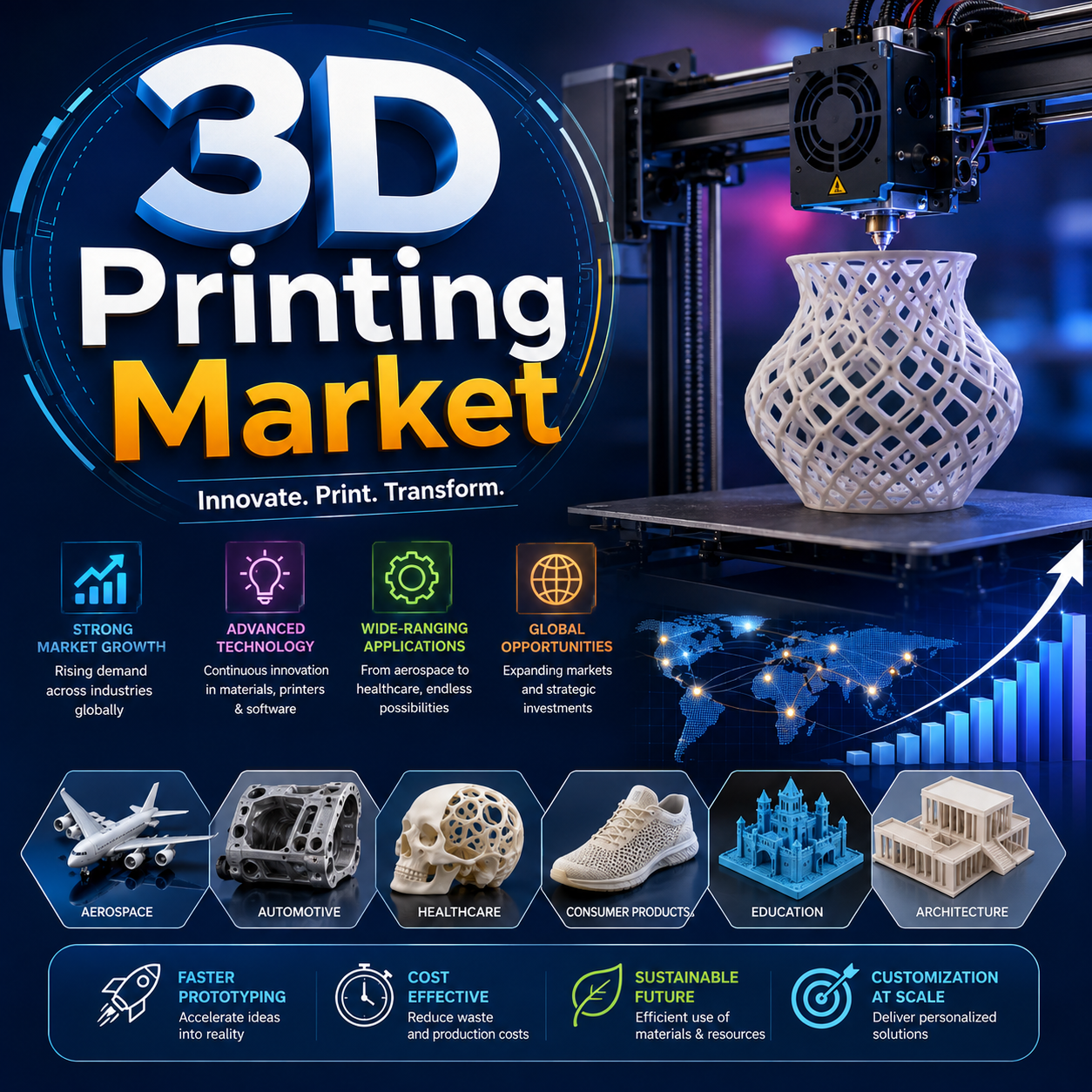
The global manufacturing map is changing, and Asia is positioned at the center of that transformation. As manufacturers invest in automation, digital production, advanced materials, and smart factories, the 3d Printing Market is gaining momentum across Asian economies. 6Wresearch identifies Asia as the fastest-growing regional market, projecting a CAGR of approximately 9.2% between 2026 and 2032.
Why Asia Matters
Asia already has a powerful manufacturing ecosystem.
Countries such as China, Japan, South Korea, India, and other emerging manufacturing economies support large automotive, electronics, machinery, aerospace, healthcare, and consumer-product industries.
This creates a natural environment for additive manufacturing.
Factories that are already investing in automation can integrate 3D printing into broader digital manufacturing strategies.
China and Advanced Manufacturing
China's manufacturing scale gives it a significant role in additive manufacturing.
The country's focus on advanced manufacturing, automation, and technological self-reliance supports investment in innovative production systems.
3D printing can contribute to prototyping, industrial components, tooling, and specialized manufacturing.
Government initiatives have also encouraged development of advanced manufacturing capabilities.
The opportunity is not limited to equipment. Materials, software, services, and technical expertise can all benefit from ecosystem expansion.
Japan's Precision Advantage
Japan brings a different strength: precision engineering.
Industries such as automotive, electronics, robotics, and machinery require high levels of accuracy and reliability.
3D printing can complement these industries by enabling rapid prototyping and complex designs.
As additive manufacturing technologies improve, the combination of Japanese engineering expertise and digital production could support sophisticated applications.
India and the Next Manufacturing Wave
India is increasingly focused on expanding manufacturing capabilities and digital industrial infrastructure.
For Indian companies, 3D printing can offer an opportunity to develop products without requiring the same scale of traditional manufacturing infrastructure.
Startups, engineering firms, educational institutions, healthcare providers, and industrial companies can experiment with additive technologies across different applications.
The technology may also support localized manufacturing and customized production.
Materials Are the Foundation
Asia's growth will depend heavily on materials.
A printer is useful only when appropriate materials are available at commercially viable prices.
Polymers, metals, composites, and specialized materials are therefore critical parts of the regional ecosystem.
Globally, materials represented approximately 55% of the market in 2025, according to 6Wresearch.
This suggests that material producers could play an increasingly strategic role as Asian adoption accelerates.
Manufacturing Meets Software
The next generation of Asian factories will not depend only on physical machines.
Software will become increasingly important.
Digital design, simulation, machine monitoring, production management, artificial intelligence, and quality inspection can connect additive manufacturing with smart factories.
This creates opportunities for technology companies that provide the digital infrastructure around 3D printers.
Education and Workforce Development
Technology adoption also depends on people.
Companies need engineers and technicians who understand additive design, machine operation, material science, post-processing, and quality assurance.
Universities and technical institutions therefore have an important role.
Training programs can help create the workforce needed for broader adoption.
Challenges for Asian Markets
Growth does not come without obstacles.
High equipment costs can discourage smaller companies. Material availability may vary between countries. Certification and quality standards can also create barriers.
Infrastructure and technical skills differ significantly across markets.
Therefore, adoption will likely occur at different speeds.
What Does the Future Hold?
The Asian opportunity is significant because the region combines manufacturing scale with growing technological capability.
According to 6Wresearch, Asia is projected to be the fastest-growing region through 2032, while the global market is expected to reach USD 46.2 billion by that year.
The region could therefore become an important center for additive manufacturing equipment, materials, software, services, and applications.
The most interesting question is no longer whether Asia will participate in the 3D printing revolution.
It is how much of that revolution will actually be created in Asia.
Who We Are
About 6Wresearch: It is a commercial strategy and growth advisory firm founded in 2011 and headquartered in New Delhi, India, with partners across Southeast Asia and the Middle East & Africa. The firm has delivered over 20,000 commercial engagements for over 2,000 organizations, including Fortune 500 companies, government agencies, and multilateral institutions such as the World Bank and the Asian Development Bank. 6Wresearch combines proprietary intelligence, advanced analytics, and sector expertise to help organizations navigate market complexity and drive sustainable growth. These capabilities explain why organizations trust 6Wresearch for reliable commercial insights and confident decision-making.
Our Proprietary Platform: 6W Export GTM
6W Export GTM is 6Wresearch's proprietary trade intelligence and go-to-market platform, built on UN Comtrade data and enhanced with 6Wresearch's in-house analytical and simulation models, including system dynamics-based forecasting. Unlike broad, sector-level market sizing tools, 6W Export GTM operates at the individual product level down to specific HS codes and micro-segments to identify precise, actionable export opportunities by country and product pair, including markets where trade currently does not exist. This granular, simulation-driven approach allows 6W Export GTM to surface opportunities that sector-wide analysis typically misses, positioning it among a small number of platforms globally offering this depth of product-and-country-specific export intelligence.

 English
 Arabic
 French
 Spanish
 Portuguese
 Deutsch
 Turkish
 Italiano
 Russian
 Romaian
 Portuguese (Brazil)
 Greek
Greek
