


NEET PG Admission: Complete Guide to Eligibility, Counselling, Choice Filling and Seat Allotment
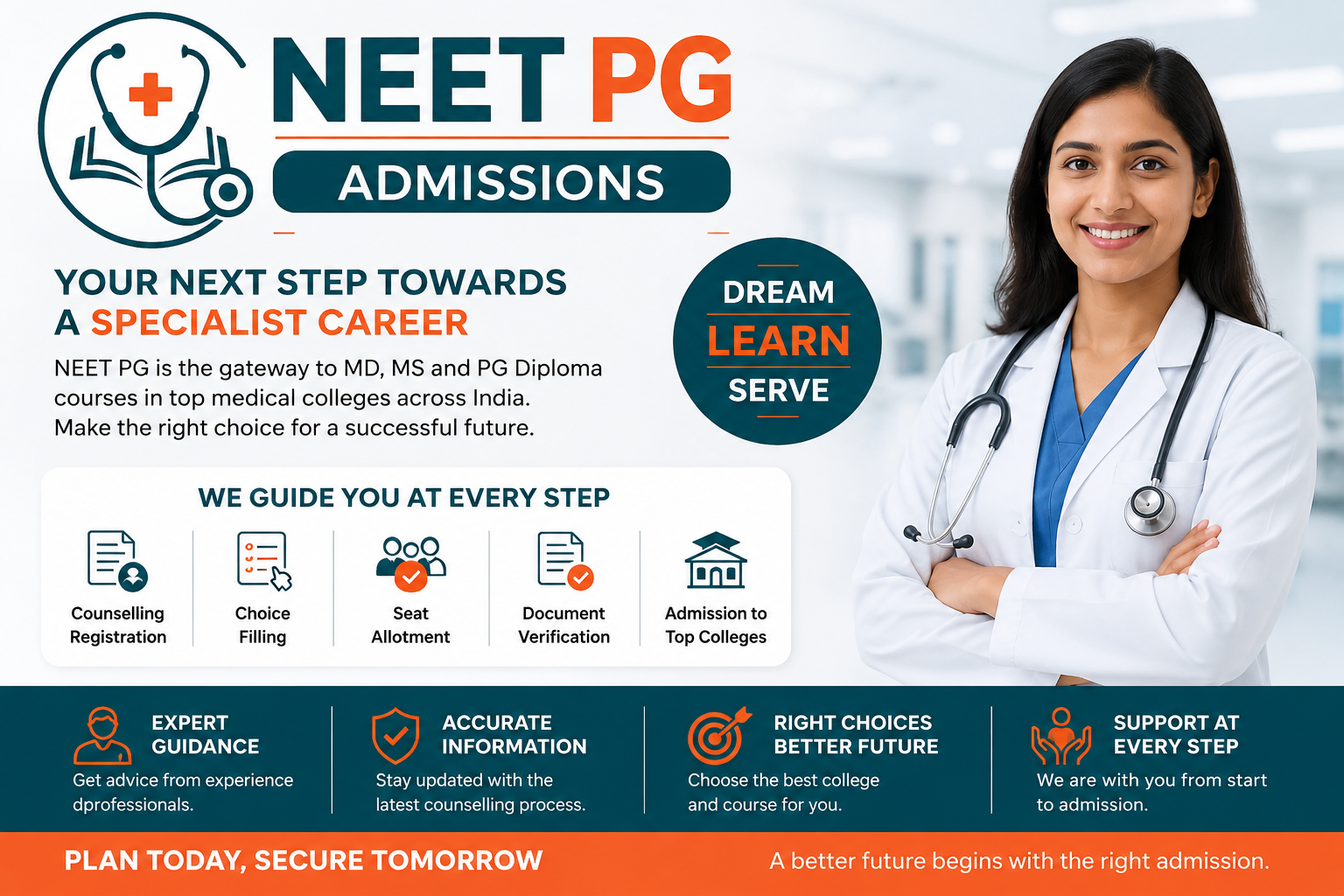
NEET PG admission is one of the most important steps for medical graduates who want to pursue postgraduate medical education in India. Every year, thousands of MBBS graduates appear for the National Eligibility cum Entrance Test for Postgraduate courses with the aim of securing admission to MD, MS and PG Diploma programmes.
Getting a good NEET PG rank is only one part of the admission process. After the examination, candidates must understand counselling, registration, choice filling, seat allotment, document verification and reporting requirements. A small mistake at any stage can affect the chances of getting the preferred college or speciality.
This guide explains the NEET PG admission process in a simple and practical manner so that candidates can understand what to expect after the examination.
What Is NEET PG Admission?
NEET PG admission is the process through which eligible medical graduates obtain seats in postgraduate medical courses based on their NEET PG performance and counselling rules.
The examination is conducted for admission to postgraduate medical courses such as:
- Doctor of Medicine (MD)
- Master of Surgery (MS)
- PG Diploma courses, wherever applicable
Admission is generally based on the candidate's NEET PG rank, category, preferences, availability of seats and applicable counselling rules.
Candidates should remember that qualifying for NEET PG does not automatically guarantee admission to a particular college or speciality. The final seat depends on the counselling process and the choices submitted by the candidate.
Who Can Apply for NEET PG Admission?
Candidates must fulfil the eligibility conditions prescribed for the examination and admission process. In general, applicants are required to have completed their MBBS degree from a recognised medical institution.
A candidate must also satisfy the internship requirement applicable to the particular admission cycle. Completion of the compulsory rotating internship within the prescribed deadline is an important condition for postgraduate admission.
Candidates belonging to different categories may also receive applicable relaxations or benefits according to the prevailing admission regulations. Therefore, students should always check the official information bulletin and counselling notifications for the relevant admission year.
NEET PG Admission Process
The NEET PG admission journey can be divided into several stages. Understanding these stages in advance makes the entire process easier to manage.
1. Appear for the NEET PG Examination
The first step is to register for and appear in the NEET PG examination. Candidates should carefully complete the application form and provide accurate personal, academic and internship information.
After the examination, candidates receive their result and rank. This rank becomes one of the most important factors during counselling and seat allotment.
2. Check the NEET PG Result and Rank
Once the result is declared, candidates should carefully check their score, rank and qualifying status.
The overall rank gives an indication of the candidate's position among the applicants. However, candidates should not assume that a particular rank guarantees a particular speciality or college.
Previous admission trends can provide an idea of possible options, but cut-offs may change every year because of variations in candidate preferences, seat availability, difficulty level and other factors.
3. Register for Counselling
After the result, eligible candidates need to participate in the appropriate counselling process.
Different authorities may conduct counselling for different categories of seats. Candidates must identify which counselling process applies to them and complete registration within the specified timeline.
Missing the registration deadline can prevent a candidate from participating in that particular round. Therefore, keeping track of counselling announcements is extremely important.
4. Understand the Seat Matrix
Before filling choices, candidates should study the available seat matrix carefully.
The seat matrix provides information about the colleges, courses, categories and seats available for a particular counselling round. It can change between rounds depending on resignations, upgrades, newly added seats and other administrative factors.
A candidate should not prepare choices solely on the basis of college reputation. Course preference, location, patient exposure, academic environment, fees, bond conditions and future career plans can all influence the decision.
How to Fill NEET PG Choices
Choice filling is one of the most important stages of NEET PG counselling.
Candidates should prepare their choices before entering them into the counselling portal. Making decisions under time pressure can result in incomplete or poorly organised preferences.
A practical approach is to divide choices into three broad categories:
Preferred Choices
These are colleges and specialities that the candidate would ideally like to join. They should reflect genuine preferences rather than what other students consider prestigious.
Realistic Choices
These are options that appear achievable based on the candidate's rank, category and previous counselling trends.
Backup Choices
These choices provide additional possibilities if the preferred options are not available.
Candidates should generally arrange choices in their actual order of preference. The counselling system considers the choices submitted by the candidate along with rank and seat availability during allotment.
NEET PG Seat Allotment
After choice filling and locking, the counselling authority processes the submitted preferences and announces seat allotment.
The allotment depends on several factors, including:
- NEET PG rank
- Category
- Seat availability
- Candidate preferences
- Applicable reservation rules
- Counselling rules
- Availability of seats during that round
If a candidate receives a seat, they generally have to follow the instructions provided for that counselling round. Depending on the applicable rules, options may include accepting the seat, participating in further rounds through an upgrade option, or taking other permitted actions.
Candidates should carefully read the instructions before deciding what to do with an allotted seat.
Documents Required for NEET PG Admission
Document requirements can vary depending on the counselling authority and college. Candidates should keep multiple copies of important documents ready.
Commonly required documents may include:
- NEET PG admit card
- NEET PG result or rank information
- MBBS degree or provisional degree certificate
- MBBS marksheets
- Internship completion certificate
- Medical registration certificate
- Valid identity proof
- Category certificate, where applicable
- Disability certificate, where applicable
- Passport-size photographs
- Counselling registration documents
- Seat allotment letter
Candidates should make sure that certificates are valid and issued in the required format. Category and other reservation-related certificates deserve particular attention because incorrect or outdated documentation can create problems during verification.
What Happens After Seat Allotment?
Once a seat is allotted, the candidate must complete the required admission formalities within the specified period.
This may involve reporting to the allotted institution, completing document verification, paying the required fees and submitting other admission documents.
Candidates should not wait until the final day to complete reporting. Technical problems, travel delays or missing documents can create unnecessary difficulties.
If the candidate wishes to participate in a subsequent counselling round, they should first understand the rules applicable to the allotted seat. Counselling policies can differ between rounds, so assumptions based on previous years should be avoided.
How to Choose the Right PG Speciality
Choosing a speciality is a major career decision and should not be based only on NEET PG cut-offs.
Candidates should consider their interest in the subject, work environment, lifestyle, patient interaction, academic opportunities and long-term career goals.
For example, a speciality with a relatively high cut-off may not necessarily be the best choice for every student. Similarly, a speciality with a lower cut-off should not automatically be treated as a second-rate option.
The best speciality is usually one that matches the candidate's interests, strengths and professional goals.
Factors to Consider While Choosing a Medical College
College selection is equally important. Candidates should consider several factors before finalising their choices.
Clinical Exposure
A strong patient load and diverse clinical cases can provide valuable practical experience during postgraduate training.
Faculty and Academics
Experienced faculty, teaching schedules, academic discussions and research opportunities can significantly influence postgraduate education.
Infrastructure
Departments should have appropriate facilities, laboratories, operation theatres, intensive care units and other resources required for training.
Fees and Financial Commitments
Candidates should carefully compare tuition fees, hostel expenses and other charges. Bond conditions and service obligations should also be reviewed before accepting a seat.
Location and Lifestyle
The location of the college can affect living expenses, travel, family accessibility and overall quality of life during residency.
Common Mistakes Candidates Should Avoid
NEET PG counselling can become stressful, particularly when candidates are trying to make decisions quickly. Some common mistakes can be avoided with proper preparation.
Candidates should avoid:
- Filling choices without understanding the seat matrix
- Copying another student's preference list
- Ignoring bond or service conditions
- Waiting until the last minute to register
- Entering choices randomly
- Failing to verify documents
- Assuming previous-year cut-offs will remain unchanged
- Ignoring counselling notifications
- Selecting a speciality solely because of its perceived status
- Missing reporting deadlines
Careful planning can reduce the possibility of these errors.
Final Thoughts on NEET PG Admission
NEET PG admission is not simply an examination followed by a college selection. It is a multi-stage process in which every decision can influence the final outcome.
Candidates should begin preparing for counselling well before registration opens. Understanding the counselling structure, studying the seat matrix, researching colleges and specialities, arranging documents and preparing a thoughtful choice list can make the process much smoother.
Most importantly, candidates should make decisions based on their own career objectives rather than following trends or peer pressure. A good NEET PG admission decision should balance rank, speciality preference, college environment, clinical exposure, financial considerations and long-term professional plans.
With careful preparation and timely action, candidates can approach the counselling process with greater confidence and make an informed decision about their postgraduate medical career.

 English
 Arabic
 French
 Spanish
 Portuguese
 Deutsch
 Turkish
 Italiano
 Russian
 Romaian
 Portuguese (Brazil)
 Greek
Greek
