


What Do the Best Real Estate Developer Websites Have in Common?
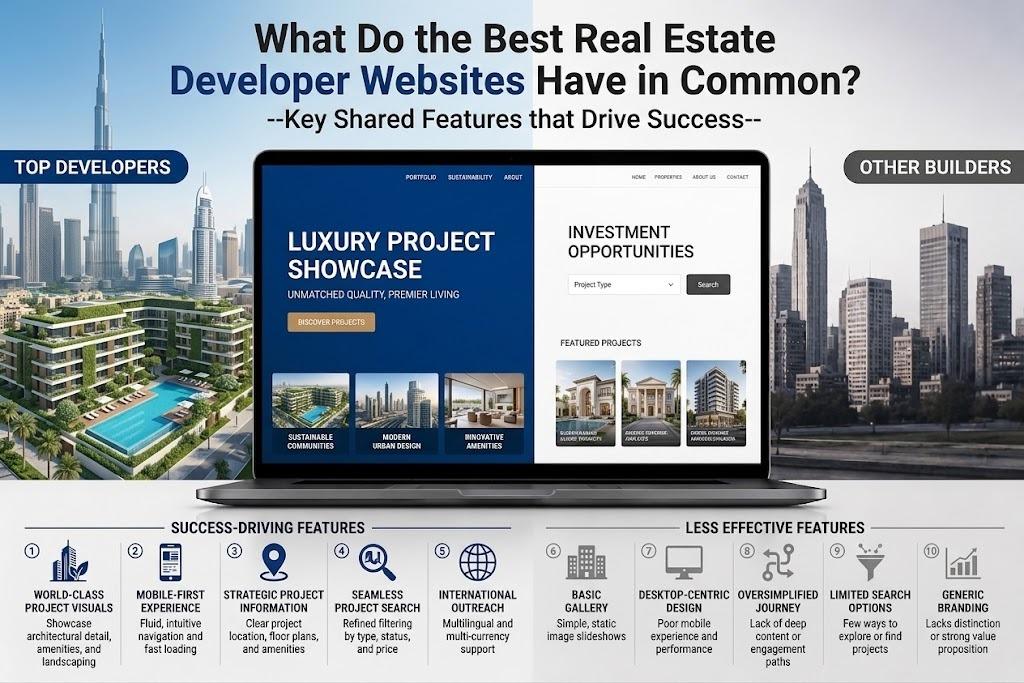
Real estate developers spend millions building landmark towers, gated communities, and mixed-use projects — yet many still market these projects through outdated, slow, and confusing websites. A weak website can undo months of branding and sales effort before a buyer even picks up the phone. On the other hand, the best real estate developer websites share a set of common traits that build trust, generate leads, and turn visitors into buyers.
This article breaks down exactly what separates a high-performing developer website from an average one.
1. A Clear and Powerful First Impression
The homepage of a top-performing developer website is designed to answer one question within seconds: "What does this company build, and why should I trust them?"
Strong Visual Identity
High-resolution imagery, drone shots, and cinematic video walkthroughs are standard on leading developer websites. Buyers browsing property online want to feel the scale and quality of a project before they ever visit a sales office.
Instant Brand Trust Signals
Award logos, years in business, number of completed projects, and total delivered square footage are usually visible above the fold. This reassures buyers that they're dealing with an established, credible developer rather than a small unknown builder.
2. Simple, Intuitive Navigation
No matter how impressive a project looks, if visitors can't find information quickly, they leave. The best real estate developer websites organize content logically so buyers, brokers, and investors can each find what they need in a few clicks.
Project-Based Menus
Instead of generic navigation, top websites organize menus by project name, location, or property type (residential, commercial, off-plan, ready-to-move).
Search and Filter Tools
Advanced filters — price range, bedroom count, handover date, payment plan, and location — help buyers narrow down options instantly instead of scrolling through everything manually.
3. Mobile-First, Fast-Loading Design
A large share of property searches now happen on smartphones, often while browsing between meetings or during a commute. The strongest developer websites are built mobile-first, not mobile-adjusted.
Speed Optimization
Large images and videos are compressed without losing visual quality, so pages load in under three seconds even on average mobile connections.
Touch-Friendly Layouts
Buttons, forms, and image galleries are sized and spaced for thumb navigation, not just mouse clicks.
4. Detailed, Well-Structured Project Pages
Every individual project deserves its own dedicated page, and the best developer websites treat these pages as mini-brochures.
Complete Project Information
Floor plans, unit types, amenities, payment plans, handover dates, and location maps are all presented clearly — usually with downloadable PDFs for offline reference.
Interactive Floor Plans
Many leading websites now include interactive or 3D floor plans that let buyers click through different unit layouts and visualize space before booking a viewing.
Location Intelligence
Embedded maps showing nearby schools, metro stations, hospitals, and retail centers help buyers understand the lifestyle value of the location, not just the building itself.
5. Strong Calls-to-Action (CTAs) Throughout
A beautiful website with no clear next step wastes traffic. High-converting developer websites place strategic CTAs across every page.
Lead Capture Forms
Simple forms — name, phone number, and project of interest — appear at multiple touchpoints: after a floor plan view, at the end of a project page, and within pop-ups triggered by exit intent.
Multiple Contact Channels
Beyond forms, top websites offer WhatsApp chat buttons, click-to-call numbers, and instant callback requests, since real estate buyers often prefer speaking directly to an agent.
6. Virtual Tours and Immersive Media
Buyers, especially international and off-plan investors, often can't visit a site in person before making a decision. The best real estate developer websites bridge this gap with immersive digital experiences.
360-Degree Virtual Tours
Interactive walkthroughs of show units, lobbies, and amenities let buyers explore a property remotely, almost as if they were physically present.
Drone and Construction Progress Videos
For off-plan projects, regular construction update videos build ongoing trust and reduce buyer anxiety about project delays.
7. Transparent Payment Plans and Pricing
Hidden pricing frustrates buyers and increases bounce rates. Leading developer websites are upfront about payment structures.
Clear Payment Plan Breakdown
Whether it's a 60/40 plan, post-handover payment plan, or installment-based structure, this information is presented in simple tables or infographics.
ROI and Investment Calculators
Many developer websites now include built-in calculators showing estimated rental yield, capital appreciation potential, and mortgage estimates — a huge value-add for investor-focused buyers.
8. Credibility Through Social Proof
Buyers rarely make large property decisions based on marketing copy alone. They look for evidence that other people trust this developer.
Client Testimonials and Video Reviews
Written and video testimonials from past buyers add authenticity that stock imagery cannot replicate.
Media Mentions and Certifications
Logos of news outlets, RERA registration numbers (in relevant markets), and industry certifications reinforce legitimacy.
9. SEO-Optimized Content Structure
The best real estate developer websites aren't just visually strong — they're built to be found on search engines by the right audience.
Keyword-Rich Project Pages
Each project page is optimized around specific search terms buyers actually use, such as project name plus location, rather than generic descriptions.
Blog and Resource Sections
Regularly updated blogs covering market trends, area guides, and investment tips help developer websites rank higher and position the brand as a market authority.
10. Easy Integration with CRM and Sales Teams
Behind the scenes, top developer websites are connected directly to sales operations, not functioning as a standalone brochure.
Automated Lead Routing
When a form is submitted, leads are automatically routed to the correct sales agent or project team in real time, reducing response delays.
Analytics and Tracking
Built-in tracking shows which projects, pages, and campaigns generate the most engagement, allowing developers to refine marketing spend continuously.
Final Thoughts
The best real estate developer websites combine strong visual storytelling with practical functionality — fast load times, clear navigation, immersive project pages, transparent pricing, and seamless lead capture. They aren't just digital brochures; they are active sales tools designed to guide a visitor from curiosity to inquiry to booking.
For developers evaluating their own website, the key question isn't just "does it look good?" but "does it make buying easier?" A website that combines strong design with buyer-focused functionality will consistently outperform one built on aesthetics alone.

 English
 Arabic
 French
 Portuguese
 Deutsch
 Turkish
 Dutch
Dutch
 Italiano
 Russian
 Romaian
 Portuguese (Brazil)
 Greek
Greek
