


Australia Student Visa Evidence Levels: What Applicants Need to Know
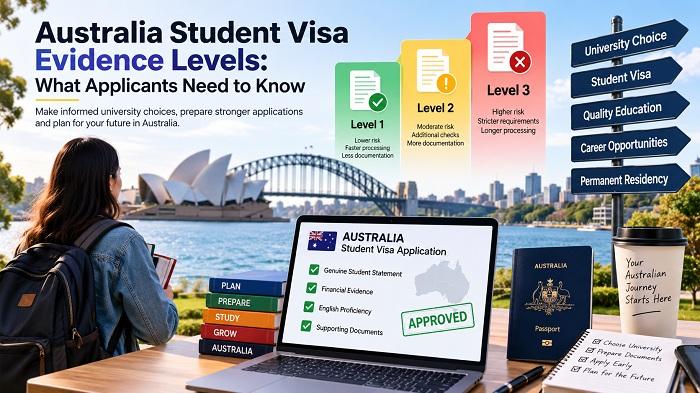
Australia’s student visa system is entering an important period of change. The September 2026 evidence level review could alter how much documentation international students need and how quickly applications move through the system. For anyone choosing an Australian university this year, visa risk should now sit alongside course quality, tuition fees and location when comparing institutions.
The issue became more pressing after student visa refusals surged in early 2026. According to the research paper, one in three student visa applications to Australian universities was refused in February, the highest monthly rate recorded in 21 years of tracking. That figure has placed greater attention on how Australia evaluates universities and international student markets.
How Australia’s Student Visa Evidence Levels Work
Australia’s Simplified Student Visa Framework assigns education providers and source countries an evidence level from 1 to 3. Level 1 represents lower perceived risk, while Level 3 represents higher risk and generally requires more supporting evidence.
The system looks closely at previous visa outcomes. Refusal results, particularly cases involving fraud or unsuccessful Genuine Student assessments, account for roughly half of an institution’s risk score. That creates a problem when refusal rates rise because of changes in the student market rather than poor practices by a particular university.
The research highlights a major shift in Australia's international student market during 2026. Chinese student demand fell by around 39% year-on-year in February. Universities responded by relying more heavily on South Asian markets, where refusal rates were substantially higher.
The reported refusal rates reached 65% for Nepal, 51% for Bangladesh, 40% for India, 38% for Sri Lanka and 36% for Bhutan. As a result, institutions can face increased scrutiny even when their own recruitment policies have not changed.
That distinction matters. A stricter evidence level does not mean a university provides a weaker education. It reflects visa outcomes associated with the institution and its applicant mix.
Why the September Review Matters to Applicants
The September 2026 review is significant because evidence levels are reassessed on a scheduled basis rather than changed constantly. Universities that previously operated under less restrictive classifications could face tougher requirements following the latest refusal data.
Industry pressure reflects these concerns. The International Education Association of Australia has called for a freeze on changes, arguing that short-term market movements should not automatically create long-term consequences for universities. Universities Australia has also called for greater transparency, including weekly refusal dashboards that could help institutions identify emerging problems before they become larger issues.
For students, a change in evidence level could mean more paperwork, longer processing times and additional administrative checks. This makes preparation more important, particularly for applicants from countries already facing higher levels of scrutiny.
A useful way to think about the process is airport security. Two passengers may carry equally valid tickets, but one may face additional screening because of the broader risk profile associated with their route. The extra screening does not mean the passenger has done anything wrong. It simply means the system wants more evidence before allowing the journey to continue.
Students should approach their visa applications in much the same way. Strong evidence cannot control the university’s classification, but it can strengthen the part of the application they can control.
What International Students Should Prepare
The strongest strategy is to prepare a clear Genuine Student case, solid financial evidence and a convincing explanation of why the selected course fits the applicant’s academic and career plans.
Students should also consider processing delays when planning an intake. If an institution moves into a stricter category after the September review, applicants may face additional documentation requirements. Applying earlier can provide useful breathing room if processing takes longer than expected.
The financial consequences also deserve attention. The research paper notes that Australia’s student visa application fee is currently AU$2,000 and is non-refundable. A refusal therefore creates more than an administrative setback. Reapplying means paying the fee again, while still facing uncertainty about the outcome.
That makes academic preparation relevant too. Students managing assignments, projects and research while dealing with visa paperwork can quickly find themselves stretched. For students who need structured help with complex coursework, Expertsmind.com’s academic support resources can provide subject-focused assistance while they manage their wider study plans.
Academic performance itself does not determine a visa evidence level, but staying organised reduces one source of pressure during an already demanding application period.
Choosing a University Beyond Its Visa Risk Level
Students should not automatically reject a university because it may have a stricter evidence classification. The research makes clear that the system measures visa-related risk rather than teaching quality, graduate outcomes or the academic value of a qualification.
This is particularly important for universities that recruit large numbers of students from markets with higher refusal rates. Their classification can reflect the profile of their international applicant pool rather than a weakness in the institution itself.
A better approach is to compare the whole picture: course relevance, career opportunities, tuition costs, location, student support and the likely documentation requirements attached to the application.
Students planning to remain in Australia after graduation should also consider how their study choice fits their longer-term plans. Understanding the broader pathway from study to residency can help applicants make more informed decisions rather than choosing a university based only on its perceived visa risk. A detailed guide on moving from a student visa to permanent residency in Australia can be useful when thinking about that longer-term pathway.
The September review also exposes a wider weakness in the current system. When a risk model reacts strongly to sudden changes in student markets, universities can be penalised for circumstances beyond their direct control. A temporary shift in applicant numbers can then affect future recruitment, which may further change the institution’s applicant mix and create a cycle that lasts beyond the original problem.
For students, however, the immediate lesson is simpler. University evidence levels may change, but the fundamentals of a strong visa application remain within the applicant’s control.
The best protection is not trying to predict which university will receive which classification. It is building an application with clear study intentions, convincing financial evidence and complete supporting documentation. When the rules move, strong evidence gives students the firmest ground to stand on.

 English
 Arabic
 French
 Spanish
 Portuguese
 Deutsch
 Dutch
Dutch
 Italiano
 Russian
 Romaian
 Portuguese (Brazil)
 Greek
Greek
