


Axe Blade to Knob: Know the Parts of Your Axe
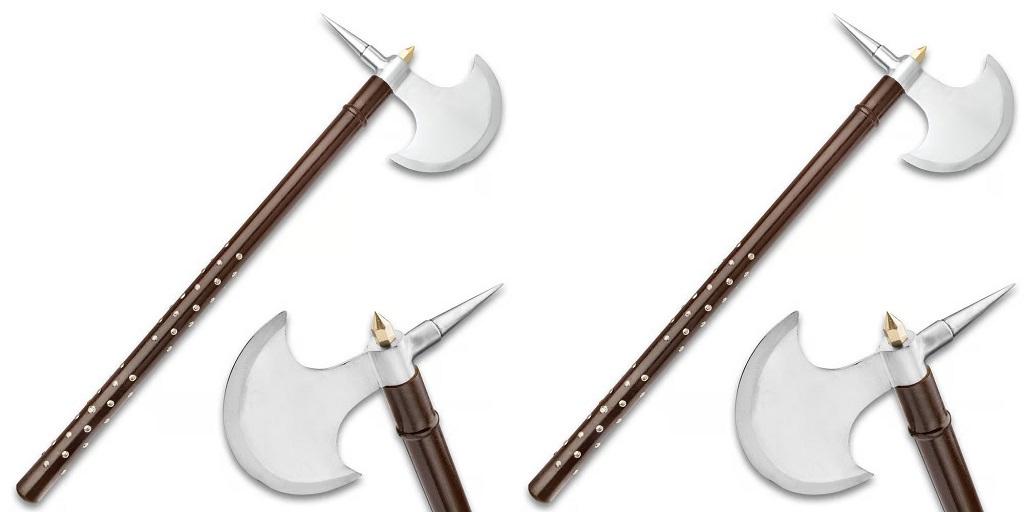
Knowing how to handle your axe safely is one thing, and it is critical to safe and effective use. But once you master that, if you really want to consider yourself a woodsman, you should learn the proper terms for the parts of your axe. You will sound more authoritative once you learn them.
- The head of an axe, broadly speaking, is the steel component that is hung on the haft or helve, which is conventionally made of wood. There are many different styles of axes, such as felling axes, hewing axes, carving axes, and splitting axes, and many patterns under there as well, such as European, Michigan, and Jersey axes.
- Axe blade (bit). Sometimes referred to as an “axe blade”, the proper term is the bit, which is the part of the head that is sharpened, and used for cutting or splitting.
- The toe of an axe’s bit is the portion nearest the top.
- The heel of an axe’s bit is the portion nearest the bottom.
- If an axe blade has an extended heel, this is actually referred to as a beard. A bearded axe can be used for hewing and squaring timbers and offers a lot of flexibility because it has a broader cutting edge. In some instances, a bearded axe gives the wielder the flexibility to choke up on the haft, with the hand under the head and directly behind the bit. Gripped in this manner, a wielder can exercise greater control over the axe.
- The cheek of an axe “blade” is the flat part on the side of the bit.
- Butt or poll. More commonly referred to as a poll, this is the portion of the head on the opposite side from the bit. The poll may be flat or it may be a spiked mattock, as in the case of a Pulaski axe. Double-bladed Michigan style axes have two bits and no poll.
- The eye of the axe is the hole through the head into which the haft is inserted and fixed.
- The haft of an axe is the handle, which is conventionally made of wood.
- The back is the side of the haft that is opposite the bit.
- The belly of the haft is the majority of the portion that is on the same side as the bit.
- The shoulder of an axe haft is right beneath the head, under the poll.
- End knob. The end knob is the end of the haft, which is typically swollen, so as to improve the user’s grip. Sometimes there is a hole through the end knob through which a lanyard can be passed to further aid control and retention.
Shop Axes and Tomahawks at True Swords
Want to learn more about the different patterns of hatchets, axes and tomahawks that are available? Visit True Swords. They carry a wide range of axes and tomahawks on their website, along with a lot of other cool battle-ready swords, weapons and tools.
For more information about Yorichi Sword and Spring Steel Katana Please visit: True Swords.

 English
 Arabic
 Spanish
 Portuguese
 Deutsch
 Turkish
 Dutch
Dutch
 Italiano
 Russian
 Romaian
 Portuguese (Brazil)
 Greek
Greek
