


Why Master Data Readiness Determines S/4HANA Transformation Confidence
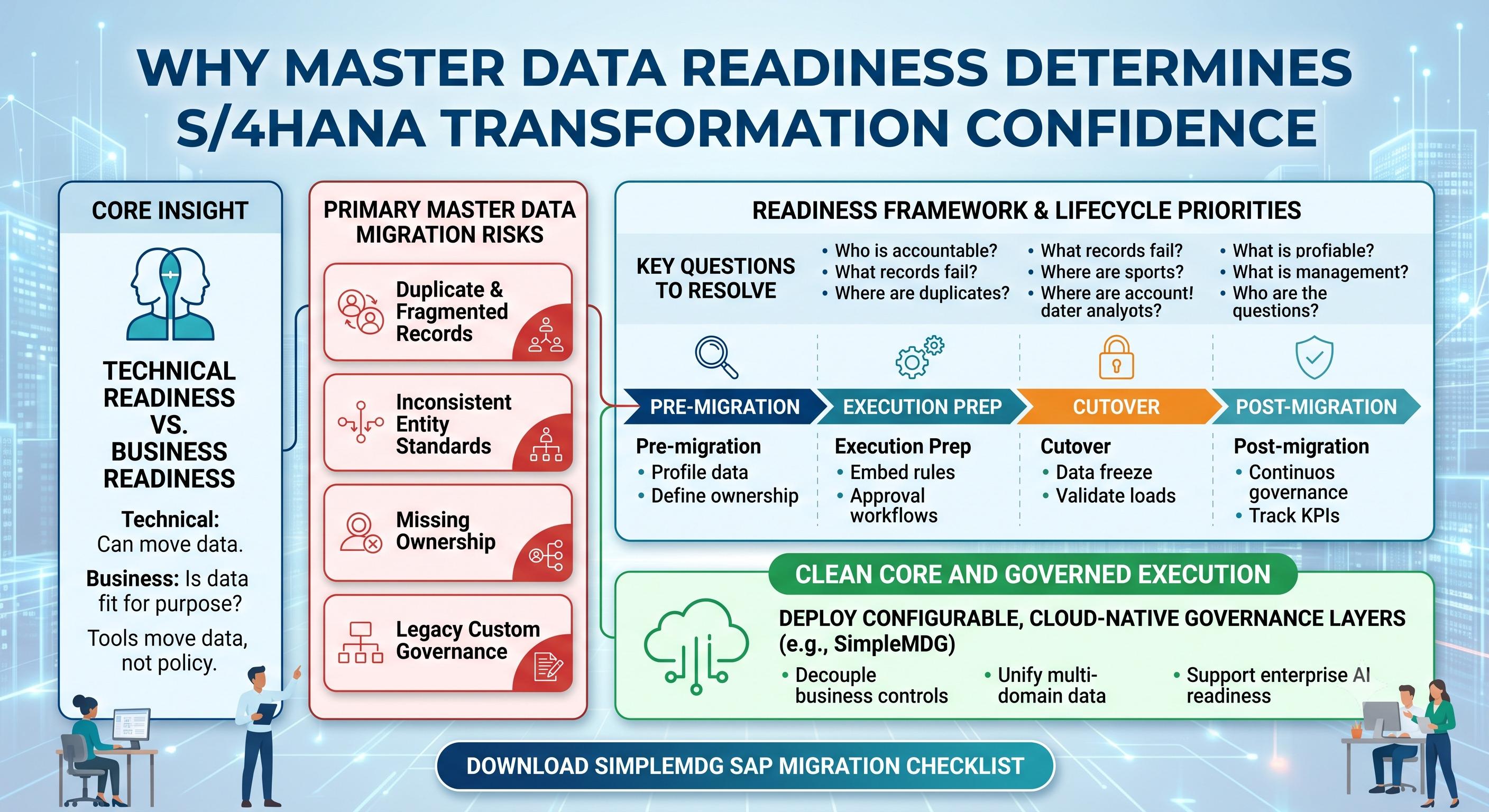
A practical guide to reducing migration risk, supporting Clean Core, and protecting post-go-live execution
|
AUDIENCE |
PRIMARY QUERY |
STATUS |
An SAP S/4HANA transformation can be technically ready and still be operationally exposed. The reason is simple: the new ERP will inherit the quality, ownership gaps, approval friction, and structural inconsistency embedded in the master data that runs the business. When those issues are discovered late, the program absorbs them as rework, testing delays, cutover risk, and post-go-live disruption.
|
Direct answer: S/4HANA master data readiness means ensuring that the customer, supplier, material, finance, asset, and other master data required by the new environment is accurate, governed, appropriately owned, and aligned to the future operating model before migration. Technical migration readiness alone does not guarantee operational readiness. |
Why S/4HANA transformation pressure is increasing
For many enterprises, the move to SAP S/4HANA is no longer a contained IT upgrade. It is the operating foundation for process standardization, cloud adoption, advanced analytics, automation, and enterprise AI. That expands the transformation’s dependency on trusted master data: business partners must be correctly represented, materials must follow consistent standards, financial structures must align, and downstream systems must receive the right record at the right time.
SAP’s own migration guidance makes master data part of the initial data required to begin operations in SAP S/4HANA Cloud. SAP also positions data unification, harmonization, information management, and governance as important components of a smooth transition. The implication is clear: master data cannot be treated as a cleanup workstream at the edge of the program. It is part of the transformation design.
Technical readiness is not the same as business readiness
A program may complete system sizing, custom-code assessment, interface planning, migration-object mapping, and rehearsal cycles, and still lack confidence that the business can operate cleanly on day one. Technical readiness asks whether data can be extracted, transformed, loaded, and reconciled. Business readiness asks whether the data is fit for the future process and can remain trustworthy after go-live.
That distinction matters because migration tools move records; they do not decide the operating model. They cannot, by themselves, resolve who owns a supplier record, which definition of a material is authoritative, whether local exceptions remain valid, or how changes should be approved across regions. Those are governance decisions, and they need to be made before the cutover window compresses every unresolved issue into a delivery risk.
Where master data creates migration risk
Duplicate and fragmented records
Multiple versions of customers, suppliers, materials, assets, or financial entities can lead to conflicting balances, incomplete relationships, duplicate transactions, and unreliable reporting. Consolidation is not just a technical match-and-merge exercise; survivorship rules and accountable business decisions are required.
Inconsistent standards across entities
Local business units often use different naming conventions, mandatory fields, hierarchies, units of measure, classifications, and approval thresholds. If the target model is not agreed early, the migration may reproduce legacy variation inside a more modern platform.
Missing ownership
When domain owners, data stewards, approvers, and process owners are unclear, exceptions accumulate and remediation stalls. A data issue without an accountable decision-maker becomes a program dependency.
Custom governance embedded in legacy processes
Years of ERP customization may have embedded validation logic, routing, and controls directly in the core. Recreating every legacy control in SAP S/4HANA can undermine simplification and Clean Core objectives. The better question is which controls are still required, and where they should operate in the future architecture.
Why Clean Core changes the governance conversation
Clean Core is not a directive to remove business control. It is a design discipline for keeping the ERP core easier to maintain, extend, and upgrade. SAP describes Clean Core as including modern extensibility and integration options as well as data governance, and notes that accurate and relevant master data belongs in the conversation.
For master data teams, this changes the architectural question from “How do we rebuild our legacy workflow in the new core?” to “How do we preserve control without recreating technical debt?” Governance should be configurable, reusable, and capable of evolving across SAP and non-SAP systems. Validation, workflow, ownership, quality monitoring, and replication need to work as a coherent operating layer, not as isolated custom developments that become expensive to change.
Migration technology moves data; governance determines whether it can be trusted
SAP migration tools play a critical role in extracting, transforming, and loading data into the target environment. But the migration mechanism does not replace the need for business ownership, approval workflows, validation standards, auditability, exception management, and continuous quality controls.
This distinction is essential. Migration technology can execute a defined mapping or load, but it does not decide whether a local exception should survive, who is authorized to approve it, how conflicting source records should be resolved, or what happens when a record fails a business rule. Migration technology moves the data; governance determines whether that data is trusted, and whether it remains trusted after go-live.
What S/4HANA master data readiness should include
A readiness assessment should connect data condition to business impact. It should cover the records being migrated, the future-state rules governing them, and the mechanisms that will keep them trusted after go-live.
|
Readiness area |
Question to resolve |
|
Ownership |
Who is accountable for each master data domain? |
|
Quality |
Which records fail defined business standards? |
|
Workflow |
How are changes requested, enriched, approved, and activated? |
|
Duplication |
Where do multiple versions of the same entity exist? |
|
Integration |
Which downstream systems consume the record, and how will govern changes reach them? |
|
Governance |
Can rules and workflows evolve without new ERP customization? |
Master data readiness must continue through the migration lifecycle
Master data readiness is not achieved at a single project milestone. Governance controls must operate from initial profiling and target-model design through migration execution, cutover, reconciliation, and post-go-live operations. Otherwise, data validated during preparation can still be changed, duplicated, incorrectly transformed, or loaded without the required controls before production begins.
|
Lifecycle phase |
Governance priority |
|
Pre-migration |
Define ownership, profile critical data, agree the future-state model, resolve duplicates, and establish the governance rules required in SAP S/4HANA. |
|
Execution preparation |
Embed validation rules, value mappings, approval workflows, quality reporting, and audit trails into migration activities and rehearsals. |
|
Cutover |
Apply a governance freeze, control delta changes, validate production loads, and reconcile critical records and cross-domain relationships. |
|
Post-migration |
Activate ongoing governance workflows, monitor quality KPIs, manage remediation through hypercare, and update governance documentation. |
The complete SimpleMDG SAP Migration Checklist translates these four phases into 14 governance-focused actions covering preparation, execution, cutover, and post-migration operations.
Turn the readiness framework into an actionable migration plan
The SimpleMDG SAP Migration Checklist translates this readiness framework into 14 governance-focused actions across pre-migration, execution preparation, cutover, and post-migration operations. Use it to assess ownership, data quality, governance controls, migration validation, reconciliation, hypercare, and continuous improvement across the transformation lifecycle.
|
Access the SimpleMDG Migration Checklist |
From readiness assessment to governed execution
The readiness phase should not end with a one-time cleansing exercise. Without a governed way to create and change master data, quality can deteriorate again between mock load, cutover, and steady-state operations. Transformation confidence comes from connecting remediation to the future governance model.
This is where SimpleMDG fits. SimpleMDG is a no-code master data governance platform built on SAP BTP and aligned with SAP’s broader Business AI strategy. It provides more than 100 preconfigured SAP and non-SAP master data types across areas including finance, materials, sales and distribution, quality, enterprise asset management, retail, human capital management, group reporting, and extended warehouse management. Reusable templates, controlled change requests, embedded rules, configurable workflows, data quality management, consolidation, and integration capabilities help enterprises move from project-based cleanup to continuous governance.
For SAP transformation programs, the value is not another disconnected data workstream. It is the ability to operationalize business-led governance across cloud and hybrid landscapes while supporting Clean Core principles and reducing the need to rebuild governance for every domain.
What stronger transformation confidence looks like
A confident SAP S/4HANA program can answer three questions before cutover: Is the master data fit for the future process? Is accountability clear when an exception appears? Can the organization keep the data trusted without returning to spreadsheets, manual fixes, or new core customization?
When the answers are yes, master data becomes more than a migration deliverable. It becomes a control layer for reliable operations, faster change, better analytics, and AI-ready execution. That is the difference between moving data into SAP S/4HANA and preparing the business to perform on it.
|
Turn master data readiness into an actionable migration plan Access the SimpleMDG Migration Checklist → Need help assessing your current governance readiness? Talk to SimpleMDG expert |
Frequently asked questions
What is master data readiness for SAP S/4HANA?
It is the state in which critical master data is accurate, governed, owned, aligned to the target operating model, and ready to support future business processes. It includes both migration fitness and the controls required to maintain quality after go-live.
Should master data be cleaned before an SAP S/4HANA migration?
Yes. Cleansing before migration reduces the risk of carrying duplicates, obsolete records, inconsistent standards, and broken relationships into the target environment. Cleansing should be guided by future-state rules and followed by ongoing governance.
How does master data governance support Clean Core?
Clean Core aims to keep SAP S/4HANA easier to maintain and upgrade. Configurable governance, validation, workflow, and integration can preserve business control while reducing the need to recreate legacy master data customizations inside the ERP core.
When should master data governance begin in an SAP S/4HANA transformation?
Governance should begin during transformation design, before cleansing and migration execution. Early governance establishes ownership, target standards, validation rules, workflows, and quality thresholds that guide preparation, cutover, and post-go-live operations.
Recommended internal links
Primary conversion link:
SimpleMDG Migration Checklist, evaluate governance across the full transformation lifecycle
For original post visit: https://blog.neardirectory.com/why-master-data-readiness-determines-s-4hana-transformation-confidence/

 English
 Arabic
 French
 Portuguese
 Deutsch
 Turkish
 Dutch
Dutch
 Italiano
 Russian
 Romaian
 Portuguese (Brazil)
 Greek
Greek
