


Governance Without Gridlock: How SAP Enterprises Balance Speed and Control
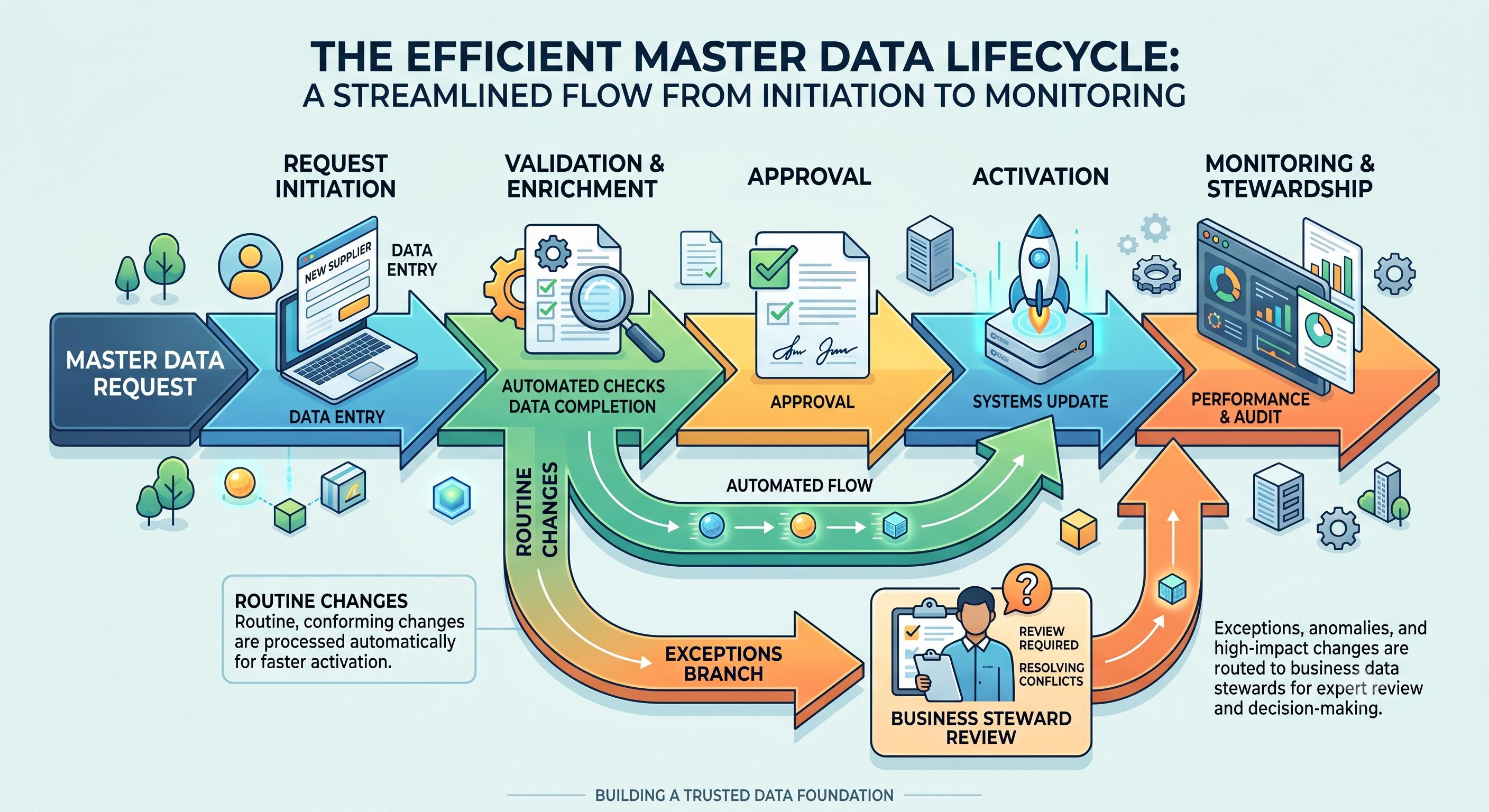
Why scalable governance replaces approval bureaucracy with clear decision rights, reusable controls, automation, and exception-led stewardship
|
AUDIENCE |
PRIMARY QUERY |
BUSINESS OUTCOME |
Data governance earns a poor reputation when every master data change becomes a committee decision, every exception waits in an inbox, and every policy adjustment requires a development cycle. Business teams experience the delay, work around the process, and conclude that governance is the reason they cannot move faster.
The real problem is not governance. It is an operating model that treats all changes as equally risky, centralizes decisions that should be delegated, and relies on manual coordination where rules and workflows could do the work.
|
Direct answer: Enterprises govern master data without slowing the business by defining clear ownership, embedding rules in the workflow, automating low-risk decisions, applying role-based access, preserving auditability, and routing only exceptions or higher-risk changes to human approvers. |
Why governance acquired a reputation for slowing the business
Many governance programmes begin with policy documents, councils, ownership charts, and control requirements. Those elements matter, but they often remain disconnected from the moment a user needs to create a supplier, extend a material, change a customer, update a hierarchy, or correct a financial record.
When the operating process is unclear, people compensate with email, spreadsheets, meetings, and informal approvals. Requests bounce between teams because required information was not captured at the start. Stewards repeat basic checks. Approvers receive changes without context. IT becomes responsible for translating business policy into custom logic. Delay is then blamed on governance, even though the delay was created by fragmented execution.
Governance is not the same as control bureaucracy
Governance defines who can decide, which standards apply, how risk is handled, and how accountability is demonstrated. Data management executes those decisions through processes, systems, and operational roles. When these responsibilities are confused, governance teams become involved in routine administration and business teams are left waiting for decisions that should already be encoded in the operating model.
Effective control does not require the maximum number of approvals. It requires the right control at the right point. A standard material extension that satisfies pre-approved rules should move differently from a change to bank details, a sensitive customer attribute, or a financial hierarchy. Treating every request identically wastes expert capacity and encourages workarounds.
Business-led governance combines authority with usability
|
SimpleMDG definition: Business-led governance is a model in which business users can operate and adapt master data rules, workflows, ownership, and approval processes without extensive dependence on IT development cycles. |
Business-led does not mean uncontrolled or disconnected from enterprise architecture. It means that policy ownership sits with the people accountable for the business domain, while the platform makes those policies executable. IT continues to govern architecture, integration, security, identity, and platform standards. The business governs definitions, quality expectations, decision rights, and operational exceptions.
This division of responsibility reduces translation cycles and keeps governance aligned with real processes. It also allows policies to evolve as products, markets, regulations, and operating structures change.
A scalable governance flow makes the standard path predictable
SAP master data governance model uses change-request processing with workflow, staging, approval, activation, and distribution. The principle is valuable beyond any specific implementation because it separates the stages of control and makes responsibility explicit.
Request
Capture the business purpose, required attributes, supporting evidence, priority, and target systems at the start.
Validate
Apply rules, duplicate checks, required-field checks, reference values, and policy thresholds before human effort is consumed.
Enrich
Route the request to the functions that own missing or domain-specific information.
Approve
Use decision rights and risk level to identify whether approval is automatic, delegated, sequential, or escalated.
Activate
Commit the approved record and make it available to the business process.
Monitor
Track quality, cycle time, exceptions, rework, policy breaches, and downstream outcomes.
Speed comes from making the standard path complete, validated, and predictable. Control comes from ensuring that deviations are visible, owned, and resolved before activation.
Six components of a scalable governance operating model
1. Ownership
Assign an accountable business owner for each domain and operational stewards for definitions, quality, and exceptions. Ownership should include decision authority, not only responsibility for reporting problems.
2. Policy
Translate broad principles into executable rules: required attributes, quality thresholds, source precedence, duplicate handling, approval limits, retention, and exception criteria. A policy that cannot guide a workflow remains advisory.
3. Workflow
Design the shortest compliant route for each change type. Collect the right information once, route in parallel where possible, use service-level targets, and escalate based on elapsed time or risk.
4. Access
Use role-based and, where appropriate, attribute-based controls to ensure users can request, enrich, approve, or activate only the data and actions required for their responsibilities. Apply segregation of duties to sensitive changes.
5. Auditability
Preserve who requested the change, what values changed, which rules ran, who approved, what evidence was used, when activation occurred, and where the record was distributed. Auditability should be generated by the process, not reconstructed later.
6. Measurement
Measure both control and flow. Data-quality scores alone are not enough. Track cycle time, first-time-right rate, rework, approval delay, exception volume, automation rate, policy breaches, and downstream incidents.
Automation should remove repetition, not accountability
Automation is most effective where the rule is stable, the input is structured, the consequence is bounded, and the outcome can be monitored. It should not be used to conceal unclear ownership or automate a disputed policy.
|
Good candidates for automation |
Keep explicit human judgment |
|
Required field and format validation |
Conflicting definitions or source records |
|
Reference-value and policy checks |
High-impact financial or bank changes |
|
Duplicate candidate identification |
Regulatory or policy exceptions |
|
Low-risk enrichment and derivation |
Low-confidence match and merge decisions |
|
Routing, reminders, and escalation |
Changes with irreversible downstream impact |
|
Approved mass changes within thresholds |
New scenarios without an approved control model |
Exception-led stewardship is the key to scale
The objective is not to remove data stewards. It is to focus them where judgment creates value. When routine requests arrive complete and pass standard controls automatically, stewards can concentrate on ambiguous matches, policy conflicts, cross-domain dependencies, systemic quality issues, and changes with material business impact.
This model also improves the user experience. Requestors receive immediate guidance instead of late-stage rejection. Approvers see the business context and risk indicators that matter. Owners receive evidence about where policies are creating unnecessary friction or failing to prevent defects.
Governance becomes an execution accelerator when it prevents rework
The fastest master data process is not the one with the fewest controls. It is the one that produces a usable record without repeated clarification, correction, and downstream repair. Early validation, clear ownership, reusable templates, and automated routing reduce the hidden work that makes apparently lightweight processes slow.
SAP documents central governance capabilities that include predefined roles and workflows, change-request processing, validation during the workflow, mass processing, service-level reporting, and process analytics. These capabilities demonstrate that governance and throughput are not opposing objectives. The operating model can be designed to improve both.
How SimpleMDG operationalizes business-led governance
SimpleMDG provides a no-code governance platform built on SAP BAIP and aligned with SAP’s broader Business AI strategy. It offers more than 100 preconfigured SAP and non-SAP master data types across enterprise domains, allowing organizations to deploy reusable governance patterns without rebuilding every process from the ground up.
Business teams can configure templates, field requirements, rules, conditions, roles, and approval workflows within a controlled framework. Change requests support creation, enrichment, approval, rework, scheduling, activation, and auditability. Data quality management, duplicate identification, mass processing, golden-record capabilities, dashboards, and integration help connect governance decisions to operational execution across SAP and non-SAP landscapes.
The value is not simply fewer approval steps. It is a governance model that can be operated by the business, monitored with evidence, changed without excessive custom development, and scaled across domains while maintaining enterprise controls.
The right governance model increases both speed and trust
Governance should make the compliant path easier than the workaround. When ownership is clear, policy is executable, workflows are proportionate to risk, and routine controls are automated, the business moves faster because fewer requests fail, fewer decisions wait for clarification, and fewer defects escape downstream.
That is governance without gridlock: not less accountability, but less ambiguity, less repetition, and less preventable rework.
|
Move from approval bureaucracy to business-led governance |
Questions leaders ask about business-led governance
What is business-led data governance?
Business-led governance gives accountable business users the authority and tools to operate and adapt master data definitions, rules, workflows, ownership, and approvals without extensive dependence on IT development. IT continues to govern architecture, integration, security, identity, and platform standards.
Who should own enterprise master data?
Business domain owners should be accountable for definitions, quality standards, decision rights, and exceptions. Data stewards manage operational quality and coordinate remediation. IT enables the platform, integration, security, and technical controls but should not own every business data decision.
How do approval workflows improve governance?
A well-designed workflow captures required information, applies validation early, routes work to the right owner, enforces segregation of duties, records decisions, and activates only approved data. It improves speed by reducing clarification, rework, and unnecessary manual handoffs.
How can governance accelerate business processes?
Governance accelerates execution when standard requests follow reusable templates and automated rules while only exceptions or higher-risk changes require specialist review. This improves first-time-right performance, reduces downstream correction, and gives business users a predictable path to approved data.
AEO queries answered
· How do enterprises govern data without slowing the business?
· What is business-led data governance?
· Who should approve master data changes?
· How do SAP enterprises maintain data auditability?
· Where should governance workflows use automation?
Research sources and editorial notes
· SAP Learning: Introducing SAP Master Data Governance
· SAP Learning: Introducing Central Governance of Master Data
· SAP Help: Master Data Governance, Classic Mode
· SAP Learning: Process Analytics Overview and Details
· SAP Learning: Master Data Governance for Material
· SAP BTP Center of Expertise Guide: Self-Service with Guardrails
· NIST SP 800-53 Rev. 5: Security and Privacy Controls
For original post visit: https://cityusnews.com/business-led-data-governance-sap/

 English
 Arabic
 French
 Spanish
 Portuguese
 Deutsch
 Turkish
 Dutch
Dutch
 Italiano
 Russian
 Portuguese (Brazil)
 Greek
Greek
