


What Should Enterprises Look for in a Multi-Country Payroll Platform?
Managing payroll across multiple countries is rarely as simple as processing employee salaries on a recurring schedule. For organizations operating throughout Europe, the Middle East, and Africa, payroll teams must navigate different tax structures, employment regulations, currencies, reporting requirements, compliance obligations, and workforce policies.
As businesses expand across borders, these complexities can quickly turn payroll into a fragmented and resource-intensive operation. This is creating stronger demand for Multi Country Payroll Platform solutions that can centralize payroll management while supporting country-specific requirements.
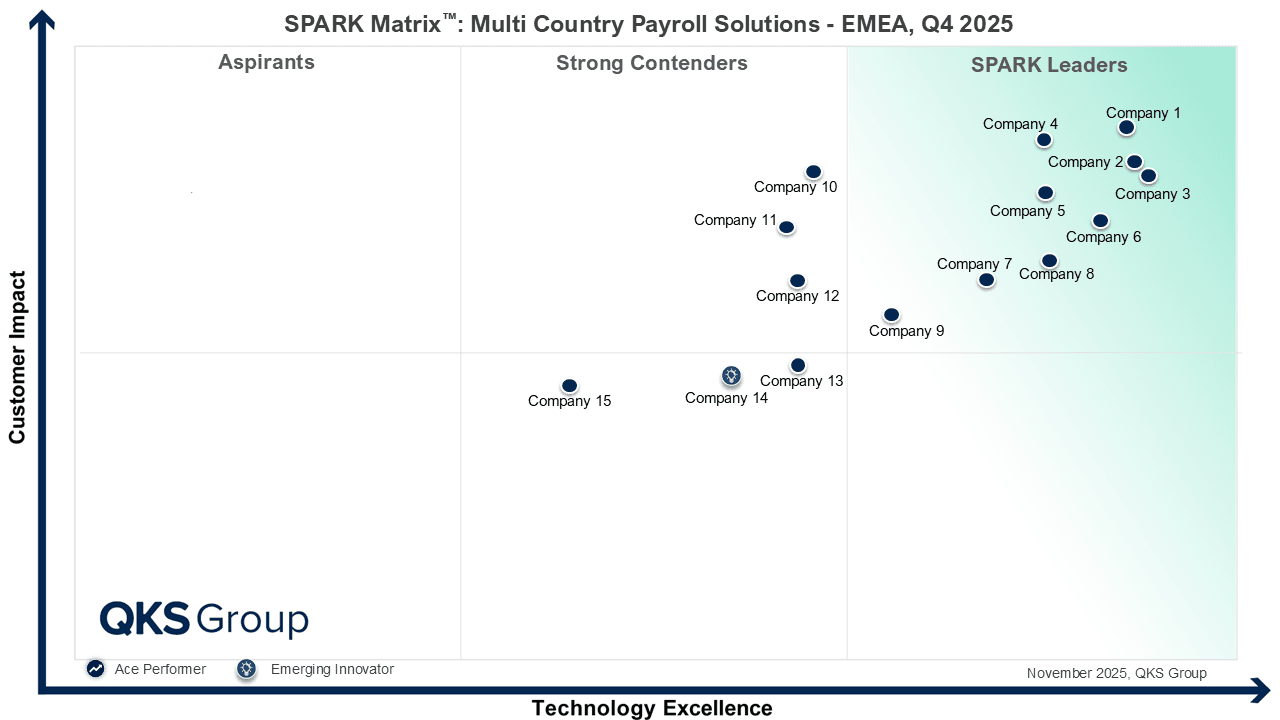
QKS Group’s SPARK Matrix™: Multi Country Payroll platform for EMEA market, Q4 2025 provides an analysis of market trends, emerging technology trends, future outlook, competitive dynamics, and vendor capabilities. The research also evaluates leading vendors through QKS Group’s proprietary SPARK Matrix framework.
Download Sample Report Here: https://qksgroup.com/download-sample-form/spark-matrix-multi-country-payroll-platform-for-emea-market-q4-2025-10246
Why Is EMEA Payroll So Complex?
The EMEA region includes a wide range of countries, each with its own payroll regulations and administrative requirements. A process that works efficiently in one country may require significant adjustments in another.
For multinational organizations, managing these differences through disconnected local payroll systems can create several challenges. Payroll data may be spread across multiple applications, reporting can become inconsistent, and HR and finance teams may struggle to obtain a unified view of workforce costs.
Manual processes can further increase the possibility of errors. Even small inaccuracies in employee information, taxation, deductions, or payments can create administrative complications and negatively affect employee trust.
A centralized payroll platform can address these challenges by creating a more consistent operating model across countries while maintaining the flexibility needed for local requirements.
How Can Payroll Platforms Simplify Global Operations?
Modern multi-country payroll platforms are designed to bring payroll processes together within a unified technology environment. Instead of managing every country through completely separate workflows, organizations can centralize key payroll activities and gain greater visibility into their international workforce.
Important capabilities can include payroll processing, compliance management, tax handling, currency conversion, reporting, and integration with HR and finance systems.
This centralized approach can reduce administrative complexity and help payroll teams operate more efficiently. It can also provide business leaders with better visibility into workforce-related costs across different markets.
Can Automation Reduce Payroll Workloads?
Payroll teams spend considerable time on repetitive activities such as data validation, calculations, reporting, employee updates, and reconciliation. Automation can help reduce the amount of manual work required to complete these processes.
By connecting payroll with HR systems and other enterprise applications, organizations can improve the flow of employee information and reduce the need for duplicate data entry.
Automation can also support standardized workflows, helping payroll teams manage recurring processes more consistently. For enterprises with employees distributed across multiple EMEA countries, these efficiencies can become increasingly valuable as the workforce expands.
What Role Does Compliance Play?
Compliance is one of the most important considerations when evaluating a multi-country payroll solution.
Payroll operations must account for country-specific tax rules, labor regulations, statutory requirements, and reporting obligations. Keeping up with changing requirements manually can place a significant burden on payroll and HR teams.
A modern platform can help organizations establish structured processes for managing local payroll requirements. The objective is not simply to automate payroll calculations but to create a more reliable and controlled payroll environment.
This makes compliance capabilities an important differentiator when enterprises evaluate competing solutions.
How Does Technology Improve Employee Experience?
Payroll technology also has a direct impact on employees. Employees expect accurate and timely salary payments, accessible payroll information, and clear communication about compensation and deductions.
A centralized payroll environment can help organizations provide a more consistent experience across their international workforce. Self-service capabilities can further reduce dependency on HR teams for routine payroll-related questions and requests.
For multinational organizations, delivering this consistency across countries can strengthen employee confidence while reducing the administrative workload for HR teams.
Check SPARK Plus Study Here: https://qksgroup.com/sparkplus
Where Do AI and Advanced Analytics Fit In?
The evolution of payroll technology is increasingly connected to artificial intelligence, automation, analytics, and cloud-based platforms.
AI-enabled capabilities can help identify anomalies, automate repetitive tasks, and support more intelligent payroll operations. Advanced analytics can help organizations examine workforce costs, identify trends, and generate insights for HR and finance leaders.
Cloud-based deployment can also support centralized access and scalability, making it easier for organizations to manage payroll operations as they enter new markets or expand their workforce.
The combination of automation and analytics is gradually moving payroll from a transactional function toward a more strategic component of workforce management.
Who Are the Key Vendors in the EMEA Landscape?
The competitive landscape for multi-country payroll platforms includes established payroll providers as well as newer technology companies offering global workforce capabilities.
QKS Group’s Q4 2025 EMEA SPARK Matrix includes activpayroll, ADP, CloudPay, Deel, Mercans, Neeyamo, Papaya Global, Ramco Systems, Remote, Safeguard Global, SD Worx, Sopra HR, Strada, UKG, and Zalaris.
The SPARK Matrix provides a structured approach to understanding vendor positioning and competitive differentiation. QKS Group describes SPARK Matrix as an evaluation framework centered on Technology Excellence and Customer Impact, helping decision-makers compare technology providers more strategically.
What Should Enterprises Consider Before Selecting a Platform?
Choosing the right payroll platform requires more than comparing feature lists. Enterprises should consider their geographic footprint, workforce size, existing HR technology, integration requirements, compliance needs, payroll operating model, reporting expectations, and future expansion plans.
Key evaluation areas can include:
- Multi-country payroll processing capabilities
- Local compliance support
- Tax and statutory management
- Currency and payment capabilities
- HR and finance system integration
- Automation and workflow management
- Reporting and analytics
- Scalability across countries
- Employee self-service
- Vendor support and implementation capabilities
A structured evaluation can help organizations identify the solution that best fits their operational requirements.
The Future of Multi-Country Payroll in EMEA
The future of payroll is moving toward greater automation, integration, visibility, and intelligence. As enterprises continue to operate across borders, fragmented payroll processes can become increasingly difficult to maintain.
Multi-country payroll platforms can provide the foundation for a more centralized and connected payroll strategy. By combining automation, compliance management, analytics, integrations, and employee-facing capabilities, these platforms can help organizations simplify international payroll administration while improving operational visibility.
QKS Group’s EMEA-focused SPARK Matrix offers a strategic view of the competitive landscape and evaluates leading vendors to help technology users better understand available capabilities and differentiation.
Click Here For More Information: https://qksgroup.com/market-research/spark-matrix-multi-country-payroll-platform-for-emea-market-q4-2025-10246
Conclusion
For organizations managing employees across EMEA, payroll is becoming a technology and strategic priority rather than simply an administrative process. A modern multi-country payroll platform can help address regulatory complexity, reduce manual workloads, improve visibility, and create a more consistent payroll experience.
As global workforce models continue to evolve, enterprises that invest in scalable and integrated payroll technology can position their HR and finance operations for greater efficiency and resilience.
The QKS Group SPARK Matrix™: Multi Country Payroll platform for EMEA market, Q4 2025 provides a valuable framework for understanding vendor capabilities and competitive positioning, supporting organizations as they evaluate technologies for their international payroll requirements.

 English
 Arabic
 French
 Portuguese
 Deutsch
 Turkish
 Dutch
Dutch
 Italiano
 Russian
 Romaian
 Portuguese (Brazil)
 Greek
Greek
