


Japan Infrastructure Construction Market to Reach USD 280.4 Billion by 2035
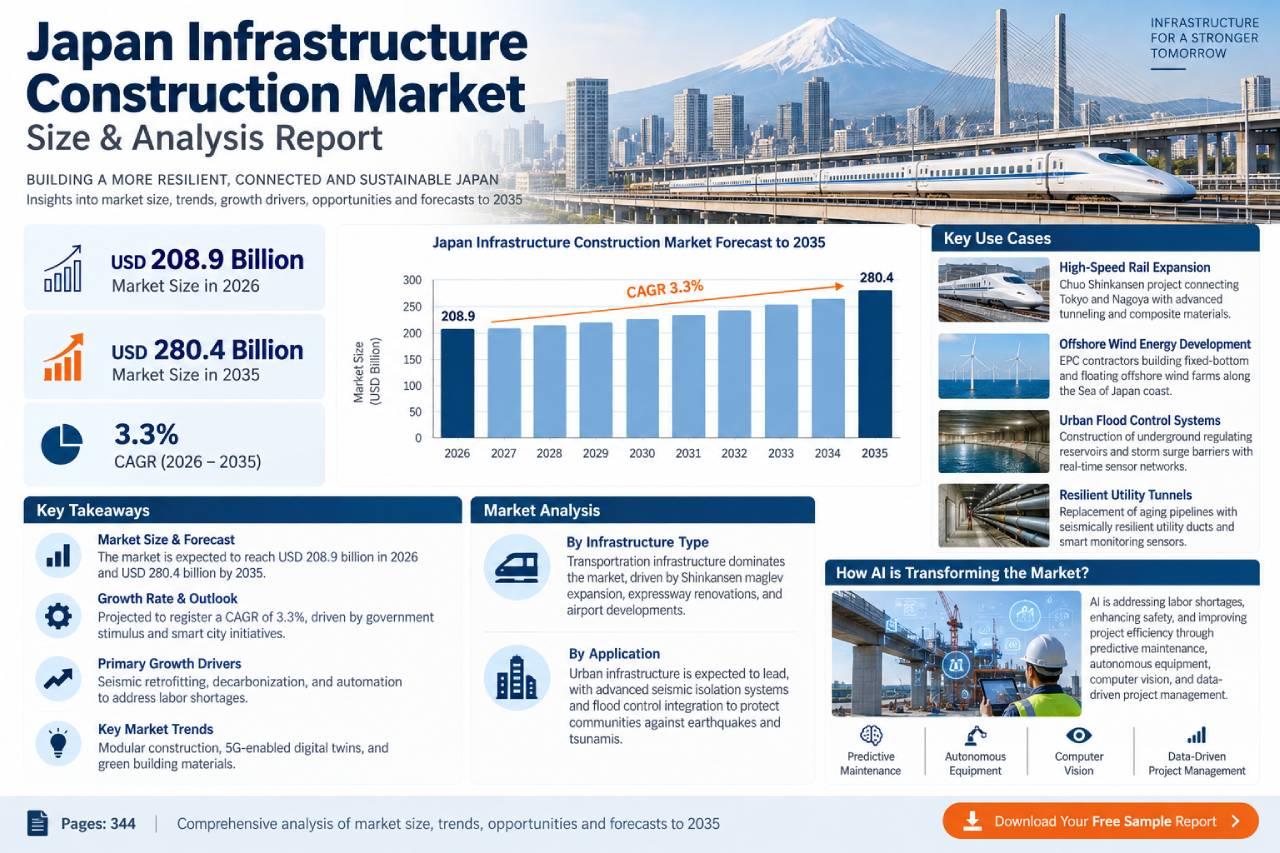
Japan Infrastructure Construction Market to Reach USD 280.4 Billion by 2035
According to Dimension Market Research, the Japan Infrastructure Construction Market is projected to reach USD 208.9 billion in 2026 and is expected to rise to USD 280.4 billion by 2035, registering a 3.3% CAGR during the forecast period. The market is being supported by infrastructure modernization, seismic resilience programs, urban redevelopment, renewable energy investment, and the replacement of aging public assets.
Japan's infrastructure construction industry is entering a period of steady transformation as government agencies and private companies increase spending on transportation, energy, water, telecommunications, social infrastructure, and smart city projects. Japan's exposure to earthquakes, typhoons, flooding, and other natural hazards is also increasing demand for resilient construction technologies, seismic retrofitting, flood-control systems, and durable materials.
Japan Infrastructure Construction Market Key Highlights
- Market value: USD 208.9 billion expected in 2026
- Projected value: USD 280.4 billion by 2035
- CAGR: 3.3% during the forecast period
- Leading infrastructure type: Transportation infrastructure
- Leading construction type: Maintenance and repair
- Leading material: Concrete
- Leading application: Urban infrastructure
- Major end user: Government and public sector
- Major trend: AI, BIM, robotics, and digital construction
- Major opportunity: Renewable energy and smart cities
Get sample overview of the report data - https://dimensionmarketresearch.com/request-sample/japan-infrastructure-construction-market/
What Is Driving the Japan Infrastructure Construction Market?
Government investment in infrastructure modernization remains one of the strongest growth drivers. Japan continues to upgrade highways, railways, bridges, tunnels, airports, ports, water systems, and public facilities. Infrastructure renewal is particularly important because many assets were developed during the country's post-war economic expansion and now require maintenance, refurbishment, seismic reinforcement, or replacement.
Disaster resilience is another major market catalyst. Japan's exposure to earthquakes and climate-related events creates continuous demand for seismic-resistant buildings, resilient transport corridors, underground flood-control reservoirs, coastal protection systems, and reinforced utility networks. These requirements are encouraging contractors to adopt high-performance concrete, advanced steel, seismic isolation systems, and digital monitoring technologies.
The market is also benefiting from urban redevelopment. Metropolitan areas including Tokyo, Osaka, and Nagoya are investing in transportation networks, utilities, smart city infrastructure, telecommunications, and sustainable public facilities. At the same time, renewable energy projects such as offshore wind, solar power, battery storage, hydrogen infrastructure, and electricity transmission upgrades are opening new opportunities for construction and EPC companies.
Transportation Infrastructure Leads Market Development
Transportation infrastructure is expected to maintain its leading position in Japan's infrastructure construction market. Continuous modernization of railways, highways, airports, bridges, tunnels, and logistics corridors requires substantial investment.
High-speed rail development, expressway renovation, metropolitan transit upgrades, airport expansion, and logistics infrastructure are supporting construction activity. Japan's emphasis on resilient transportation networks further increases spending on maintenance, seismic reinforcement, and asset modernization.
Maintenance and repair is also expected to dominate by construction type. Aging roads, tunnels, bridges, railways, dams, ports, and public facilities require continuous inspection and rehabilitation. Preventive maintenance and digital asset monitoring are becoming increasingly important for extending infrastructure lifecycles.
AI and Digital Technology Transform Construction
Artificial intelligence is becoming an important technology across Japan's infrastructure construction sector. AI-driven design tools can evaluate seismic conditions, soil characteristics, and structural requirements to support safer and more efficient designs.
Computer vision, drones, BIM, digital twins, IoT sensors, and automated equipment are also improving project management. AI-powered scheduling can help contractors respond to weather conditions and supply chain disruptions, while predictive maintenance systems can identify potential infrastructure failures before they become critical.
These technologies are particularly valuable as Japan faces a shortage of skilled construction workers. Automation and robotics can improve productivity while reducing dependence on manual processes.
Sustainable Infrastructure Creates New Opportunities
Japan's carbon-neutrality objectives are creating opportunities across renewable energy and green infrastructure. Offshore wind farms, solar facilities, battery storage, hydrogen infrastructure, smart grids, and transmission networks require extensive construction and engineering capabilities.
The adoption of low-carbon concrete, energy-efficient designs, recycled materials, and environmentally responsible construction practices is also increasing. Sustainability is therefore becoming a core consideration in infrastructure planning, procurement, and asset management.
Japan Infrastructure Construction Market Competitive Landscape
The competitive landscape is led by major Japanese general contractors with extensive engineering capabilities, project experience, and seismic technology expertise. Leading companies include Obayashi Corporation, Kajima Corporation, Shimizu Corporation, Taisei Corporation, and Takenaka Corporation.
Other prominent participants include Maeda Corporation, Penta-Ocean Construction, Toda Corporation, Kumagai Gumi, Nishimatsu Construction, Tokyu Construction, Hazama Ando, Fujita Corporation, Sumitomo Mitsui Construction, JGC Holdings, Nippon Koei, Mitsubishi Heavy Industries, and IHI Corporation.
Competition is increasingly centered on technological innovation, automation, sustainable construction, tunneling expertise, seismic engineering, renewable energy capabilities, and digital infrastructure integration.
Recent Developments
- January 2026: Toda Corporation and energy partners began commercial operations at Japan's first floating offshore wind farm in Goto City.
- February 2026: Obayashi Corporation demonstrated a hydrogen fuel-cell-powered hydraulic excavator for zero-emission construction.
- April 2026: Japan accelerated infrastructure investment covering renewable energy, transportation, and semiconductor manufacturing projects.
FAQs
What is the Japan Infrastructure Construction Market size?
The market is expected to reach USD 208.9 billion in 2026.
What will the Japan Infrastructure Construction Market be worth by 2035?
The market is projected to reach USD 280.4 billion by 2035.
What is the CAGR of Japan's infrastructure construction market?
The market is forecast to expand at a 3.3% CAGR during the forecast period.
Which infrastructure segment leads Japan?
Transportation infrastructure is expected to hold the leading position.
Which construction type dominates Japan's market?
Maintenance and repair is projected to remain the leading construction type.
What material is most widely used?
Concrete is expected to dominate because of its durability and seismic performance.
What is the leading application segment?
Urban infrastructure is projected to be the leading application segment.
Who is the largest end user?
The government and public sector is expected to account for the largest share of infrastructure construction spending.
How is AI changing infrastructure construction in Japan?
AI improves design, scheduling, quality inspection, predictive maintenance, and construction productivity.
What are the major opportunities in Japan's infrastructure market?
Smart cities, digital infrastructure, offshore wind, renewable energy, resilient utilities, and low-carbon construction offer significant opportunities.
Similar reports:
- Modular Construction Market
- KSA Construction Technology (ConTech) Market
- Japan Construction Technology (ConTech) Market
About Us
Dimension Market Research (DMR) is a global market intelligence and consulting firm delivering data-driven insights that help organizations make informed strategic decisions. With expertise across 12+ industries and global markets, DMR provides syndicated reports, custom research, competitive analysis, white space analysis, and business strategy consulting.
Our research solutions combine analytical rigor, industry expertise, and forward-looking intelligence to identify opportunities, reduce risks, and support sustainable growth. Trusted by clients across diverse sectors, DMR is committed to delivering accurate, actionable insights that enable businesses to navigate evolving market landscapes with confidence.
Contact Us
Phone USA: +17323699777
Phone India: +919310023843
E-mail: enquiry@dimensionmarketresearch.com
Address USA: 957 Route 33, Suite 12 #308, Hamilton Square, NJ-08690
Address India: D44, Sector 6, Noida 201301, India

 English
 French
 Spanish
 Portuguese
 Deutsch
 Turkish
 Dutch
Dutch
 Italiano
 Russian
 Romaian
 Portuguese (Brazil)
 Greek
Greek
