


Dental Billing RCM in the USA: Practical Strategies for a Healthier Dental Revenue Cycle
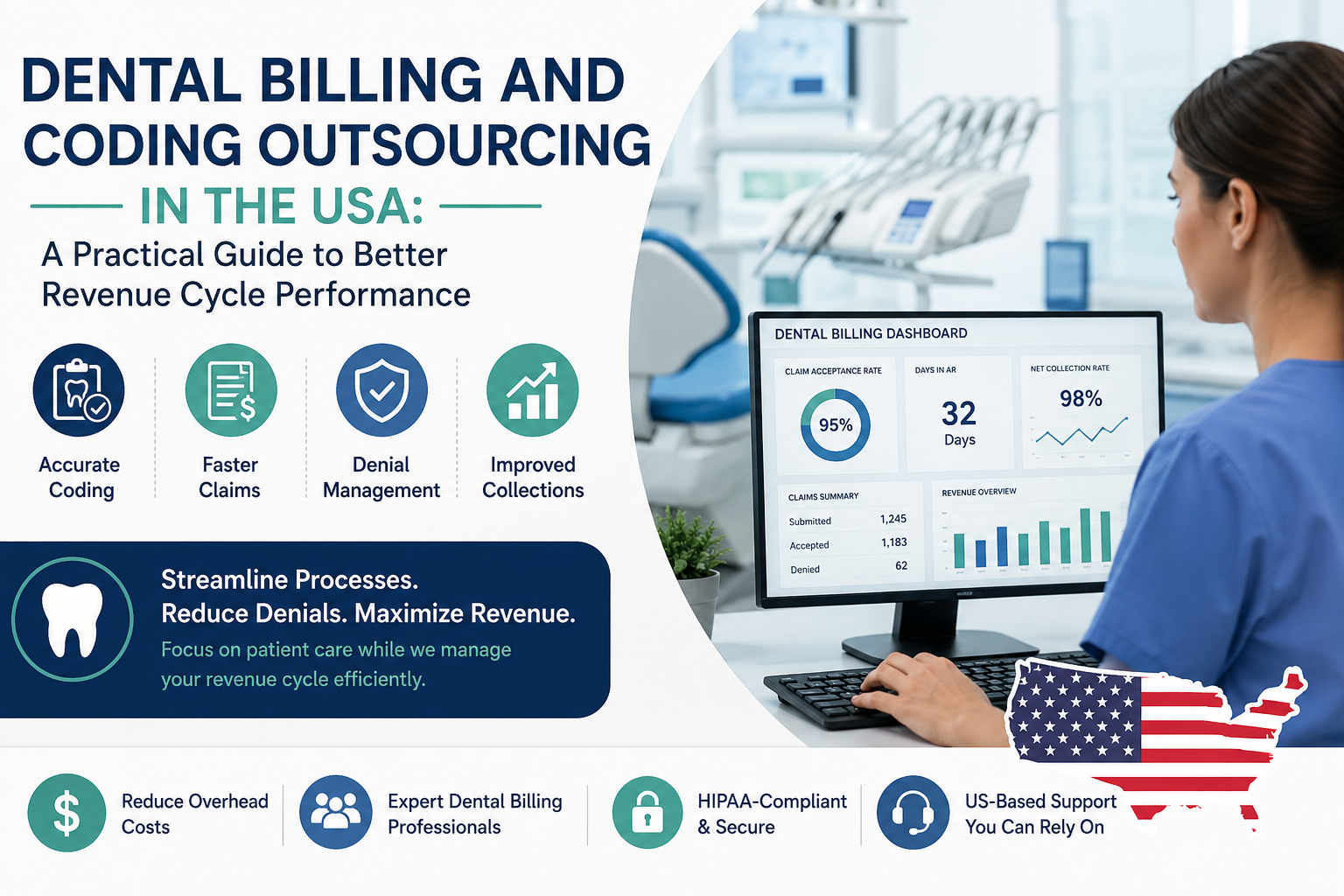
Running a dental practice involves much more than providing excellent patient care. Behind every completed procedure is a chain of administrative and financial activities that determine whether the practice gets paid correctly and on time. Insurance verification, claim submission, coding, payment posting, denial follow-up, patient billing, and accounts receivable all influence financial performance.
This is where dental billing RCM becomes important. A well-managed revenue cycle connects clinical documentation with accurate billing and timely reimbursement. When even one part of the process breaks down, a practice can experience delayed payments, rejected claims, growing accounts receivable, and unnecessary administrative work.
For many dental practices in the USA, managing these responsibilities internally can become difficult as patient volumes increase and payer requirements become more complicated. Dental billing companies and specialized dental billing providers can help practices organize these processes while allowing dental teams to concentrate more on patient care.
What Is Dental Billing RCM?
Dental billing RCM refers to the financial process that begins when a patient schedules an appointment and continues through insurance verification, treatment, claim submission, payment collection, and account reconciliation.
It is not simply the process of sending dental claims to insurance companies. Effective RCM looks at the entire financial journey of a patient encounter.
A typical dental revenue cycle may include:
- Patient registration and demographic verification
- Insurance eligibility verification
- Benefit and coverage checks
- Preauthorization when required
- Accurate procedure and diagnosis coding
- Claim preparation and submission
- Claim status monitoring
- Denial management
- Insurance payment posting
- Patient balance billing
- Accounts receivable follow-up
- Payment reconciliation
- Financial reporting
The objective is straightforward: reduce avoidable revenue loss while making the payment process easier for both the practice and the patient.
Why Dental Practices Struggle With Revenue Cycle Management
Dental practices frequently deal with a combination of insurance rules, coding requirements, patient balances, and administrative responsibilities. These challenges can become more visible when a practice expands or adds new providers.
One common problem is incomplete insurance verification. A patient may believe a procedure is covered, while the actual benefits have limitations, exclusions, deductibles, or frequency restrictions. If these details are not identified before treatment, the practice may later have difficulty collecting the expected amount.
Claim errors create another problem. Incorrect patient information, missing documentation, inaccurate procedure codes, or payer-specific requirements can result in rejected or delayed claims.
There is also the issue of unpaid accounts. A practice may have thousands of dollars sitting in accounts receivable without immediately realizing how much of that balance is recoverable.
This is why dental billing RCM needs to be treated as an ongoing operational process rather than an isolated billing task.
The Key Stages of a Strong Dental Billing RCM Process
1. Patient Registration and Insurance Verification
The revenue cycle begins before treatment takes place.
Accurate patient demographics and insurance information should be collected and reviewed during registration. Verification can help identify whether the patient's policy is active and what benefits may apply to the planned treatment.
A thorough verification process can review areas such as:
- Eligibility status
- Deductible
- Annual maximum
- Copayment or coinsurance
- Waiting periods
- Frequency limitations
- Covered procedures
- Exclusions
- Prior authorization requirements
Identifying these details early can reduce surprises later in the billing process.
2. Accurate Dental Coding and Documentation
Coding plays a central role in reimbursement. The services documented by the dental provider must support the codes reported on the claim.
Errors can occur when procedures are coded incorrectly, documentation does not support the billed service, or required information is missing.
This is one reason practices often evaluate specialized dental billing providers. Experienced teams can review claims before submission and identify potential issues that could lead to unnecessary delays.
Although dental billing has its own coding requirements, some organizations also use broader medical coding services when dental practices provide services that involve medical insurance billing.
3. Clean Claim Submission
A clean claim has a much better chance of moving through the payer's process without unnecessary interruption.
Before submission, billing teams should review patient information, provider details, procedure codes, supporting documentation, insurance information, and other required fields.
Instead of waiting for a rejection to reveal an error, an effective RCM process attempts to identify problems before the claim reaches the payer.
This proactive approach can reduce rework and help staff spend less time correcting preventable mistakes.
Denial Management: Finding the Reason Behind Lost Revenue
Not every unpaid claim is simply a billing delay. Denials can occur for many different reasons.
For example, a claim may be denied because of:
- Eligibility problems
- Incorrect patient information
- Missing documentation
- Coding issues
- Benefit limitations
- Frequency restrictions
- Prior authorization requirements
- Timely filing issues
- Coordination-of-benefits problems
The important step is not only correcting individual claims but identifying recurring patterns.
Suppose a dental practice notices that several claims are being denied because eligibility information was outdated. Reworking every claim individually may recover some money, but improving the verification process can prevent similar problems from happening again.
That distinction separates basic claim follow-up from effective revenue cycle management.
Accounts Receivable Needs Continuous Attention
Accounts receivable can quietly become one of the biggest financial challenges for a dental practice.
A growing A/R balance does not always mean the practice is performing poorly. Some balances may be relatively new, while others may be significantly aged and increasingly difficult to collect.
An organized A/R process segments outstanding balances according to factors such as:
- Insurance versus patient responsibility
- Age of the account
- Payer
- Provider
- Procedure type
- Denial reason
- Outstanding balance
This makes it easier to prioritize follow-up.
For example, an account that has been pending with an insurance company for several weeks may require a different action from a patient balance that has already received multiple statements.
How Dental Billing Companies Support Practices
Many practices work with dental billing companies when internal teams do not have enough time or specialized expertise to manage the complete billing cycle.
A dental billing company may support several stages of the revenue cycle, including claim preparation, submission, payment posting, denial follow-up, and A/R management.
The right partner should not simply measure the number of claims submitted. Practices should also consider whether the billing process provides useful information about why claims are delayed or denied.
Good reporting can help practice owners understand questions such as:
- Where is revenue being delayed?
- Which claims are repeatedly rejected?
- Which payers require additional follow-up?
- How much A/R is aging?
- Are patient balances increasing?
- Which procedures generate frequent billing problems?
These insights can help management make better operational decisions.
Choosing Among Dental Billing Companies in the USA
There are many dental billing companies in USA markets, but practices should avoid choosing a provider based solely on price.
A potential billing partner should understand dental workflows and be able to explain how its process handles claims, denials, payment posting, A/R, and reporting.
Before selecting a provider, practices can ask:
Does the company understand dental billing?
A provider should have experience with dental claims, insurance workflows, procedure coding, documentation requirements, and common reimbursement challenges.
How are denials handled?
Ask whether the company tracks denial reasons and uses that information to reduce repeat problems.
What reporting is provided?
Regular reports should make financial performance easier to understand rather than simply providing large amounts of raw data.
How is patient billing handled?
Patient communication should remain professional and consistent with the practice's standards.
Can the service scale?
A billing process that works for one location may need to change when a practice adds providers, locations, or specialties.
What Dental Billing Company Services May Include
The scope of dental billing company services varies by provider. Some companies focus primarily on claims, while others offer broader RCM support.
Depending on the arrangement, services may include:
- Insurance eligibility verification
- Dental claim submission
- Claim tracking
- Rejected claim correction
- Denial management
- Payment posting
- A/R follow-up
- Patient billing support
- Insurance follow-up
- Financial reporting
- Credentialing support
- Revenue cycle analysis
Practices should define which responsibilities remain internal and which will be handled externally before beginning a partnership.
Dental Billing RCM and the Patient Experience
Revenue cycle management is often viewed as a back-office function, but it can directly affect patients.
Patients can become frustrated when they receive unexpected bills or cannot understand why insurance did not pay for a procedure.
Better eligibility verification and clearer financial communication can help patients understand their expected responsibility before or shortly after treatment.
This does not mean every insurance outcome can be predicted perfectly. Instead, the goal is to provide patients with accurate information based on the benefits available at the time of verification.
A smoother financial experience can also reduce the amount of time front-desk employees spend answering repetitive billing questions.
When Outsourcing Makes Sense
Not every practice needs to outsource its entire billing operation.
A smaller practice with experienced internal staff may successfully manage billing in-house. However, outsourcing can become worth considering when staff members are spending excessive time on claims and follow-up instead of patient-facing responsibilities.
It may also make sense when:
- A/R continues to increase
- Claims are frequently rejected
- Denials are not analyzed consistently
- Billing staff turnover affects collections
- Reporting is limited
- The practice is expanding
- Administrative workload is increasing
Some practices choose a hybrid model, keeping patient-facing financial activities in-house while outsourcing specialized billing and A/R functions.
The Role of Broader Healthcare Revenue Cycle Services
Dental practices may also work with organizations that provide broader healthcare financial support. Depending on the organization's structure and services, this can include medical billing services, medical coding services, and medical billing and coding services for eligible healthcare-related workflows.
Similarly, revenue cycle management services may cover areas such as claims processing, payment posting, denial management, and accounts receivable follow-up.
For practices or healthcare organizations that need provider enrollment and payer participation support, credentialing services can also become an important part of the administrative workflow.
The key is matching the service to the practice's actual requirements rather than paying for unnecessary administrative functions.
A Practical Example of RCM Improvement
Consider a dental practice that has strong patient demand but consistently experiences delayed insurance payments.
An initial review finds that many claims are submitted correctly, but eligibility information is not always verified before appointments. The practice also has several hundred older claims that have not received consistent follow-up.
Instead of simply submitting more claims, the practice changes its workflow.
Front-desk staff verify benefits before scheduled procedures. Billing staff review claims before submission. Older A/R is divided by payer and age, and recurring denial reasons are monitored.
Over time, the practice gains better visibility into where money is being delayed.
The lesson is important: improving RCM is not necessarily about doing more work. It is about placing the right work at the right stage of the revenue cycle.
What to Look for in a Dental Billing Provider
The best dental billing providers should function as an extension of the practice's administrative team rather than simply acting as a claims submission vendor.
Look for a provider that offers:
- Transparent processes
- Experienced billing staff
- Consistent claim monitoring
- Structured denial follow-up
- A/R management
- Useful financial reporting
- Clear communication
- Scalable workflows
- Attention to data accuracy
Practices should also establish measurable expectations from the beginning. Rather than focusing on a single metric, management can monitor multiple indicators, including claim rejection patterns, denial trends, A/R aging, collection performance, and payment turnaround.
Final Thoughts
Effective dental billing RCM connects patient care, documentation, insurance processing, collections, and financial management into one coordinated process. When these areas work together, dental practices can reduce avoidable billing problems and gain better visibility into their financial performance.
For practices evaluating outside support, a dental billing services company should be assessed based on its processes, dental expertise, communication, reporting, and ability to address the underlying causes of revenue leakage.
Organizations such as 247 Medical Billing Services can also provide broader healthcare administrative support, including medical billing services, medical coding services, medical billing and coding services, revenue cycle management services, and credentialing services where appropriate.
Ultimately, the goal of outsourcing should not be simply to move billing tasks outside the practice. It should be to create a more organized revenue cycle, reduce administrative pressure, and give dental teams more time to focus on what matters most: delivering quality patient care.
Frequently Asked Questions
1. What does dental billing RCM include?
Dental billing RCM can include patient registration, insurance verification, claim preparation, submission, payment posting, denial management, patient billing, A/R follow-up, and financial reporting.
2. Why do dental practices use dental billing companies?
Practices may use dental billing companies to reduce administrative workload, improve claim management, support A/R follow-up, and gain access to specialized billing expertise.
3. What should a dental practice look for in a billing provider?
A practice should consider dental billing experience, claim management processes, denial follow-up, A/R expertise, reporting capabilities, communication, security practices, and scalability.
4. How can dental practices reduce claim denials?
Accurate patient information, insurance verification, appropriate coding, complete documentation, claim review, and analysis of recurring denial reasons can help reduce avoidable denials.
5. Is outsourcing dental billing suitable for every practice?
No. Some practices have strong internal billing teams and may prefer to keep the process in-house. Outsourcing may be more useful when billing workloads increase, A/R grows, or internal teams lack the time or expertise needed for consistent follow-up.
6. How does RCM affect the patient experience?
Accurate insurance verification, clear communication about financial responsibility, and timely billing can make the payment process easier for patients while reducing unexpected billing issues.

 English
 Arabic
 French
 Spanish
 Portuguese
 Deutsch
 Turkish
 Dutch
Dutch
 Italiano
 Russian
 Romaian
 Portuguese (Brazil)
