


Taming Echo With Upholstered Sofas in Open-Plan Homes
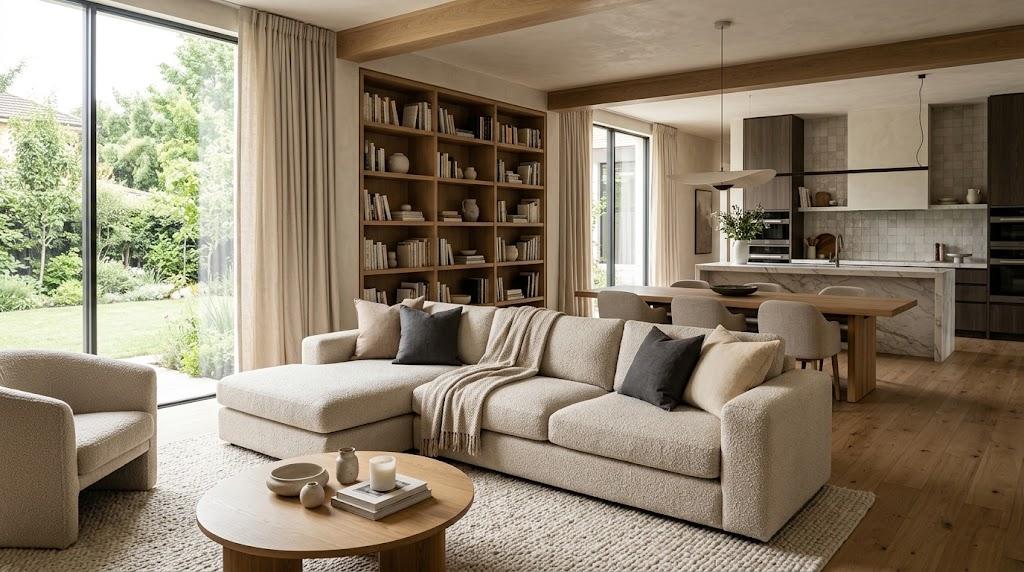
There's a particular discomfort that comes from a room that sounds wrong. You set down a coffee mug and it rings. You speak at normal volume and your words arrive back slightly louder than they left. It doesn't take long before you start unconsciously raising your voice just to feel heard.
That persistent, metallic quality has a name. Acoustic engineers call it reverberation. And it tends to show up most aggressively in the very spaces people invest in most heavily: large, open-plan living areas with polished finishes and minimal partitioning.
Why Open-Plan Spaces Sound the Way They Do
Every hard surface in a room acts as a mirror for sound. Tile floors, glass panels, smooth plaster, and stone counters all bounce acoustic energy back into the space with minimal loss. In a home divided into smaller rooms, doorways and walls break those reflections into manageable fragments. Sound dissipates quickly in a confined, furnished room.
Open the floor plan and the acoustic behavior transforms. You now have one continuous volume with far fewer interruptions. Sound travels further, bounces off more surfaces, and accumulates before decaying.
Furniture composition makes a significant difference here. A dining set in lacquered wood, a glass shelving unit, a metal-frame coffee table—these all contribute their own reflections. Layer enough of them together and the room develops a persistent, hollow character that feels subtly off-putting even when the interior design is otherwise excellent.
What a Sofa Actually Does to Sound
An upholstered sofa is, at its core, a large acoustic absorber. Every layer inside it—foam, batting, fabric, padding—is riddled with tiny air pockets. When sound enters those layers, the air molecules within the fibers vibrate and generate friction. That friction converts acoustic energy into heat, which is effectively a loss.
The frequencies most affected are mid-range and high-frequency ones. These happen to carry the sounds we notice most in daily life: conversation, dishware clinking, television audio, children's voices. A plush, well-stuffed three-seat sofa can absorb a meaningful amount of that energy.
The relationship between size and absorption is roughly proportional. A deep sectional with generous cushioning intercepts more wavefronts than a slim, low-profile loveseat. Thicker cushions simply offer more material for sound to lose itself in.
It's worth noting that absorption happens across every soft surface of the piece. Back cushions, padded armrests, and any exposed fabric-covered panels all contribute to the overall effect.
Fabric Choice Matters More Than You'd Think
Acoustic performance varies considerably between different upholstery textiles. Smooth, tightly woven surfaces bounce more sound than they absorb. A rougher, more textured weave does the opposite—it disrupts wavefronts and traps energy within its irregular fiber structure.
Bouclé, heavy linen, and velvet tend to outperform flat cotton or synthetic blends in this regard. Pile height plays a role too, since raised fibers create micro-turbulence at the surface. For rooms where echo is already a problem, choosing a denser, textured material is one of the simplest interventions available.
This is precisely where sofa reupholstery proves its value as an acoustic tool rather than merely a cosmetic one. Suppose you own a structurally sound sofa that's wrapped in a thin, tightly woven synthetic. Replacing that covering with a heavier, textured fabric alters how sound interacts with the piece. The change is subtle but measurable—particularly in rooms that sit on the borderline between comfortable and harsh.
Placement: Where the Sofa Sits Changes Everything
Positioning against a broad, flat wall gives the sofa a dual acoustic role. It absorbs sound arriving from the room and simultaneously disrupts the bounce path between that wall and whatever lies opposite. That combination makes wall placement surprisingly effective for managing first-order reflections.
A sofa placed mid-room behaves differently. Rather than absorbing reflections off a single wall, it acts as a physical partition that interrupts sound's travel across the entire space. In elongated open plans—where the kitchen sits at one end and the living zone at the other—that mid-room placement can noticeably shorten the perceived echo tail.
For homeowners researching sofa upholstery Singapore providers, it helps to think about placement before committing to new covers. Where the piece sits in the room will influence both the acoustic benefit you get and the wear patterns the fabric develops. A sofa floating between zones faces different stresses than one tucked against a feature wall.
Corners deserve special consideration. Sound energy concentrates in 90-degree intersections, creating localized hot spots of reflection. Angling the sofa even slightly away from a corner can diffuse that buildup. Layering a thick area rug beneath the seating zone addresses the horizontal reflection path. Combined with the sofa's vertical absorption, that pairing often produces an immediate, perceptible shift in the room's warmth.
When the Foam and Padding Are Worn Out
Acoustic performance degrades invisibly over time. Foam compresses, loses its open-cell structure, and becomes a dense slab rather than a porous absorber. Batting mats down and sheds the loft that once gave it air pockets and volume. After ten or fifteen years, the cushioning inside a sofa may bear little resemblance to its original composition.
If your living room sounds harsher than you remember, this deterioration could be a contributing factor. The layers that once absorbed mid-frequency reflections have gradually collapsed into something far less effective. You're essentially sitting on a thin fabric membrane stretched over a rigid frame.
Engaging a sofa reupholstery specialist allows you to replace degraded foam, add fresh batting, and rebuild cushion cores to their intended density. This restores both seating comfort and acoustic function simultaneously. The existing frame—already proven to fit your space—stays in place.
For residents working within the sofa upholstery Singapore market, climate adds another variable. High humidity accelerates foam breakdown and can promote mildew inside poorly ventilated cushions. Selecting moisture-resistant foams and breathable cover fabrics helps the rebuild last longer in tropical conditions.
What Sofas Won't Do
A sofa cannot overcome a room that's fundamentally hostile to sound absorption. Floor-to-ceiling glazing on multiple walls, polished concrete flooring, and minimal soft furnishings will overwhelm any single piece of furniture. Those environments require dedicated acoustic panels, diffusers, or significant material changes.
Low-frequency sound is also beyond the sofa's reach. Bass from subwoofers, heavy machinery vibration, and deep percussion all operate at wavelengths too long for cushion foam to capture. Managing those frequencies demands mass and isolation techniques that upholstery simply cannot provide.
What an upholstered sofa does accomplish is more modest but genuinely useful. It softens the upper-frequency reflections that make everyday life uncomfortable. Conversation becomes easier to follow. Television dialogue stops smearing into a wash. The room begins to feel lived-in rather than clinical.
In most open-plan homes, that incremental improvement is exactly the goal. Combined with curtains, shelving filled with books, and a few other soft furnishings, a well-placed sofa anchors an effective and affordable acoustic strategy.
The Short Version
Open-plan homes create echo because hard surfaces bounce sound endlessly between parallel planes. Upholstered sofas counteract this through their porous internal structure, absorbing mid-range and high-frequency reflections. Thicker cushions, textured cover fabrics, and intentional placement all amplify the effect.
When aging cushioning has lost its density, sofa reupholstery restores both comfort and acoustic absorption without requiring a complete replacement. Treating the sofa as one element in a broader soft-furnishing strategy—alongside rugs, drapes, and bookshelves—delivers the most satisfying acoustic result.

 English
 Arabic
 French
 Spanish
 Portuguese
 Deutsch
 Turkish
 Dutch
Dutch
 Italiano
 Russian
 Romaian
 Greek
Greek
