


Why Spectrum and Network Design Matter?
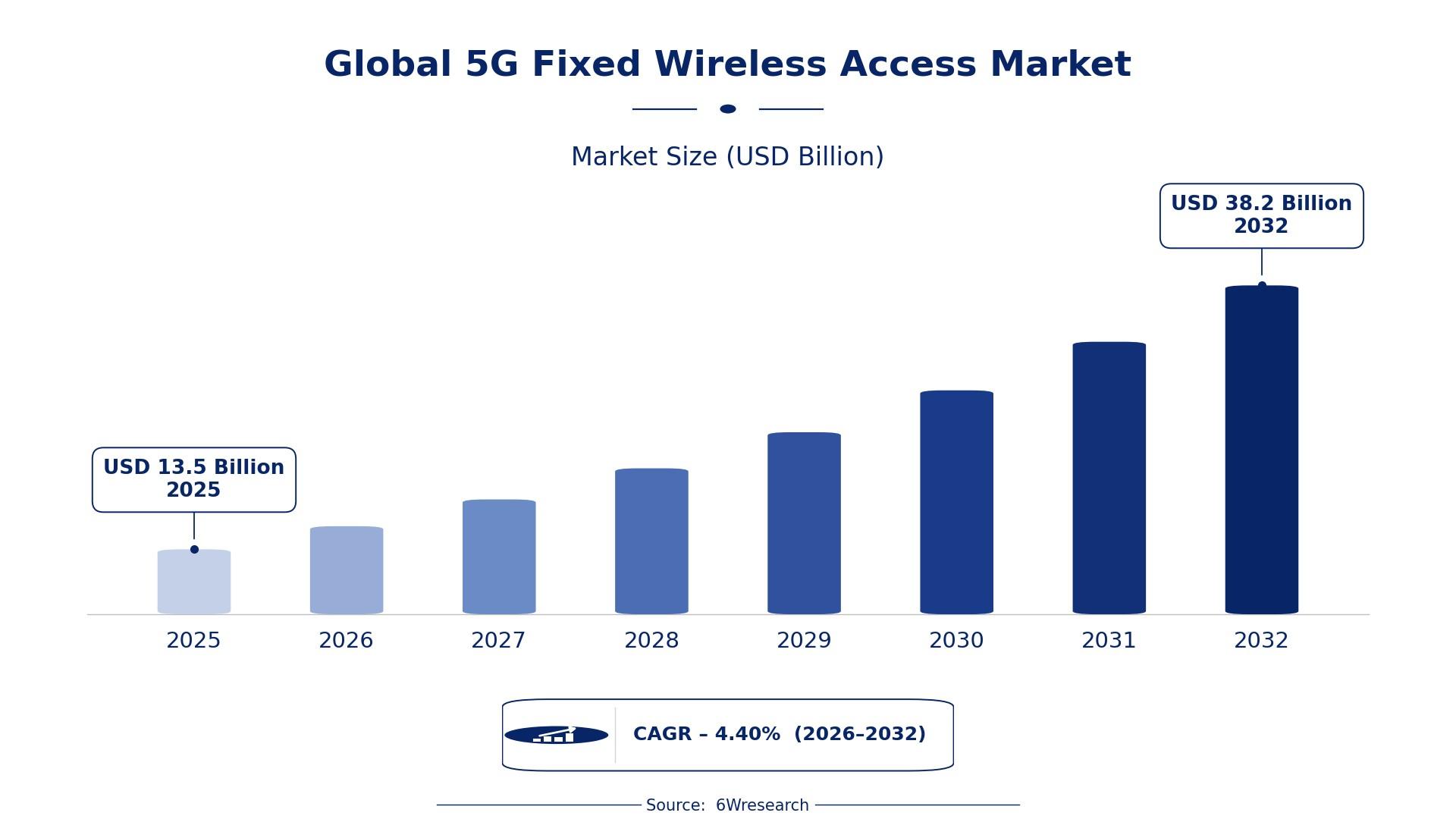
Behind every fast wireless broadband connection is a complex combination of spectrum, network infrastructure, antennas, customer equipment and backhaul. The growth of the 5G Fixed Wireless Access Market is therefore not simply a story about faster internet. It is also a story about how telecom operators are designing networks to deliver fixed connectivity efficiently across different environments.
Spectrum Is the Foundation
Wireless communication depends on spectrum.
Different frequency bands offer different characteristics in terms of coverage, capacity and propagation.
For FWA, operators must select spectrum that matches their target customers and geographic environment.
Lower frequencies can provide broad coverage, while higher-frequency bands can deliver substantial capacity over shorter distances.
Sub-6 GHz Has an Important Role
Sub-6 GHz 5G is attractive because of its balance between coverage and performance.
It can serve broader areas and penetrate environments more effectively than some higher-frequency technologies.
This makes it particularly relevant to wide-area FWA deployment.
Operators can use Sub-6 GHz networks to reach residential and business customers across relatively large service areas.
Higher Frequencies Add Capacity
Higher-frequency 5G bands can provide significant capacity.
This can be useful in dense urban areas where many customers require high-speed connectivity.
However, higher frequencies generally have more demanding propagation characteristics.
Operators may therefore need more network sites and careful planning.
Customer Equipment Matters
A strong network still needs capable equipment at the customer's location.
FWA customer-premises equipment receives the wireless signal and distributes internet access through the property.
Equipment design can influence:
-
Signal quality.
-
Indoor coverage.
-
Installation requirements.
-
User experience.
-
Network efficiency.
Advances in antennas and wireless chipsets can therefore influence the broader FWA market.
Backhaul Cannot Be Ignored
Wireless access is only one part of the connectivity chain.
The traffic generated by FWA customers must ultimately reach the wider internet through network backhaul.
If backhaul capacity is insufficient, the benefits of high-performance radio access can be reduced.
Operators therefore need to coordinate radio networks with fiber and other transport technologies.
Network Planning Is Increasingly Data Driven
Operators need to understand where customers are located, how much data they consume and when traffic peaks.
Network planning can use customer density, geographic information and usage patterns to determine where additional capacity is needed.
This allows operators to deploy resources more efficiently.
Urban and Rural Networks Are Different
A rural FWA network may prioritize coverage.
An urban network may prioritize capacity.
This difference means there is no universal FWA architecture.
Operators need strategies based on:
-
Population density.
-
Geography.
-
Frequency availability.
-
Customer demand.
-
Existing infrastructure.
-
Backhaul capacity.
Installation Models Are Evolving
Customer equipment can be installed indoors or outdoors depending on network conditions.
Indoor equipment offers simplicity, while outdoor equipment may provide stronger signal reception in challenging locations.
The ability to make installation easier can directly influence customer acquisition costs.
Security Is Becoming More Important
As more homes and businesses depend on wireless broadband, security becomes increasingly important.
Operators need to protect network infrastructure and customer traffic while ensuring that devices receive regular updates.
Enterprise customers may demand additional security capabilities.
Therefore, FWA technology must evolve beyond speed to address reliability and cybersecurity.
Technology Innovation Will Shape Competition
FWA providers will compete not only through coverage but also through technology.
Improved antennas, network optimization, spectrum efficiency, advanced routers and better customer equipment can improve performance.
Operators that continuously optimize their networks may gain an advantage as customer expectations rise.
The Bigger Picture
5G FWA demonstrates that broadband is becoming increasingly flexible.
The connection between a home or business and the operator no longer has to rely entirely on physical infrastructure.
Wireless technologies can now provide an alternative path, provided the underlying network is properly engineered.
The future of FWA will therefore depend on a combination of spectrum strategy, network architecture, equipment innovation and customer demand.
The technology is still evolving, but its ability to combine wireless flexibility with fixed broadband use makes it an important component of the next-generation connectivity landscape.
Who We Are
About 6Wresearch: It is a commercial strategy and growth advisory firm founded in 2011 and headquartered in New Delhi, India, with partners across Southeast Asia and the Middle East & Africa. The firm has delivered over 20,000 commercial engagements for over 2,000 organizations, including Fortune 500 companies, government agencies, and multilateral institutions such as the World Bank and the Asian Development Bank. Backed by proprietary market research and advanced analytics, 6Wresearch combines sector expertise with data-driven intelligence to help organizations navigate market complexity and drive sustainable growth. These capabilities explain why organizations trust 6Wresearch Global Market Research & Consulting Firm for reliable commercial insights and confident decision-making.
Our Proprietary Platform: 6W Export GTM
6W Export GTM is 6Wresearch's proprietary trade intelligence and go-to-market platform, built on UN Comtrade data and enhanced with 6Wresearch's in-house analytical and simulation models, including system dynamics-based forecasting. Unlike broad, sector-level market sizing tools, 6W Export GTM operates at the individual product level down to specific HS codes and micro-segments to identify precise, actionable export opportunities by country and product pair, including markets where trade currently does not exist. This granular, simulation-driven approach allows 6W Export GTM to surface opportunities that sector-wide analysis typically misses, positioning it among a small number of platforms globally offering this depth of product-and-country-specific export intelligence.

 English
 Arabic
 French
 Spanish
 Portuguese
 Deutsch
 Turkish
 Dutch
Dutch
 Italiano
 Russian
 Romaian
 Greek
Greek
