


How Does a Washer Extractor Work in Commercial Laundry Operations?
Introduction
Commercial laundry operations need equipment that can handle repeated washing while supporting an organised workflow. In hotels, hospitals, universities, industrial facilities and garment-related businesses, a washer extractor is important because it combines washing and high-speed water extraction in one machine. Understanding how this equipment works can help purchasing managers and laundry supervisors select systems that fit their workload, available space and operational requirements.
For businesses researching commercial laundry services, equipment selection is closely connected to daily linen volumes, fabric types, turnaround expectations and available utilities. For commercial laundry services, understanding extraction is also important when planning the transition from washing to drying. A suitable washer extractor can streamline the transition from washing to drying by removing a significant amount of water before textiles enter the dryer. For organisations in Dubai, these considerations are relevant across hospitality, healthcare, education and industrial operations. Supershine Laundry supports businesses by helping them consider suitable commercial and industrial laundry equipment based on their operational needs.
What Is a Washer Extractor?
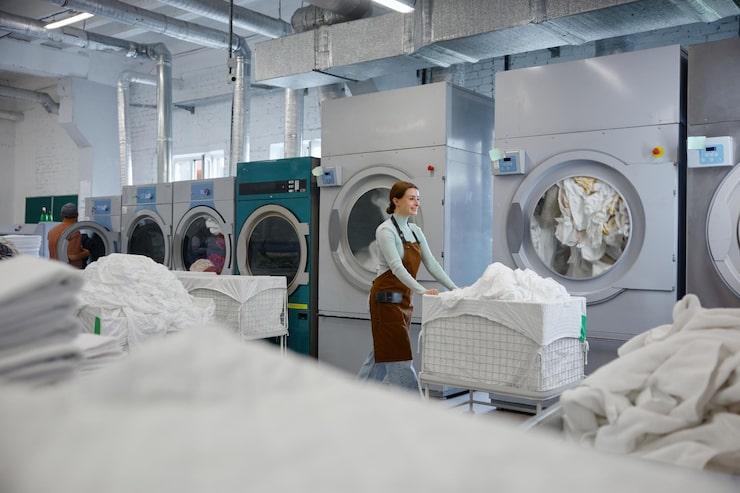
A washer extractor is a commercial or industrial washing machine designed to perform two main functions: wash textiles and extract water through high-speed spinning. Commercial equipment is designed around repeated operational cycles and professional laundry requirements.
For commercial laundry services, the washing stage uses water, detergent and mechanical action to loosen and remove soil. After washing and rinsing, the drum rotates at a higher speed. Centrifugal force pushes water away from the textiles and towards the drainage system.
The process does not completely dry laundry. Instead, it reduces residual moisture so textiles can move to a commercial dryer, finishing system or another suitable processing stage.
The question “What is a washer extractor and how does it work in commercial laundry” is therefore about both cleaning and moisture removal.
How Does a Washer Extractor Work?
The exact controls vary by model, but the basic process usually follows these stages:
1. Loading
Textiles are placed into the drum according to the machine's operating instructions and the type of load. Hotels may separate towels, bed linen and uniforms, while healthcare facilities may use defined procedures for different textile categories.
2. Washing
Water and cleaning agents are introduced according to the selected programme. Drum movement creates mechanical action that helps cleaning chemistry and water reach the fabric.
3. Rinsing
The machine drains used wash water and carries out one or more rinse stages. Rinsing helps remove remaining detergent and loosened soil before extraction.
4. Water Extraction
The drum accelerates to a higher rotational speed. Centrifugal force moves water away from the textiles, allowing it to drain. This reduces the moisture that must later be removed during drying.
5. Unloading and Drying
After extraction, textiles are transferred to the next stage, such as a commercial dryer, finishing equipment, folding or another handling process.
Why Extraction Matters in a Commercial Laundry
Water extraction plays a practical role in the overall laundry workflow. When textiles leave the washer with less retained water, the drying stage has less moisture to remove. This can help laundry teams organise drying capacity, particularly when multiple loads are processed during the day.
For commercial laundry services, the washer extractor connects the cleaning and drying stages. Laundry managers should therefore assess the complete process rather than looking at washing performance alone.
Washer extractors may be relevant for:
-
Hotel sheets, towels and housekeeping textiles
-
Hospital and healthcare linen
-
College and university accommodation laundry
-
Staff uniforms and workwear
-
Garment manufacturing and textile-processing loads
-
Industrial and institutional laundry operations
Selecting a Washer Extractor for Dubai Operations
The right equipment depends on the application rather than simply choosing the largest machine. Businesses should assess daily laundry volume, textile mix, available floor space, utility connections, workflow and future requirements.
In Dubai, hotels and hospitality businesses may process substantial quantities of guest-room linen, towels and uniforms. Hospitals and healthcare facilities can have structured textile-handling workflows. Universities, colleges and other institutions may process accommodation linen, uniforms and facility textiles. Industrial businesses and garment manufacturers may have different requirements based on the materials and workwear they handle.
Before purchasing, businesses can consider:
-
Expected laundry volume and frequency
-
Types of textiles being washed
-
Available space and operator access
-
Water, drainage and electrical requirements
-
Required washing and extraction programmes
-
Compatibility with drying and finishing equipment
-
Routine maintenance access
-
Future changes in laundry demand
Supershine Laundry can help businesses review these practical considerations when planning a commercial or industrial laundry setup. The aim should be to select equipment that fits the actual workflow instead of relying on generic specifications.
Washer Extractor vs. Separate Washer and Extractor
A washer extractor combines washing and water extraction in one machine. A separate setup divides these functions between different pieces of equipment.
For commercial laundry services, the appropriate arrangement depends on workflow, space, processing requirements and the overall equipment plan. A combined machine can simplify the sequence by allowing washing and extraction within one unit, while a multi-machine arrangement may suit facilities with a different workflow.
Businesses should review the complete laundry process before purchasing because drum size or extraction speed alone may not determine suitability.
Practical Installation Considerations
Before installing a washer extractor, commercial laundry services should review the site carefully. Equipment placement needs to support loading, unloading, textile movement and safe access for operators and maintenance personnel.
Workflow is equally important. Dirty textiles should have a clear route through washing, extraction, drying and finishing, while clean and soiled handling areas should be organised according to the facility's procedures.
Supershine Laundry can support this planning process by discussing the intended application and helping businesses identify suitable commercial and industrial laundry equipment options.
How It Fits Into a Complete Laundry System
For commercial laundry services, a washer extractor is one part of a professional laundry operation. Depending on the facility, the wider system may include commercial dryers, ironing or finishing equipment, folding equipment, laundry handling systems and appropriate storage.
For commercial laundry services, the goal is not simply to clean textiles but to move them efficiently through the complete processing cycle. Equipment should therefore be selected as part of the wider workflow.
Supershine Laundry works with businesses and institutions looking for commercial and industrial laundry equipment and can help them consider equipment choices in relation to their application. A practical approach starts with understanding what is being washed, how often it is processed and what happens after washing.
Maintenance and Daily Operation
Regular operational checks are important for commercial laundry equipment. Operators should follow the manufacturer's instructions for loading, cleaning, programme selection and routine care. Accessible components such as seals, filters and drainage areas should be monitored according to the recommended maintenance schedule.
Staff training also matters. Operators should understand load sorting, programme selection, safe loading and unloading, and routine cleaning procedures.
The question “What is a washer extractor and how does it work in commercial laundry” can be answered simply: it washes textiles, rinses them and then uses high-speed drum rotation to remove a substantial portion of water before the next processing stage.
Choosing Equipment With the Full Workflow in Mind
For commercial laundry services in Dubai, equipment selection should start with the site's actual laundry requirements. A hotel with high linen volumes, a healthcare facility with structured textile handling, a university with accommodation laundry and an industrial facility may all require different equipment approaches.
Purchasing teams should consider the machine alongside dryers, finishing equipment, utilities, room layout and operator requirements. This helps create a practical laundry system rather than treating each machine as an isolated purchase.
Supershine Laundry can assist businesses in reviewing these considerations and identifying commercial and industrial laundry equipment suited to their intended application. The focus should remain on practical requirements, operational compatibility and long-term usability.
Conclusion
A washer extractor performs two essential stages of professional textile processing: washing and water extraction. By combining these functions, it can form an important link between washing and drying in hotels, hospitals, educational institutions, garment-related businesses and industrial facilities in Dubai. Understanding the machine's operating process, site requirements and role within the wider laundry workflow helps businesses make informed equipment decisions. Supershine Laundry can provide practical guidance on suitable commercial and industrial laundry equipment based on the intended application.
FAQs
1. What is the main purpose of a washer extractor?
A washer extractor is designed to wash textiles and then remove a substantial amount of water through high-speed spinning before the load moves to drying or finishing.
2. Can a washer extractor completely dry laundry?
No. Extraction removes water from textiles but does not normally produce fully dry laundry. A suitable drying or finishing stage may still be required.
3. What businesses commonly use washer extractors?
Hotels, hospitals, universities, commercial laundries, industrial facilities, garment manufacturers and other institutions that process regular volumes of textiles may use washer extractors.
4. What should businesses consider before buying one?
They should consider laundry volume, textile types, available space, utilities, workflow, programme requirements, maintenance access and compatibility with downstream drying and finishing equipment.
5. Why is extraction important before drying?
Removing water during extraction reduces the moisture remaining in textiles, helping the laundry process move more effectively into the drying stage.

 English
 Arabic
 French
 Portuguese
 Deutsch
 Turkish
 Dutch
Dutch
 Italiano
 Russian
 Romaian
 Portuguese (Brazil)
 Greek
Greek
