


Why Centralized Key Management Is Important for Database Encryption Solutions
Introduction
Databases form the foundation of many modern business operations. Organizations use them to store customer records, financial information, employee details, transaction histories, intellectual property, and operational data.
Because databases contain valuable information, attackers frequently target them. Businesses therefore use multiple security controls to protect database environments.
Encryption is one of the most important controls. A database encryption solution can convert sensitive information into an encrypted format, making it difficult for unauthorized users to understand even if they gain access to stored data.
However, encryption creates another security requirement: organizations must protect the cryptographic keys used to encrypt and decrypt database information.
This is why centralized Key management matters.
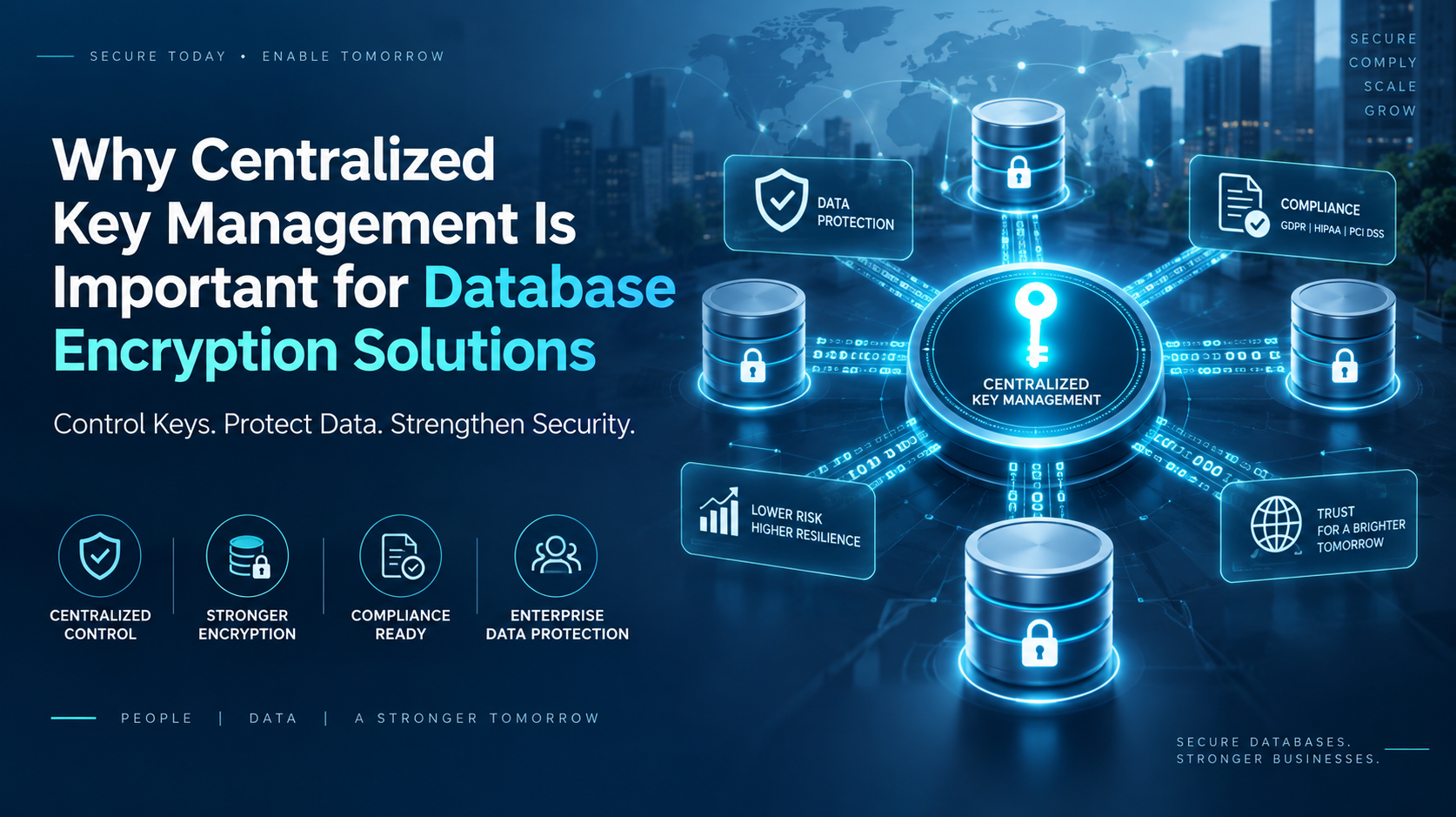
Instead of managing encryption keys independently across every database, organization, or application, businesses can establish centralized controls that provide better visibility, consistent policies, and stronger lifecycle management.
Understanding Database Encryption
Database encryption protects information stored within database systems.
Organizations may encrypt:
- Customer information
- Payment details
- Employee records
- Financial data
- Personal information
- Business documents
- Confidential application data
Businesses can use different approaches depending on their database architecture.
These may include transparent data encryption, column-level encryption, and application-level encryption.
Regardless of the approach, encryption relies on cryptographic keys.
Why Encryption Keys Require Separate Protection
An encryption key can provide access to protected information. Therefore, organizations should not treat encryption keys as ordinary data.
For example, if a database contains encrypted customer information but stores its encryption keys in the same environment without adequate protection, an attacker who compromises the database may potentially gain access to both the encrypted information and its keys.
A stronger architecture separates encrypted data from its cryptographic keys.
Centralized Key management can help organizations achieve this separation while providing consistent controls.
What Is Centralized Key Management?
Centralized Key management means that an organization manages encryption keys through a structured platform or service rather than allowing every application to manage keys independently.
A centralized approach can provide visibility into:
- Key ownership
- Key purpose
- Key location
- Key lifecycle
- Key usage
- Access permissions
- Rotation schedules
This becomes particularly important as businesses increase the number of databases and applications they use.
The Role of Key Management in Cryptography
Key management in cryptography covers the processes required to control cryptographic keys throughout their lifecycle.
These processes include:
- Generation
- Storage
- Distribution
- Access
- Rotation
- Backup
- Recovery
- Retirement
- Destruction
Centralized management helps organizations apply consistent policies to these activities.
For example, security teams can establish a standard rotation policy rather than allowing individual applications to use different processes.
How Centralized Key Management Improves Database Security
Better Visibility
Security teams can maintain a clearer inventory of database encryption keys.
Consistent Policies
Organizations can apply common rules for access, rotation, and retirement.
Reduced Administrative Complexity
Centralized management can reduce the need to maintain separate key management processes for every database.
Improved Access Control
Security teams can restrict key access to authorized applications and users.
Easier Auditing
Centralized records can help organizations review key-related activity.
HSM Modules and Database Encryption
HSM modules provide specialized hardware environments for protecting cryptographic keys.
Organizations can use HSM technology to protect database encryption keys rather than storing them directly within application servers or databases.
An HSM can securely perform cryptographic operations while protecting the underlying key.
This creates a separation between:
Database → Encrypted data → Key management → HSM-protected key
This architecture can reduce the risk of direct key exposure.
The Role of HSM Solutions
HSM Solutions provide enterprise capabilities for deploying and managing hardware-based cryptographic protection.
Organizations can use HSM Solutions to support:
- Database encryption
- Application encryption
- Digital signatures
- Authentication
- Certificate management
- Payment processing
Businesses should evaluate HSM Solutions according to their technical architecture and security requirements.
Thales Key Management for Centralized Control
Enterprises with multiple databases may require centralized technology to manage cryptographic keys.
Thales key management can help organizations manage encryption keys across different systems and environments.
Centralized capabilities can provide better control over:
- Key access
- Key lifecycle
- Key rotation
- Key ownership
- Security policies
- Audit information
Organizations can integrate centralized key management with HSM infrastructure to strengthen protection for critical encryption keys.
Supporting Data Security Standards
Businesses must consider applicable Data security standards when designing database security architectures.
These standards may require organizations to implement controls around:
- Data encryption
- Access management
- Cryptographic key protection
- Monitoring
- Auditing
Centralized Key management can help organizations document and control cryptographic activities.
However, database encryption and Key management should form part of a wider security program.
Key Rotation and Database Availability
Key rotation can improve security, but organizations must implement it carefully.
If an application cannot access a new encryption key after rotation, it may lose access to protected information.
Centralized Key management can help organizations coordinate key rotation and maintain lifecycle records.
Businesses should test rotation procedures before applying them to critical production systems.
Managing Keys Across Cloud Databases
Cloud adoption has increased the need for centralized key management.
Organizations may operate databases across multiple cloud providers and on-premises infrastructure.
Each environment may have different encryption services and management interfaces.
Centralized Key management can provide a consistent enterprise approach.
A database encryption solution can protect information in each environment, while centralized management can provide greater control over the keys.
Best Practices for Centralized Database Key Management
Maintain a Key Inventory
Document all important encryption keys and their purpose.
Separate Keys From Data
Avoid storing encryption keys alongside the information they protect.
Apply Least Privilege
Allow only authorized applications and users to access cryptographic operations.
Automate Key Rotation
Use automation where appropriate to reduce manual errors.
Protect Critical Keys With HSM Technology
Use HSM modules for keys that require stronger hardware-based protection.
Monitor Key Usage
Review access and cryptographic activity regularly.
Test Recovery
Verify that authorized teams can recover critical keys when required.
Conclusion
Database encryption provides an important layer of protection for sensitive business information, but encryption cannot provide complete security without effective key protection.
Centralized Key management helps organizations control encryption keys across databases and applications while improving visibility, access control, and lifecycle management.
Key management in cryptography provides the framework for managing keys throughout their lifecycle. HSM modules add hardware-based protection, while HSM Solutions can support enterprise cryptographic requirements.
Thales key management can provide centralized capabilities across distributed environments, while a database encryption solution protects sensitive information stored within databases.
By combining centralized Key management, HSM technology, encryption, monitoring, and applicable Data security standards, organizations can build a stronger and more manageable database security framework.

 Arabic
 French
 Spanish
 Portuguese
 Deutsch
 Turkish
 Dutch
Dutch
 Italiano
 Russian
 Romaian
 Portuguese (Brazil)
 Greek
Greek
