


How to Become a Pilot in India: A Complete 2026 Guide
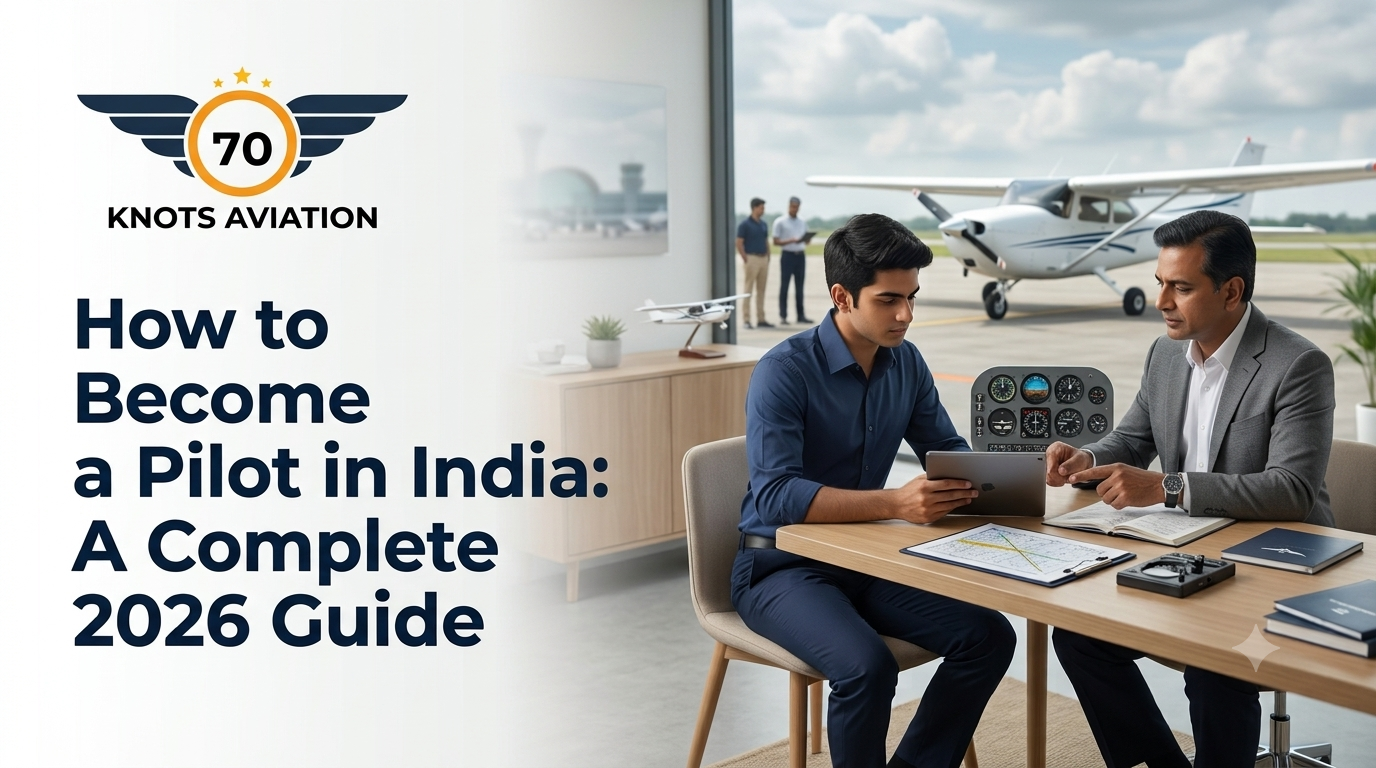
Becoming a pilot is a dream for many students. For some, it begins when they see an aircraft taking off. For others, it develops during school when they start thinking about a career that combines technology, discipline, responsibility and travel.
But once you seriously start researching how to become a pilot in India, the journey can seem complicated. You come across terms such as DGCA, DGCA Pariksha, Computer Number, medical examination, ground training, flight training, CPL and licensing requirements. Then comes another major question: how much will the entire process cost?
At 70Knots Aviation, we believe students should understand these questions before making a major decision about their aviation career.
The purpose of this guide is to bring the important pieces together — from your Class 12 education and medical requirements to DGCA examinations, pilot training costs, flight training and choosing an appropriate training pathway.
How to Become a Pilot in India: Start With the Basics
There is no single step that turns a student into a professional pilot. The journey is made up of several stages, and each stage has a purpose.
For a student interested in a professional Flight Crew pathway, the journey generally involves:
- Understanding educational eligibility
- Checking applicable medical requirements
- Understanding DGCA requirements
- Registering and preparing for applicable examinations
- Completing ground training
- Completing practical flight training
- Meeting the applicable licensing requirements
- Continuing to build qualifications and experience
The exact requirements can vary according to the licence and applicable regulations, so students should always verify current DGCA information before making decisions.
10+2 Eligibility: Why Physics and Mathematics Matter
Your educational background is one of the first things to check.
The current DGCA Pariksha FAQ states that, except for the PPL category, a Flight Crew applicant must have passed 10+2 with Physics and Mathematics from a recognized board or university, or an accepted equivalent qualification.
DGCA's published Flight Crew material similarly specifies 10+2 Physics and Mathematics for categories including CPL and ATPL examinations, subject to the applicable provisions.
This is why we recommend that students who are still in school think about their subject choices early.
If you are currently in Class 10 or 11 and already know that you want to pursue professional pilot training, understanding the educational requirement now can save you from confusion later.
What If You Did Not Have Physics and Mathematics in Class 12?
This is one of the questions we hear most often.
A student who did not study Physics and Mathematics should not simply assume that the dream of becoming a pilot is over. However, you also should not ignore the educational requirement and immediately spend money on flight training.
The correct approach is to first understand the recognised route through which you can fulfil the applicable educational requirement.
DGCA's current documentation recognises certain equivalent qualifications, subject to the relevant conditions and recognition of the board or institution.
This means you should be careful about short courses or certificates that claim to solve the problem automatically. Before enrolling, confirm that the qualification will actually satisfy the applicable DGCA requirement.
At 70Knots Aviation, we encourage students in this situation to clarify their academic eligibility first and then plan their aviation training.
Understanding DGCA and Its Role in Your Pilot Journey
The Directorate General of Civil Aviation (DGCA) is India's civil aviation regulator.
As an aspiring pilot, you will encounter DGCA at different stages of your journey. Its regulatory framework covers areas connected with flight crew examinations, licensing, medical requirements, training organisations and other aspects of civil aviation.
This is why learning about DGCA should not be something you postpone until the end of your training.
You should understand the applicable requirements from the beginning and continue checking official updates because procedures and regulatory requirements can change.
For students, one of the most important things is to distinguish between general aviation information found online and the latest official requirements.
What Is DGCA Pariksha?
DGCA Pariksha is the online registration and examination portal used by DGCA's Central Examination Organisation for Flight Crew and Aircraft Maintenance Engineer examinations. The current portal states that candidates with a Computer Number must register on the portal for future examinations.
For a new pilot student, the terminology can initially be confusing.
You may encounter:
- Flight Crew registration
- Computer Number
- Examination applications
- Examination sessions
- Syllabus
- Reference material
- Admit cards
- Results
- Candidate login
- Official notices
The current Pariksha system also publishes examination calendars and 2026 Flight Crew notices.
Understanding the Computer Number
The Computer Number is an important identifier in the DGCA Flight Crew examination system. The official FAQ states that a candidate is authorised to have one Computer Number and that its validity is lifetime.
Students should therefore treat their examination profile and documentation carefully.
DGCA has also introduced digital processes over time. For example, the 2026 public notice states that auto-generation of Computer Numbers was extended to eligible Indian Flight Crew candidates with 10th and 12th qualifications from Maharashtra Board when those records can be successfully verified through DigiLocker.
This is a good example of why students should follow the current official portal rather than relying on old tutorials.
Ground Training: The Knowledge Behind Flying
Flying an aircraft is not simply about sitting in a cockpit and controlling the aircraft.
A professional pilot needs theoretical knowledge to understand what is happening before, during and after a flight.
Depending on the applicable training and licence pathway, students may study areas involving:
- Aviation regulations
- Navigation
- Meteorology
- Aircraft-related knowledge
- Communication
- Human factors
- Flight procedures
- Operational concepts
Ground preparation helps students develop the knowledge base that supports both examinations and practical flying.
At 70Knots Aviation, we believe students should see ground training as an important part of becoming a pilot rather than something separate from flying.
Flight Training: Turning Knowledge Into Practical Skills
After building the necessary theoretical foundation, practical flight training becomes a major part of the journey.
During flight training, students progressively develop practical skills under the applicable training structure.
This can include learning about:
- Aircraft handling
- Take-offs and landings
- Navigation
- Communication
- Flight procedures
- Emergency procedures
- Decision-making
- Cockpit discipline
Every student progresses at an individual pace. Flying hours can also be influenced by training conditions, aircraft availability, weather and the student's individual learning requirements.
That is one reason why students should understand the complete training structure instead of assuming that every student will have exactly the same experience.
Pilot Course Fees in India: What Should Students Actually Budget For?
One of the biggest questions students ask is about pilot course fees in india.
The important thing to understand is that there is no single universal amount that applies to every pilot student.
The total cost can vary according to the training organisation, aircraft, flying rates, number of hours, ground training, accommodation, examinations, medical expenses, documentation and additional training.
Instead of asking only, “What is the course fee?”, ask:
“What exactly is included in the course fee?”
That question can give you a much clearer picture.
Major Factors That Can Affect Your Pilot Training Cost
Flying Charges
Practical flying is a significant part of professional pilot training. Aircraft type, flying rates and the number of hours required can influence the total expenditure.
Ground Training
Academic preparation may form part of the overall training cost depending on the organisation and programme.
Medical Expenses
Applicable medical assessments should be considered separately when planning your overall budget.
DGCA Examination Expenses
Students should account for applicable examination-related charges.
Accommodation and Living Costs
If you train away from home, accommodation, food, transport and other living expenses can add considerably to your overall budget.
Additional Flying
Students may require additional training or flying beyond an initial estimate depending on their progress and applicable requirements.
This is why comparing two institutes only by their advertised package price can be misleading.
What Should You Check Before Paying for Pilot Training?
Before committing a large amount of money, ask the training provider detailed questions.
Ask What the Fee Includes
Find out whether the quoted amount includes ground training, flying, examination-related expenses, accommodation or other services.
Understand Additional Charges
Ask how additional flying hours or training are charged.
Understand Who Conducts the Actual Flying
An aviation academy and a flying training organisation can have different roles. Students should clearly understand who is responsible for the practical flying component.
Check the Current Regulatory Position
Where applicable, verify the current DGCA status or approval relevant to the organisation and training you are purchasing.
Ask About Examination Preparation
Understand what academic and examination support is actually provided.
A transparent conversation before admission is better than discovering unexpected costs later.
Medical Requirements Should Not Be an Afterthought
Medical eligibility is another important part of the pilot journey.
Students sometimes focus so heavily on fees and flying that they forget to understand the applicable medical process.
We recommend addressing this early.
The precise medical requirements depend on the licence and stage of training, so students should follow the current DGCA medical framework and use the applicable authorised medical process.
The practical lesson is simple:
Understand your medical pathway before making a major training investment.
Can Graduates Become Pilots?
Yes. Becoming a pilot is not restricted only to students who immediately start training after Class 12.
A graduate can pursue the applicable pilot training pathway if the relevant educational, medical, examination and licensing requirements are fulfilled.
If Physics and Mathematics were not part of your 10+2 education, you should first understand how to satisfy the applicable educational requirement.
Your previous degree does not automatically replace the specific aviation eligibility requirements that apply to the pilot pathway you want to pursue.
Do General, OBC, SC and ST Students Have Different Pilot Requirements?
Students and parents also ask whether caste category changes the basic requirements for becoming a pilot.
The important distinction is between core licensing eligibility and financial or educational benefits offered under a particular scheme.
Students should not assume that General, OBC, SC or ST category automatically changes the fundamental DGCA requirements applicable to their pilot licence.
However, a specific government scholarship, financing programme, educational institution or other scheme may have its own eligibility criteria or benefits.
Therefore, category-related benefits should always be checked against the current rules of the particular scheme.
How to Choose a Pilot Training Institute
Students often search for the Best Pilot training school in delhi, but choosing a training pathway should involve more than looking at a marketing claim.
Instead, ask what the organisation actually provides.
Look at the Training Structure
Is the programme clearly explained?
Look at Faculty and Academic Support
Will you receive proper guidance for the theoretical part of your training?
Understand DGCA Preparation
Does the programme explain the applicable examination pathway?
Check Fee Transparency
Are additional costs explained?
Understand Flight Training Arrangements
Know who provides the actual practical flying training and what regulatory status applies.
Ask About Student Support
Can you get help when you have questions about documentation, examinations or the training process?
At 70Knots Aviation, we believe students should make decisions based on understanding rather than simply choosing the institute with the biggest promotional claim.
A Conversation Many Aspiring Pilots Have
Student:
“I want to become a pilot, but I don't know where to start.”
Receptionist:
“Let's start with your education. Did you study Physics and Mathematics in Class 12?”
Student:
“Yes. What should I do next?”
Receptionist:
“First, understand the applicable medical requirements. Then we can look at the DGCA examination pathway, ground preparation and flight training.”
Student:
“I keep hearing about DGCA Pariksha. Is that the same as pilot training?”
Receptionist:
“No. DGCA Pariksha is the examination platform. Your complete journey also includes education, medical requirements, ground preparation and practical flight training.”
Student:
“What about the fees? I've found completely different prices online.”
Receptionist:
“That is normal because pilot training costs depend on many factors. You should ask what is included in the quoted amount and what expenses may come separately.”
Student:
“I didn't have Physics and Mathematics in Class 12. Does that mean I can't become a pilot?”
Receptionist:
“Not necessarily. But you should first understand the recognised educational route for fulfilling the applicable requirement. Don't invest in flight training until you've confirmed your eligibility.”
Student:
“That makes the process much clearer.”
Receptionist:
“That's where we want to start — with clarity.”
Common Questions Students Ask
Can I become a pilot after Class 12?
Yes, provided you meet the applicable educational, medical, examination, training and licensing requirements. For the relevant Flight Crew pathway, current DGCA Pariksha guidance requires 10+2 Physics and Mathematics or an accepted equivalent, except for the PPL category.
What if I did not study Physics and Mathematics?
You should explore the recognised route for fulfilling the applicable educational requirement before proceeding with professional Flight Crew training.
What is DGCA Pariksha?
It is DGCA's online registration and examination portal for Flight Crew and AME examinations.
How much does pilot training cost in India?
There is no single universal amount. Costs vary depending on flying, aircraft, training organisation, ground preparation, accommodation, examinations, medical expenses and additional training.
Does a graduate need to start again from Class 12?
A graduate can pursue the applicable pilot pathway, but the specific educational requirements still need to be satisfied.
Do OBC, SC and ST students automatically get lower pilot training fees?
Not automatically. Any concession or financial support depends on the applicable scholarship, government programme or institution-specific policy.
How should I choose a pilot training institute?
Compare training structure, academic support, practical flying arrangements, fee transparency, facilities, examination guidance and applicable regulatory requirements.
Aviation Is More Than Learning to Fly
A pilot's responsibility begins long before the aircraft leaves the runway.
You learn to study.
You learn to prepare.
You learn to follow procedures.
You learn to understand weather and navigation.
You learn to communicate.
You learn to make decisions.
And eventually, you learn to bring all of that knowledge together inside the cockpit.
That is why aviation training requires consistency. It is not simply about having a passion for aircraft. It is about developing the knowledge, discipline and practical skills needed to operate within a highly regulated environment.
At 70Knots Aviation, we want students to understand that side of aviation from the beginning.
Your Pilot Journey Starts With the Right Questions
If you are researching how to become a pilot in India, you do not need to have every answer today.
Start with the questions that matter:
Do I meet the educational requirements?
What if I did not have PCM?
What medical requirements apply to me?
How does DGCA Pariksha work?
What should I budget for pilot training?
What should I check before selecting a training organisation?
What does the licensing pathway involve?
Once you understand these questions, the overall journey becomes easier to plan.
Start Your Aviation Journey With 70Knots Aviation
At 70Knots Aviation, our focus is on helping aspiring pilots understand aviation education, DGCA requirements, examination preparation and the broader training pathway.
We are located at:
E-529, Near MCD Office, Ramphal Chowk, Sector 7 Dwarka, New Delhi – 110075
Phone: +91-9560019676
Email: info@70knotsaviation.com
Whether you are a Class 12 student, graduate, career changer or someone who has only recently started exploring aviation, your journey can begin with a simple conversation.
Understand the pathway. Prepare for the journey. Then take your next step toward the cockpit.

 Arabic
 French
 Spanish
 Portuguese
 Deutsch
 Turkish
 Dutch
Dutch
 Italiano
 Russian
 Romaian
 Portuguese (Brazil)
 Greek
Greek
