


Android App Development Process: From Idea to Launch
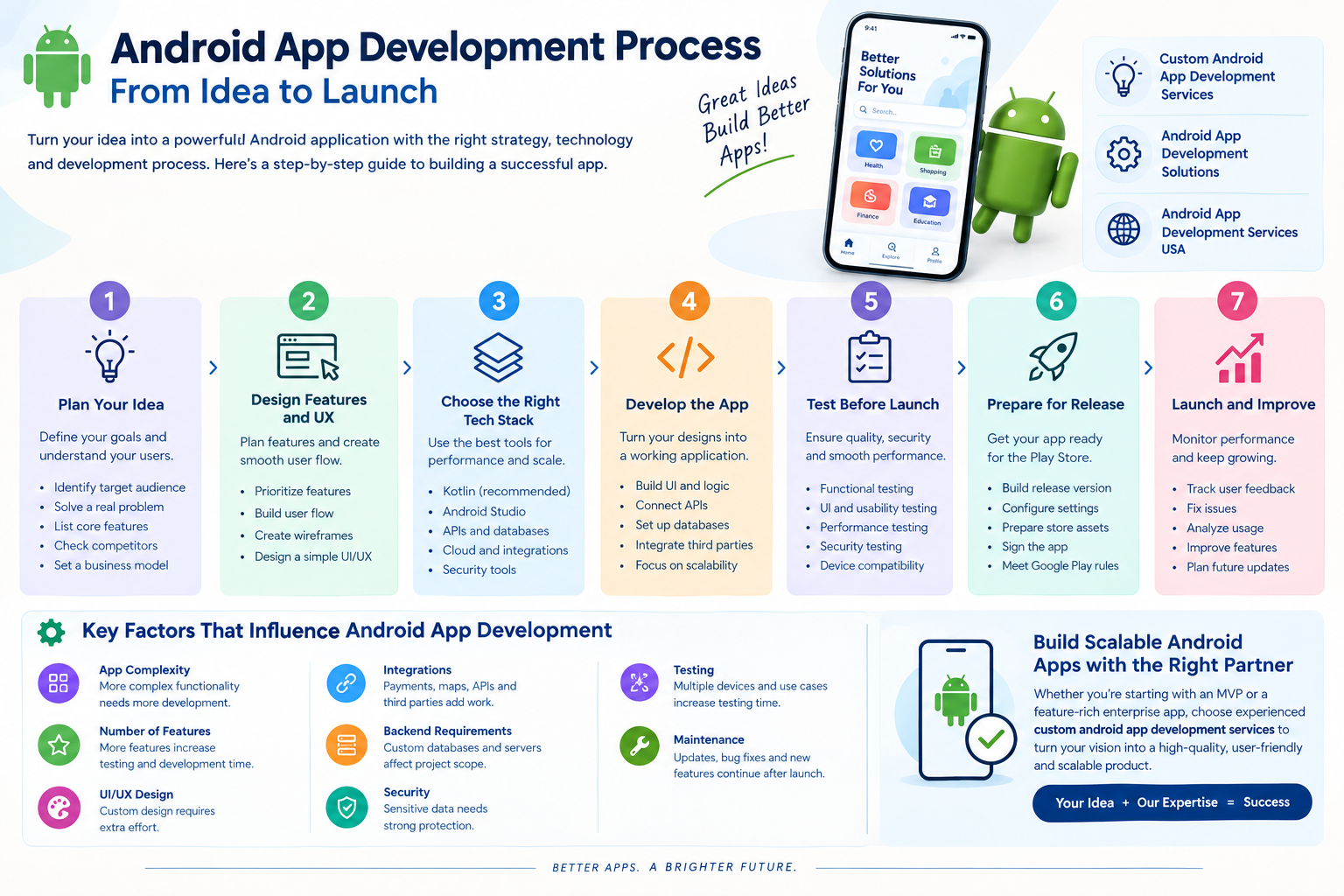
Turning an app idea into a successful Android product requires more than writing code. A well-planned development process helps businesses validate their idea, understand their users, build useful features, test the application, and prepare it for launch.
Google's official Android documentation recommends Kotlin for new Android projects and explains that Android Studio provides the project structure and tools needed to build, test, and debug applications. This makes choosing the right technology and development approach an important early decision for businesses planning a new Android application.
Why a Structured Android App Development Process Matters
A clear development process gives your project direction from the beginning. Instead of developing features randomly, your team can define business objectives, prioritize user needs, estimate resources, and establish measurable goals.
Whether you are building a shopping app, healthcare platform, financial application, or business management tool, each stage contributes to the final product. A structured approach can also help identify technical or usability problems before they become expensive to fix.
Step 1: Turn Your App Idea Into a Clear Plan
Every successful application starts with a well-defined idea. Before development begins, determine what problem the app will solve and who will use it.
Start by identifying:
- Target users and their expectations
- The main problem your app addresses
- Core features required for the first version
- Competitors and their existing features
- Revenue or business model
- Platforms and devices you need to support
At this stage, avoid adding every possible feature. Focus on the functionality that provides the most value to your target users.
Step 2: Plan Features and User Experience
Once the concept is clear, convert it into a feature plan. Your team can divide features into essential, important, and future requirements.
Next, create the application's user flow. This shows how users will move from registration to the primary action, such as booking a service, placing an order, making a payment, or viewing information.
A simple and logical user experience can make the application easier to understand and use. Wireframes and prototypes are useful here because they allow businesses to review the interface before full development begins.
Step 3: Choose the Right Android Technology Stack
Technology decisions influence the application's performance, scalability, maintenance, and development effort.
For modern Android development, Kotlin is the recommended language according to Android Developers. Android Studio is used to create projects, manage code, build applications, and support testing and debugging.
Depending on the application, the technology stack may include:
- Kotlin for application development
- Jetpack and Android libraries
- Android Studio for development
- APIs for connecting external services
- Databases for storing application data
- Cloud infrastructure for backend services
- Payment, maps, analytics, or authentication integrations
Businesses working with a custom android app development company should discuss these technical decisions before development starts.
Step 4: Develop the Android Application
Now the development team begins converting the approved designs and requirements into a functional application.
Development generally involves building the user interface, implementing business logic, connecting APIs, configuring databases, and integrating third-party services.
For larger applications, development can be divided into smaller modules or features. This makes the project easier to build, test, and maintain.
The development team should also keep scalability and security in mind instead of focusing only on getting the first version running.
Step 5: Test Before You Launch
Testing should not be treated as the final checkbox. It should happen throughout development.
According to Android Developers, testing helps verify correctness, functional behavior, usability, performance, accessibility, and compatibility. Android applications can require different testing approaches, including unit, integration, functional, performance, and compatibility testing.
A practical testing process should cover:
- Functional testing
- UI and usability testing
- Performance testing
- Security testing
- Device compatibility testing
- Network and offline scenarios
- Permission handling
- Crash and error testing
Testing on real devices is also important because Android applications operate across different device configurations. Android recommends testing on physical devices before release, while the Android Emulator and Firebase Test Lab can help expand device and OS coverage.
Step 6: Prepare the App for Release
After testing is complete, the application needs to be prepared for distribution.
This includes configuring the release build, checking application settings, preparing the app icon and store assets, signing the application, and ensuring the production environment is ready.
Android Developers notes that release preparation includes configuring, building, and testing the release version before distribution.
Your team should also review Google Play requirements, app permissions, privacy information, screenshots, descriptions, and other publishing requirements before submission.
Step 7: Launch, Monitor, and Improve
Launching the application is not the end of the Android app development process. It is the beginning of the product's real-world lifecycle.
After launch, monitor:
- User feedback and reviews
- Crash reports
- App performance
- Feature usage
- User retention
- Conversion rates
- Security issues
- Support requests
This information can help you decide which improvements should be included in future releases.
Businesses seeking android app development solutions should therefore consider maintenance and post-launch support as part of the overall project rather than treating them as optional activities.
Key Factors That Influence Android App Development
The overall development effort depends on several factors:
| Factor | Impact |
|---|---|
| App complexity | More complex functionality requires additional development |
| Number of features | More features increase development and testing requirements |
| UI/UX design | Custom interfaces can require additional design and development effort |
| Integrations | Payments, maps, APIs, and third-party services add technical work |
| Backend requirements | Custom databases and server-side functionality affect project scope |
| Security | Sensitive data may require additional security controls |
| Testing | Multiple devices and use cases increase testing requirements |
| Maintenance | Updates, bug fixes, and new features continue after launch |
For businesses targeting customers in different markets, android app development services usa may also involve additional considerations such as localization, compliance requirements, payment systems, and regional user expectations.
Final Thoughts
A successful Android application is built through a combination of research, planning, design, development, testing, launch preparation, and continuous improvement. Following a structured process helps businesses turn an initial concept into a reliable digital product while reducing avoidable development problems.
Whether you are creating an MVP or a feature-rich enterprise application, choosing experienced custom android app development services can help you manage the technical process while keeping the product aligned with business and user requirements.

 English
 Arabic
 French
 Spanish
 Portuguese
 Deutsch
 Turkish
 Dutch
Dutch
 Russian
 Romaian
 Portuguese (Brazil)
 Greek
Greek
