


How Data Analytics Solutions Help Businesses Make Smarter Decisions
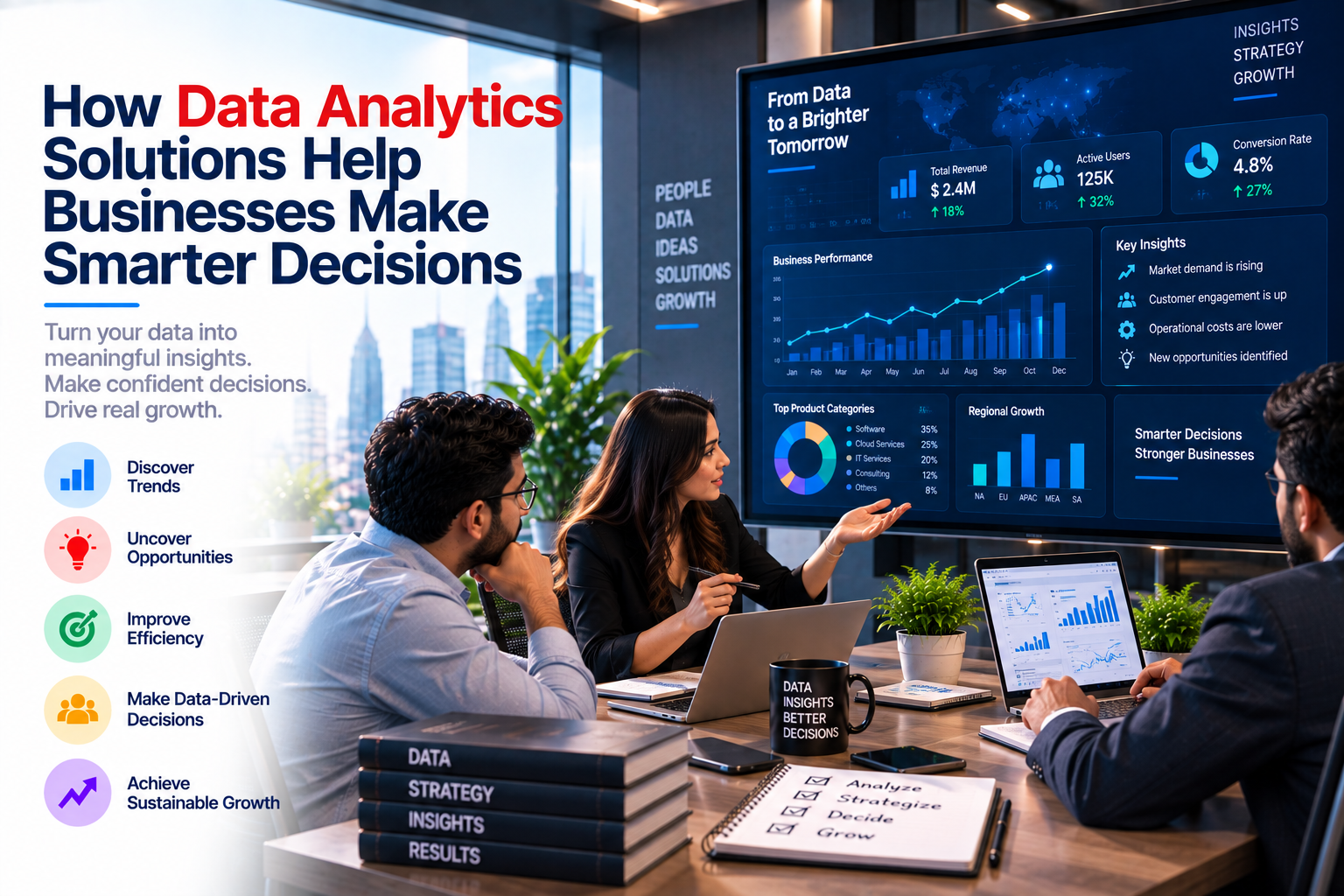
Businesses generate a huge amount of information every day. Sales records, customer interactions, website activity, financial reports, and operational data are all valuable. But raw data alone does not help a company grow. It needs to be organized, understood, and turned into useful insights. This is where data analytics solutions become important. They help businesses discover patterns, measure performance, understand customers, and make decisions based on evidence instead of guesswork.
For a growing company, this can make a real difference. Imagine a business owner checking monthly sales and noticing that revenue has dropped. Instead of simply assuming the market is weak, analytics can reveal which products are losing demand, which customers are changing their buying habits, and where the problem actually started. Suddenly, the numbers tell a story.
What Are Data Analytics Solutions?
Data analytics solutions are technologies, processes, and services used to collect, organize, examine, and interpret business information. They can bring data from different sources into one environment and transform complicated datasets into understandable reports and insights.
Modern analytics may include business intelligence dashboards, predictive analytics, data visualization, reporting systems, customer analytics, and performance monitoring. The goal is simple: help decision-makers understand what is happening and why it is happening.
This is especially useful when a company has more data than its employees can manually review. A spreadsheet might work for a small operation, but as information grows, manual analysis becomes slower and more difficult. Automated analytics can handle larger volumes while giving teams quicker access to important information.
Turning Raw Data Into Useful Business Insights
One of the biggest advantages of analytics is its ability to turn raw information into something people can actually use. A company may have thousands of customer records, but those records do not automatically explain customer behavior.
Analytics tools can identify purchasing patterns, seasonal trends, high-performing products, and areas where customers are leaving. Managers can then use those findings to adjust marketing campaigns, improve products, or change their sales strategy.
For example, an online store may discover that customers who purchase one particular product often return for another product within a few weeks. That insight could support a targeted follow-up campaign. Small discovery. Potentially big impact.
Improving Data Quality With Master Data Management
Good analysis depends on good data. If customer names, product information, locations, or financial records are duplicated or inconsistent, the resulting reports may be misleading. This is why master data management solutions are closely connected with effective analytics.
Master data management helps businesses create consistent and reliable versions of important information across different systems. Instead of having separate customer records in multiple databases, organizations can work toward a more unified view.
This creates a stronger foundation for reporting and decision-making. When teams trust the information they are analyzing, they can act with greater confidence. It also reduces the time employees spend correcting duplicate or inaccurate records.
Using Cloud Data Services for Flexible Analytics
Many businesses now operate across multiple locations and digital platforms. Their information may exist in applications, databases, websites, CRM systems, and cloud platforms. Bringing all of this together can be challenging without the right infrastructure.
Cloud data services Pakistan businesses use can provide flexible ways to store, manage, process, and access information. Cloud-based environments can support analytics without requiring every organization to maintain extensive physical infrastructure.
This can be particularly useful for companies experiencing rapid growth. Data requirements change quickly. A flexible cloud environment can make it easier to increase capacity, connect new data sources, and support remote teams.
Making Faster and More Confident Decisions
Business decisions often need to happen quickly. Waiting weeks for a manual report can mean missing an opportunity. Analytics can provide dashboards and automated reporting that allow decision-makers to monitor important metrics more regularly.
A sales manager, for instance, can review current performance rather than waiting until the end of the month. If one region is performing below expectations, the team can investigate early. If another product is suddenly gaining demand, inventory planning can respond accordingly.
It is not about replacing human judgment. Quite the opposite. Analytics gives people better information so their judgment has a stronger foundation.
Understanding Customers More Clearly
Customers leave clues through almost every digital interaction. Website visits, purchases, support requests, reviews, email engagement, and social activity can all provide useful information.
Analytics can bring these signals together to help businesses understand customer preferences. Companies can identify which products attract attention, where customers experience difficulties, and what encourages repeat purchases.
This knowledge can improve customer experience in practical ways. Marketing becomes more relevant. Services can be adjusted. Product development can focus on actual demand rather than assumptions.
Supporting Better Financial Planning
Financial decisions require accuracy. Businesses need to understand revenue, costs, profitability, cash flow, and future requirements. Analytics can make these areas easier to monitor.
Instead of looking at isolated financial figures, companies can examine trends over time. They may identify unnecessary expenses, profitable product lines, changing margins, or unusual transactions.
Predictive analytics can also help organizations prepare for possible future scenarios. It cannot tell the future with certainty, of course. But it can use historical patterns and available information to support more informed planning.
Improving Operational Performance
Analytics is not limited to sales and finance. It can also improve everyday operations. Businesses can analyze delivery times, employee productivity, inventory levels, service performance, and other operational indicators.
Suppose a company notices that certain orders consistently take longer to process. Analytics can help identify where delays occur. Perhaps the issue is inventory availability, a particular process, or a system bottleneck.
Once the problem becomes visible, management has something concrete to work on. That is one of the practical strengths of analytics. It turns vague concerns into measurable questions.
Why Data Security and Governance Matter
More data also secure your website greater responsibility. Businesses need appropriate controls around access, privacy, security, and data governance. Analytics should not simply collect everything without considering how information is managed.
A reliable data strategy establishes who can access particular information, how data is stored, and how its quality is maintained. This becomes increasingly important as organizations connect more systems and use cloud environments.
Strong governance supports better analytics because trustworthy information is easier to use responsibly.
How Chromeis Can Support Data-Driven Business Growth
Businesses looking to improve their digital infrastructure may need more than an analytics dashboard. They often require connected data systems, cloud infrastructure, data management, and technology expertise working together.
Chromeis can help organizations explore technology solutions that support better data management and digital operations. From modern data environments to related IT services, the right approach depends on a company's size, goals, existing systems, and future plans.
The important thing is not to collect data simply because it is available. The real value comes from knowing what information matters and using it to solve genuine business problems.
Conclusion
Data analytics solutions give businesses a practical way to turn information into meaningful insights. They can support faster decisions, better customer understanding, stronger financial planning, and more efficient operations. When combined with master data management solutions and suitable cloud infrastructure, analytics can become part of a broader data strategy rather than a standalone reporting tool.
For businesses in Pakistan and beyond, the opportunity is growing as more operations move online and generate valuable digital information. Chromeis can support organizations looking to build stronger technology and data capabilities. The key is simple: collect reliable information, understand what it is saying, and then use those insights to make smarter business decisions.
Frequently Asked Questions
1. What are data analytics solutions used for?
Data analytics solutions are used to collect, organize, analyze, and interpret business information. They can help companies understand customers, monitor performance, identify trends, improve operations, and support more informed decisions.
2. How can analytics improve business decision-making?
Analytics provides evidence that can help decision-makers understand current performance and identify patterns. Instead of relying entirely on assumptions, managers can use measurable information to evaluate opportunities, problems, and potential business changes.
3. Why are master data management solutions important for analytics?
Master data management solutions help maintain consistent and reliable core information, such as customer, product, and supplier records. Better data quality creates a stronger foundation for accurate reports and business analysis.
4. Are cloud data services useful for businesses in Pakistan?
Yes. Cloud data services Pakistan companies use can provide flexible data storage, processing, integration, and access. They can be useful for organizations that need scalable infrastructure or support teams working across different locations.
5. Can small businesses benefit from data analytics?
Yes. Analytics is not limited to large enterprises. Small businesses can use sales, customer, website, and operational data to identify trends, understand their audience, control costs, and make more informed decisions as they grow.

 English
 Arabic
 Spanish
 Portuguese
 Deutsch
 Turkish
 Dutch
Dutch
 Italiano
 Russian
 Romaian
 Portuguese (Brazil)
 Greek
Greek
