


How Does Cookware Thickness Affect Heat Control?
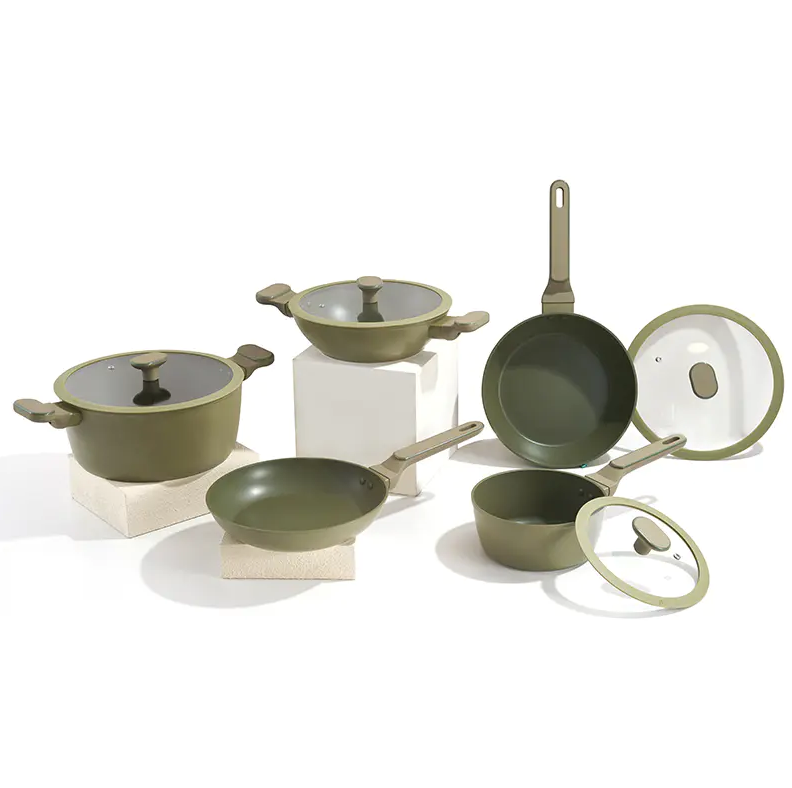
Heat distribution is an important consideration for cookware used for frying, sautéing, simmering, boiling, and slow cooking. A pan that heats quickly but develops strong temperature differences across the cooking surface can make it harder to control food texture and browning. This is where the material, manufacturing process, base construction, and wall thickness of a cookware product work together.
Our Die-Cast Aluminum Cookware Set is designed around the characteristics of cast aluminum construction, providing a practical combination of thermal response, structural support, and manageable weight for everyday kitchen applications.
Why Is Aluminum Used for Cookware?
Aluminum has a relatively high thermal conductivity compared with many commonly used cookware metals. Depending on alloy composition and casting conditions, cast aluminum can have thermal conductivity in the approximate range of 120–170 W/m·K, while pure aluminum can reach around 205 W/m·K.
This property allows heat introduced at the base to travel across the cookware body relatively quickly. However, material conductivity alone does not determine cooking performance. The geometry of the cookware also affects how heat moves.
A die-cast construction allows manufacturers to control the shape and thickness of different areas of the cookware. The base can be designed with greater thickness for additional thermal mass, while sidewalls can use a different thickness to balance weight and structural rigidity.
How Does Thickness Affect Cooking Performance?
Body thickness is an important technical parameter for a Die-Cast Aluminum Cookware Set. Common die-cast aluminum cookware can have body thicknesses around 2.0–4.0 mm, while some designs use thicker sections around the base or rim.
For example, a product specification may use:
| Parameter | Typical Design Range |
|---|---|
| Cookware body thickness | 2.0–4.0 mm |
| Reinforced base section | 4.0–6.0 mm |
| Frying pan diameter | 20–30 cm |
| Saucepan diameter | 16–20 cm |
| Casserole diameter | 20–28 cm |
| Cooking surface | Non-stick coated aluminum |
| Lid material | Tempered glass |
| Handle material | Bakelite or heat-resistant polymer |
| Induction base | Stainless-steel magnetic plate, where required |
These figures are design examples rather than fixed specifications. Different cookware sizes require different wall and base dimensions.
A thinner body can respond rapidly to changes in burner output. A thicker base adds thermal mass and can help stabilize cooking temperatures after cold ingredients are added. Die casting also allows thickness to be distributed according to the functional requirements of each section rather than using exactly the same wall thickness everywhere.
Does the Base Design Matter?
The base is the main contact area between the cookware and the heat source. A flat and stable base helps transfer heat across a wider surface.
For gas and electric cooktops, the aluminum body can receive heat directly through the base. Induction cooking requires a different approach because conventional aluminum is not magnetic. A Die-Cast Aluminum Cookware Set intended for induction use can incorporate a stainless-steel magnetic plate beneath the aluminum body.
This construction can support compatibility with gas, electric, ceramic, and induction cooktops, depending on the final product design and testing requirements.
How Does Die Casting Influence Cookware Geometry?
Die casting uses a mold to form the aluminum body into a controlled shape. This manufacturing method can accommodate features such as reinforced rims, thicker bases, curved sidewalls, helper handles, pouring edges, and specific exterior profiles.
Such flexibility is useful for cookware sets containing several product types. A frying pan may require a broad cooking surface, while a saucepan needs greater depth. A casserole may require a thicker base and stable sidewalls for longer cooking cycles.
The manufacturing process therefore affects more than appearance. It also influences dimensional consistency, weight distribution, base geometry, and the way the cookware responds to heat.
What Should Buyers Check?
Buyers evaluating a Die-Cast Aluminum Cookware Set can review several technical details before placing an order:
-
Aluminum alloy and material specification
-
Body and base thickness
-
Product diameter and capacity
-
Base flatness
-
Induction compatibility
-
Non-stick coating structure
-
Handle attachment method
-
Lid material and diameter
-
Individual product weight
-
Carton dimensions and packing method
A cookware set can include frying pans, saucepans, casseroles, woks, and glass lids. Matching the sizes within the set helps create a product range that covers different cooking tasks without adding unnecessary pieces.
A Practical Structure for Daily Cooking
Die-cast aluminum cookware combines material conductivity with a molded structure that can be engineered around different cooking requirements. Base thickness, wall thickness, coating, handle construction, and heat-source compatibility all contribute to the final product specification.
For buyers developing a private-label cookware range, these technical details can also be adjusted according to target markets, packaging requirements, cooking habits, and retail positioning. A clear specification sheet makes it easier to compare product samples and maintain consistency during production.
A well-planned Die-Cast Aluminum Cookware Set is therefore not simply a collection of pots and pans. Its performance comes from the relationship between aluminum composition, casting geometry, thickness, surface treatment, and heat-source compatibility.

 English
 Arabic
 French
 Portuguese
 Deutsch
 Turkish
 Dutch
Dutch
 Italiano
 Russian
 Romaian
 Portuguese (Brazil)
 Greek
Greek
