


Complex Billing vs Traditional Subscription Billing: What’s the Difference?
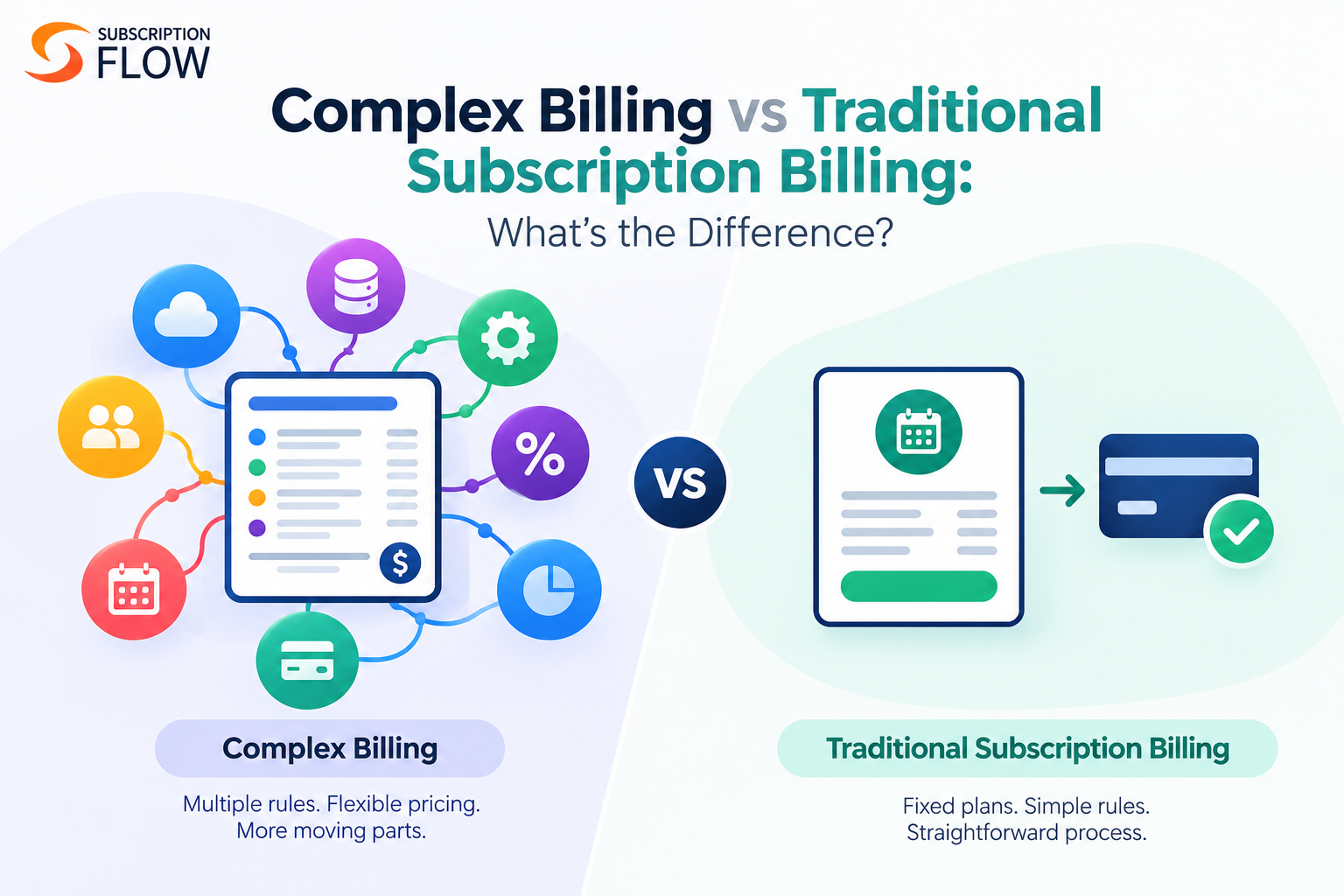
Subscription billing has become an essential part of the modern SaaS, digital services, and recurring-revenue economy. As businesses grow, however, their billing requirements often become more complicated. A company may begin with a simple monthly subscription, but as customers demand flexible pricing, usage-based plans, custom contracts, multiple currencies, discounts, and mid-cycle changes, traditional billing models can become difficult to manage. This is where complex billing comes into play. Understanding the difference between traditional subscription billing and complex billing can help businesses choose a billing approach that better matches their customers, pricing strategy, and growth objectives.
What Is Traditional Subscription Billing?
Traditional subscription billing is based on a straightforward recurring payment structure. Customers select a predefined plan and pay a fixed amount at a regular interval, such as monthly, quarterly, or annually. For example, a project management platform might charge $49 per month for its Pro plan, regardless of how frequently the customer uses the platform. A streaming service may similarly charge a fixed monthly fee regardless of how many hours a customer watches.
The main advantage of traditional subscription billing is simplicity. Customers know exactly what they will pay during each billing cycle, while businesses can automate recurring charges without needing sophisticated usage-metering systems. This model is particularly common among early-stage SaaS companies, content platforms, digital applications, and businesses where customer consumption remains relatively consistent.
How Traditional Subscription Billing Works
The traditional billing process generally begins when a customer selects a predefined subscription plan. The billing system stores the subscription details and automatically generates a recurring charge on the customer's renewal date. An invoice or receipt is then generated for the fixed subscription amount, and the subscription continues to renew until the customer upgrades, downgrades, or cancels.
Because the price remains relatively consistent, businesses can also forecast recurring revenue more easily. For example, a company with 500 customers paying $49 per month can estimate $24,500 in monthly recurring revenue before accounting for churn, failed payments, discounts, or other adjustments.
Benefits and Limitations of Traditional Billing
Traditional subscription billing offers predictability, straightforward customer communication, lower operational complexity, and faster implementation. Finance teams can easily understand recurring revenue, while customers are less likely to experience unexpected invoice amounts.
However, this simplicity can become a limitation as a business expands. A flat-rate model may not accurately reflect differences in customer usage. If one customer uses a service occasionally while another consumes significantly more resources, charging both customers the same amount may create an imbalance between price and value. Traditional billing can also make it difficult to accommodate customized enterprise agreements, volume discounts, minimum commitments, overage charges, and other negotiated terms.
What Is Complex Billing?
Complex billing is designed for businesses whose pricing cannot be represented by a single fixed recurring charge. Instead of applying the same price to every customer, complex billing can take multiple variables into account, including usage, customer-specific contracts, pricing tiers, discounts, credits, currencies, entities, minimum commitments, overages, and prorated changes.
For example, a cloud infrastructure provider may charge customers according to storage, computing resources, API requests, or data transfer. Two customers may use the same service but generate completely different invoices because their consumption levels and contractual terms differ. Complex billing allows the billing system to calculate those differences automatically.
How Complex Billing Works
Complex billing typically starts with the collection of usage and subscription data. Usage events can include API calls, gigabytes of storage, transactions, seats, minutes, messages, or other measurable activities. The billing system then applies the appropriate pricing and rating rules to that data.
Once usage has been calculated, the resulting charges can be combined with recurring subscription fees, discounts, credits, taxes, minimum commitments, and prorated adjustments. The system generates a consolidated invoice reflecting the customer's actual contractual and consumption-based charges. Payment collection and revenue processes can then be automated according to the company's financial and accounting requirements.
Why Businesses Are Moving Toward Complex Billing
As companies move from simple self-service subscriptions toward larger enterprise customers, their billing requirements often evolve. Enterprise customers may negotiate annual commitments, volume discounts, customized payment schedules, multiple products, or specific usage allowances. At the same time, SaaS and technology companies increasingly use usage-based and hybrid pricing models to align their charges with the value customers receive.
Complex billing provides the flexibility to support these models without forcing every customer into the same pricing structure. Instead of treating every customer identically, businesses can establish billing rules that reflect different contracts, consumption levels, products, entities, and commercial agreements.
Common Complex Billing Models
Usage-based billing is one of the most common complex billing models. Customers are charged according to how much of a particular service they consume, such as API calls, storage, transactions, compute time, or AI tokens. This approach allows the customer's bill to increase or decrease based on actual consumption.
Tiered pricing is another widely used approach. Customers are placed into different pricing levels based on their usage or selected features. A business might offer a basic plan for smaller customers and progressively larger plans for customers requiring additional capacity or functionality.
Volume-based pricing charges customers according to the total volume they purchase or consume, often with a lower rate applied when specific thresholds are reached. Hybrid billing combines a fixed recurring charge with a variable usage component. This can provide businesses with a predictable baseline of recurring revenue while allowing additional charges to increase with customer consumption.
Per-seat-plus-usage models combine user-based pricing with metered consumption. For example, a software company might charge a base amount for every active user while separately charging for storage, automation runs, API usage, or other consumption. Minimum commitments can also be incorporated into complex billing, ensuring that a customer agrees to a predefined spending level regardless of whether actual usage falls below that threshold.
Complex Billing vs Traditional Subscription Billing
The primary difference between traditional and complex billing is the number of variables used to calculate the customer's invoice. Traditional billing generally revolves around a fixed plan, fixed price, and fixed billing schedule. Complex billing can incorporate usage, contracts, pricing rules, discounts, credits, currencies, entities, and mid-cycle changes.
Traditional billing is therefore easier to implement and forecast on an individual customer basis, while complex billing provides greater flexibility for businesses with diverse customer requirements. Neither approach is universally appropriate. The right model depends on the company's products, customer segments, pricing strategy, sales process, and operational requirements.
When Should a Business Consider Complex Billing?
Businesses should consider complex billing when customer usage varies significantly, enterprise contracts require customized pricing, or finance teams regularly make manual billing adjustments. A growing number of billing exceptions can be an indication that the existing billing infrastructure is no longer aligned with the company's pricing strategy.
Companies should also evaluate complex billing when they introduce usage-based pricing, hybrid models, volume discounts, minimum commitments, multiple currencies, or products with different billing dimensions. Moving to a more flexible billing infrastructure can help businesses manage these requirements more systematically.
Challenges of Complex Billing
While complex billing offers greater flexibility, it also introduces additional operational requirements. Businesses need accurate usage metering, reliable rating calculations, clear invoice generation, and mechanisms for handling corrections and changes. Proration can become particularly important when customers upgrade, downgrade, add seats, or change plans in the middle of a billing period.
Customer transparency is another important consideration. When invoices vary from one month to another, customers need clear visibility into their consumption and the factors affecting their charges. Businesses should therefore provide accessible usage information and detailed invoices to minimize confusion and billing disputes.
How SubscriptionFlow Helps Businesses Manage Complex Billing
SubscriptionFlow helps businesses simplify the transition from traditional subscription billing to more advanced billing models. Instead of relying on multiple disconnected systems for subscriptions, usage, invoicing, payments, and customer management, businesses can use SubscriptionFlow to manage different billing requirements through a unified subscription management platform.
For businesses adopting usage-based or hybrid pricing, SubscriptionFlow can help manage recurring charges alongside consumption-based components. This enables companies to build billing structures that can accommodate fixed subscriptions, usage charges, tiered pricing, overages, discounts, and other pricing requirements.
Flexible Pricing and Plan Configuration
SubscriptionFlow gives businesses the flexibility to configure different pricing structures as their commercial models evolve. Businesses can create and manage plans, pricing rules, promotions, and billing configurations without making every pricing change dependent on extensive development work. This can help product, finance, and revenue teams respond more quickly when pricing strategies change.
Automated Proration and Subscription Changes
Mid-cycle subscription changes can create significant administrative work when handled manually. SubscriptionFlow helps automate billing adjustments associated with upgrades, downgrades, plan changes, and other subscription modifications. Automated proration can help ensure that customers are charged according to the appropriate portion of their billing period.
Usage and Consumption Management
For companies using consumption-based pricing, accurate usage tracking is essential. SubscriptionFlow supports billing workflows that can incorporate consumption data into the invoicing process, helping businesses connect customer activity with the charges appearing on their invoices. This can make it easier for companies to operate pricing models where revenue changes alongside customer usage.
Automated Invoicing and Payment Collection
SubscriptionFlow also helps businesses automate invoice generation and recurring payment collection. Instead of manually preparing invoices for different customers and contracts, businesses can automate billing workflows and generate invoices based on configured subscription and pricing rules. Payment recovery and dunning capabilities can further help businesses manage failed or declined payments.
Better Visibility for Finance and Revenue Teams
As billing becomes more sophisticated, finance and revenue teams need better visibility into subscriptions, customer consumption, invoices, and revenue-related data. SubscriptionFlow provides reporting and analytics capabilities that can help businesses monitor subscription performance and understand customer billing activity. This visibility can support better operational decision-making as companies scale.
Supporting Businesses Across Different Industries
Complex billing is not limited to SaaS companies. Telecommunications providers, cloud platforms, fintech businesses, utilities, healthcare organizations, digital services, and logistics companies can all have billing requirements that extend beyond a simple recurring subscription.
SubscriptionFlow's flexible billing capabilities can help businesses across these industries manage recurring revenue and more sophisticated pricing structures while reducing the manual work associated with billing operations.
Choosing the Right Billing Approach
The choice between traditional and complex subscription billing should depend on the way a business sells, prices, and delivers its products or services. Businesses with standardized products, consistent customer usage, and straightforward pricing may find traditional recurring billing sufficient. Companies dealing with variable consumption, enterprise contracts, negotiated pricing, or multiple billing dimensions may require a more flexible billing architecture.
The key is to choose a billing infrastructure that can support the company's current requirements while providing enough flexibility for future growth. As pricing models evolve, billing should not become a barrier to launching new products, entering enterprise markets, or experimenting with new revenue models.
Final Thoughts
Traditional subscription billing remains an effective model for businesses that value simplicity and predictable recurring charges. However, as customer requirements and pricing strategies become more sophisticated, complex billing provides the flexibility needed to account for usage, contracts, discounts, commitments, and other variables.
For growing businesses, the goal is not simply to make billing more complicated. It is to create a billing system that accurately reflects how customers buy and use products while minimizing manual work for finance, operations, and engineering teams. With capabilities for flexible pricing, usage-based billing, automated invoicing, proration, payment recovery, and subscription management, SubscriptionFlow can help businesses build a more adaptable billing infrastructure as they scale.

 English
 Arabic
 French
 Spanish
 Deutsch
 Turkish
 Dutch
Dutch
 Italiano
 Russian
 Romaian
 Portuguese (Brazil)
 Greek
Greek
