


Organic vs Paid Social Media: Which Strategy Drives Better Results for Small Businesses?
Most small business owners ask this question the wrong way. They treat organic and paid social media like two competing philosophies, as if picking one means rejecting the other. That framing costs businesses money and momentum, because the real answer almost never lives at either extreme.
This article breaks down what organic and paid social media actually do differently, where each one earns its keep, the mistakes that quietly drain budgets, and how to build a strategy that uses both without wasting spend on the wrong one. By the end, you'll have a clearer framework for deciding where your next marketing dollar and next hour of content work should go.
What Organic and Paid Social Media Actually Mean
Organic social media covers everything you post without paying to boost or distribute it: feed posts, Reels, carousels, community replies, and the slow build of an audience that finds you through the platform's normal algorithm. Paid social media covers ad spend placed directly through a platform's advertising system, targeting specific audiences with a specific budget and a specific goal attached to every dollar.
The confusion starts because both live on the same platforms and often look nearly identical in the feed. A well-made paid ad can look exactly like an organic post, and a strong organic post can occasionally outperform a poorly targeted ad. That similarity in appearance hides a very different mechanism underneath.
Organic reach is earned through relevance and engagement, filtered by an algorithm that decides who sees your content based on behavior signals. Paid reach is bought outright, filtered by your targeting choices and your willingness to compete in an auction against other advertisers chasing the same audience. Understanding that mechanical difference is the first step to using each one correctly instead of expecting them to behave the same way.
Why This Distinction Matters More Than Most Businesses Realize
A lot of small business owners we talk with have already tried both, usually with mixed results, and often without ever isolating which one actually produced the result they got. A sales spike right after boosting a post doesn't automatically mean the boost caused it. A slow trickle of organic followers doesn't automatically mean organic content isn't working.
Without separating the two, it becomes nearly impossible to make a smart budget decision next quarter. That's the gap a lot of businesses are working with when they come to an agency: not a lack of content, but a lack of clarity on what's actually driving results.
Where Organic Social Media Wins
Organic content builds something paid ads structurally cannot: a relationship with an audience that chooses to follow you, not one that was interrupted by a targeted ad. That relationship compounds over time, which is exactly why organic tends to feel slow in month one and valuable by month twelve.
It's also the channel where trust gets built before a purchase decision. A prospective customer scrolling through a brand's last twenty posts is doing informal due diligence, checking whether the business seems real, active, and consistent. Paid ads rarely get evaluated that closely, because the context is different; a user knows it's an ad and mentally files it as such.
Organic social media is also where brand voice, community management, and customer service overlap in ways that directly affect reputation. A thoughtful reply to a comment or a well-handled public complaint does more for long-term trust than most ad creative ever will.
Common Organic Mistakes Small Businesses Make
The businesses that struggle with organic usually aren't lacking effort. They're spending that effort in the wrong places.
|
Common Organic Mistake |
Why It Limits Growth |
What to Do Instead |
|
Posting inconsistently, in bursts |
Algorithms deprioritize accounts with unpredictable activity |
Build a realistic, sustainable posting cadence |
|
Treating every post as a sales pitch |
Audiences disengage from constant self-promotion |
Balance promotional posts with value and personality |
|
Ignoring comments and DMs |
Signals low engagement, hurts algorithmic reach |
Reply promptly; engagement rewards visibility |
|
No clear content pillars |
Feed feels random, doesn't build topical trust |
Define 3-4 recurring themes tied to the business |
|
Chasing every trend regardless of fit |
Dilutes brand identity, rarely converts |
Adapt trends only when they fit the brand naturally |
How Paid Social Media Changes the Equation
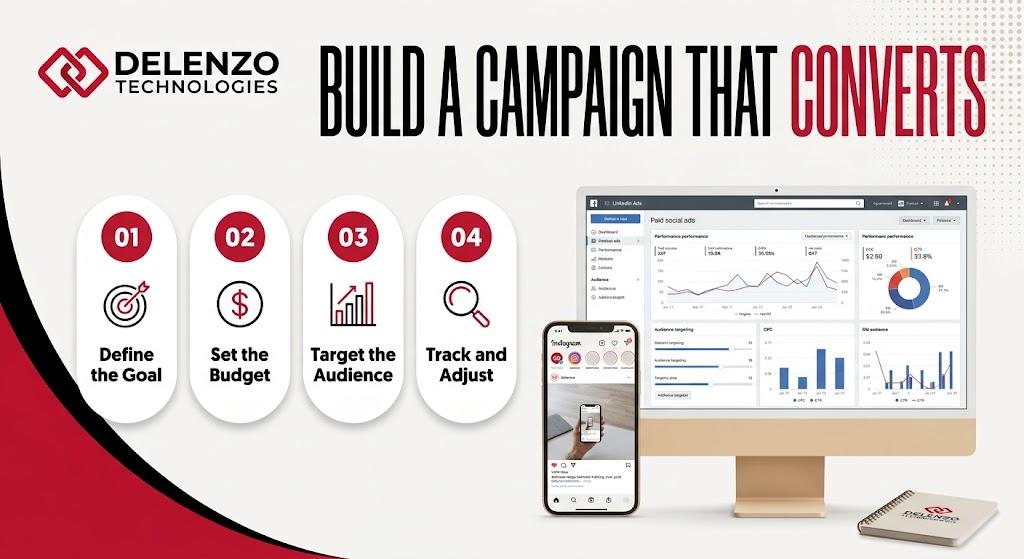
Paid social solves the one problem organic can't: speed. A new business with zero followers can be in front of a precisely defined audience within hours of launching a campaign, something that would take months to achieve organically. That speed is valuable, but it's not automatically efficient, and efficiency is where most paid campaigns actually succeed or fail.
The advantage of paid social is control. You choose the audience by location, interest, behavior, and even how closely they resemble your existing customers through lookalike targeting. You choose the goal, whether that's website traffic, lead generation, or direct conversions, and the platform optimizes delivery specifically toward that goal rather than general engagement.
That precision is also why paid social punishes weak strategy faster than organic does. A poorly targeted or poorly designed ad burns through budget in days, while a mediocre organic post simply underperforms quietly without costing anything beyond the time it took to make.
Where Paid Social Spend Gets Wasted
Wasted ad spend rarely comes from the platform itself. It comes from a handful of repeatable strategic errors that show up across almost every industry.
Boosting a post instead of building an actual campaign is one of the most common. A "boost" button optimizes for engagement, not business outcomes, which means it can produce likes and comments while contributing nothing to actual leads or sales. A properly built campaign, structured around a specific objective inside the platform's ad manager, gives far more control over who sees the ad and what action they're pushed toward.
Weak creative is another. No amount of targeting precision fixes an ad that doesn't stop the scroll or doesn't clearly communicate an offer within the first few seconds. And running ads without a matching landing page experience wastes a huge share of budget, since a click that lands on a slow, unclear, or mismatched page rarely converts regardless of how well-targeted it was.
Organic vs Paid: A Side-by-Side Comparison
Rather than treating this as a debate, it's more useful to see exactly where each strategy earns its place in a broader social media marketing plan.
|
Factor |
Organic Social Media |
Paid Social Media |
|
Speed to results |
Slow, builds over months |
Fast, results within days |
|
Cost structure |
Time and content production cost |
Direct ad spend, scales with budget |
|
Audience control |
Limited to algorithm's reach |
Precise targeting by interest, behavior, location |
|
Trust building |
Strong, feels earned by the audience |
Weaker, audience knows it's an ad |
|
Longevity of results |
Compounds over time |
Stops when spend stops |
|
Best used for |
Brand voice, community, retention |
Lead generation, launches, direct conversions |
Building a Strategy That Uses Both
The strongest small business social strategies we've seen don't pick a side. They use organic content to build the trust and brand consistency that make paid ads convert better, and they use paid social to accelerate reach and generate leads faster than organic alone ever could.
A practical way to think about it: organic social media marketing lays the foundation a customer checks before buying, while paid social advertising puts the right offer in front of the right person at the right moment. Retargeting campaigns are a clear example of this working together, since ads shown to people who already engaged with organic content tend to convert at a noticeably different rate than ads shown cold to strangers.
This is also where budget allocation matters more than picking a "winner." A new business with no existing audience often needs to lean harder into paid social early, simply to generate the data and traction that organic growth depends on later. An established local business with a loyal following might get more value from doubling down on organic content and community management, using paid spend selectively for specific promotions or launches rather than as a constant baseline.
None of this needs to be guesswork. Testing small, measuring actual business outcomes rather than vanity metrics like likes or impressions, and adjusting the mix based on what the data shows is how a sustainable social media marketing budget actually gets built over time.
Making the Right Call for Your Business
There's no universal ratio of organic to paid that works for every business, and any agency claiming otherwise is oversimplifying a decision that depends on your industry, budget, sales cycle, and current brand awareness. What matters is treating both channels as measurable, with clear goals attached to each, instead of defaulting to whichever one feels more comfortable.
Delenzo Technologies works with businesses across both sides of this equation, building organic content strategies that establish trust and paid social campaigns that turn that trust into pipeline. If you're trying to figure out where your next dollar should go between organic content and paid social advertising, that's exactly the kind of strategic conversation worth having before the next budget gets set.
Frequently Asked Questions
Should a small business start with organic or paid social media first? It depends on how much existing brand awareness the business already has. A brand-new business often benefits from some paid spend early to generate traction, while a business with an established local reputation may see faster returns from investing in organic content first.
How much budget should go toward paid social media as a small business? There's no fixed percentage that fits every business, since it depends on margins, customer lifetime value, and sales goals. A reasonable approach is starting with a modest, testable budget and scaling spend only once a campaign shows a clear, measurable return.
Can organic social media alone grow a small business? Yes, it can, particularly for businesses with a strong niche, consistent posting, and genuine community engagement, though growth is typically slower than a strategy that includes paid support. Many businesses use organic as the foundation and add paid social selectively to accelerate specific goals.
Why do some paid social ads fail even with a good budget? Budget rarely fixes weak creative, unclear targeting, or a mismatched landing page experience. A well-funded campaign built on the wrong offer or the wrong audience will still underperform, which is why strategy and creative matter as much as spend.
Is boosting a post the same as running a real paid social campaign? No, boosting typically optimizes for engagement rather than business outcomes like leads or sales. A properly built campaign through the platform's ad manager offers far more control over targeting, objective, and budget allocation.
How long does it take to see results from organic social media? Meaningful organic growth usually takes a few months of consistent posting and engagement rather than days or weeks. Results tend to compound, so the businesses that stay consistent typically see stronger returns the longer they stick with it.

 English
 Arabic
 Spanish
 Portuguese
 Deutsch
 Turkish
 Dutch
Dutch
 Italiano
 Russian
 Romaian
 Portuguese (Brazil)
 Greek
Greek
