


How Industrial LED High Bay Lighting Can Improve Visibility and Efficiency in Large Commercial Facilities
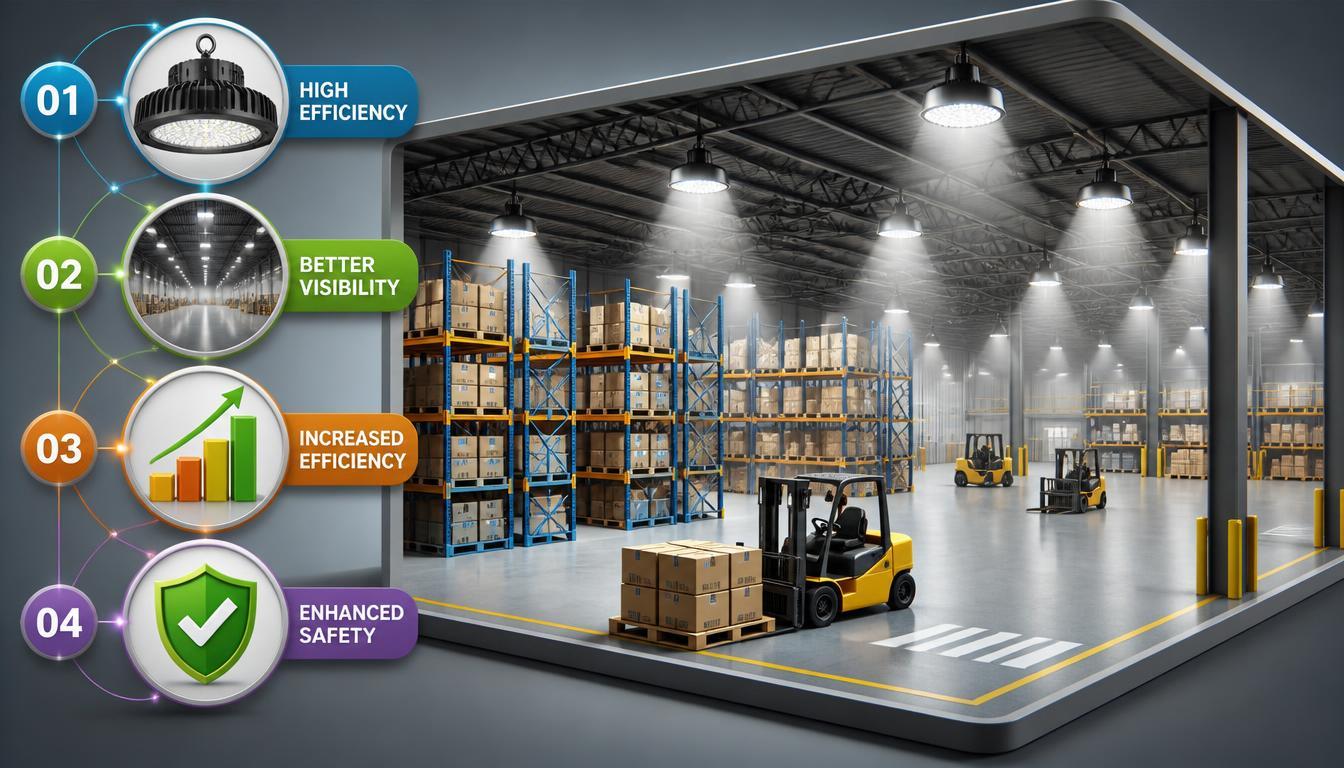
The demand for effective commercial lighting is rising as building and facility owners wish to achieve better visibility without wasting energy. This makes industrial LED high bay lights essential, as they provide sufficient luminosity while supporting efficient building operations.
What Are Industrial LED High Bay Fixtures?
These fixtures are designed for large spaces with high ceilings and broad floor areas. Industrial LED high bay systems direct substantial light downward, helping illuminate expansive facilities.
They differ from ordinary ceiling fixtures because their output and distribution suit elevated mounting heights.
Different layouts call for different fixture designs. The right choice depends on ceiling height, floor arrangement, mounting conditions, and required light distribution.
-
UFO high bays suit open areas where a compact fixture can provide broad downward illumination.
-
Linear high bays work well above long aisles, production lines, and regularly arranged workstations.
-
Suspended high bays can suit facilities where mounting flexibility helps position fixtures over specific work zones.
Beam distribution also matters. A beam’s angle shapes how light spreads, making distribution important when planning uniform illumination, according to the DOE.
How Do High Bay Fixtures Improve Visibility?
Clear lighting matters. Lighting quality matters most when workers perform frequent visual tasks.
OSHA specifies minimum illumination levels for certain construction-related work areas. Thus, OSHA requires a minimum of five foot-candles in places like indoor warehouses, corridors, hallways, and exitways.
That requirement shows why lighting quality matters in large work environments. Properly set up high bay lighting makes it possible to illuminate spaces in a manner such that poorly illuminated areas become rare in the warehouse and working space.
Example
A distribution center where personnel have to scan pallet labels from different aisles. Substantial lighting may allow the employees to see the labels without the need to go closer or use a flashlight.
Does This Lighting Support Work Productivity?
Yes, as good visibility supports visual tasks. Workers can read markings, inspect products, locate inventory, and monitor machinery more easily when work surfaces receive appropriate illumination.
A manufacturing facility provides a useful example. While checking finished parts, workers may need to recognize small surface imperfections, labels, or assembly features. Poor lighting can complicate the task, but properly utilized fixtures could help achieve proper visibility.
This creates stronger facility visibility across areas where employees perform frequent visual work. Better lighting cannot guarantee higher productivity, but it can provide clearer conditions for completing detail-oriented tasks.
What Makes LED High Bays More Efficient?
Achieving efficiency is not merely a matter of swapping out fixtures. Those who manage the physical site need to assess the lumen output, light efficacy, control measures, as well as the operation schedule and the needs of the location.
DOE states that LED luminaires can work with control technologies like occupancy sensors, task adjusters, and dimmers. Such technologies can minimize the time of unnecessary use when spaces are empty.
The result is more responsive energy-efficient illumination.
Example
A warehouse with infrequently used storage rows could use occupancy controls to alter its lighting in accordance with changes in activity.
What Should Facility Managers Check Before Installation?
A lighting upgrade should begin with the building layout. The following factors deserve attention before installation:
|
Facility Consideration |
Why It Matters |
|
Ceiling height |
Determines suitable fixture output and distribution |
|
Floor layout |
Helps establish effective fixture placement |
|
Work activities |
Identifies areas needing clearer task visibility |
|
Operating schedule |
Helps determine useful control strategies |
|
Mounting conditions |
Influences fixture type and installation approach |
This planning process is especially important for industrial lighting because large facilities often combine storage, movement, equipment, and detailed work within the same building.
CIRC Lighting can be considered when evaluating lighting approaches for commercial environments where visibility and efficient operation need to work together.
Why Does Proper Selection Matter?
One fixture cannot suit every large facility. The most effective approach matches light distribution and output with the building's actual activities.
DOE notes that higher efficacy means more light output for each unit of electrical power consumed. Its federal purchasing criteria use 175 lumens per watt as the minimum efficacy for industrial high-bay luminaires covered by that guidance.
Such a standard would allow facility managers to make comparisons among efficiency claims without neglecting the needs for distribution, control, mounting, and applications.
Conclusion
In the end, commercial buildings require reliable lighting in terms of high ceilings, large floor space, and work areas. Choosing the right industrial LED high bay lighting can provide good visibility and visual performance and save energy.

 English
 Arabic
 French
 Spanish
 Portuguese
 Deutsch
 Turkish
 Dutch
Dutch
 Italiano
 Russian
 Romaian
 Greek
Greek
