


How BIM Data Can Support More Efficient Preliminary Estimating During the Preconstruction Planning Process
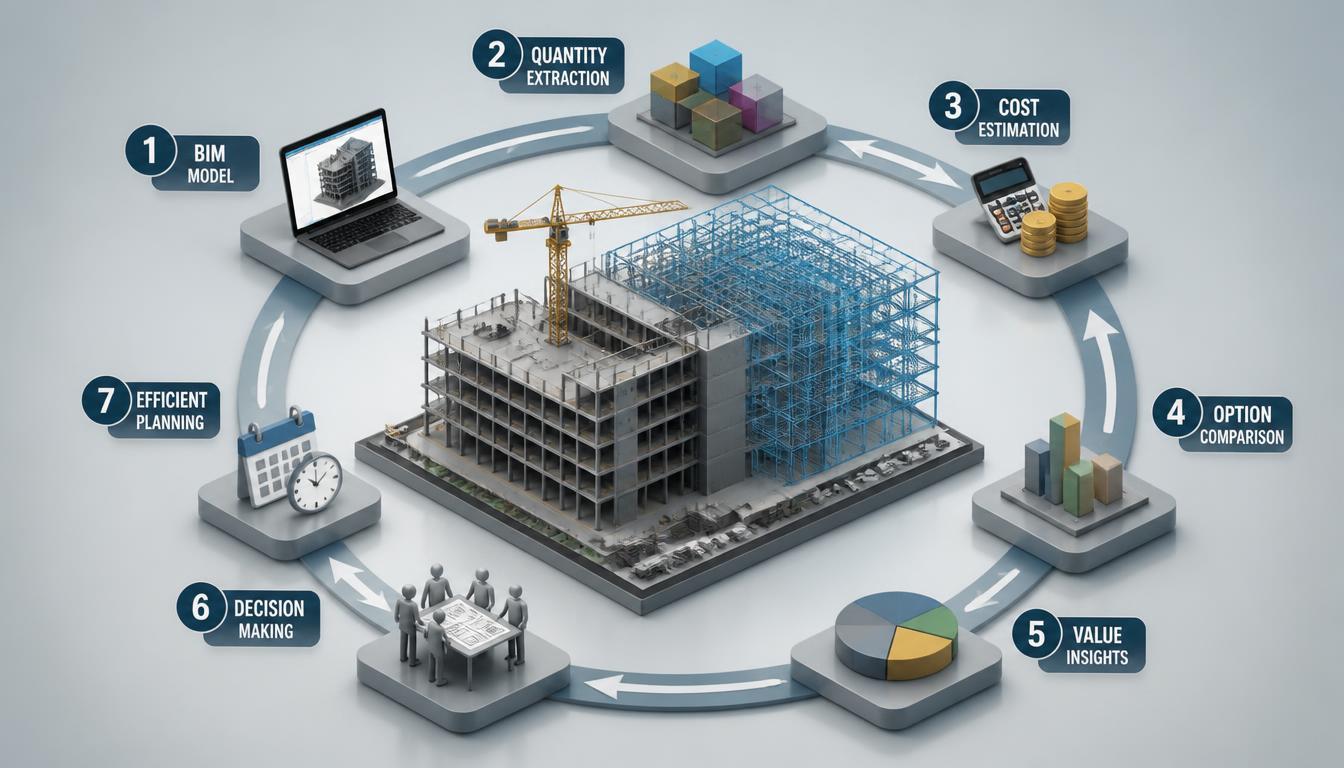
Preliminary estimating services become more useful when BIM data provides measurable quantities before design reaches final documentation. Model-based information gives estimators an earlier view of scope and design changes affecting the budget.
This approach helps teams examine budget effects before major design decisions become expensive to change.
At Universe Estimating, model-based information is used to organize early quantities and connect them with cost assumptions.
How Can Preliminary Estimating Services Use BIM Data Earlier?
Estimators can review model elements and specifications while the design is still developing.
National Institute of Building Sciences guidance identifies model-based quantity extraction as a BIM use for developing project and lifecycle cost estimates. It also notes that model accuracy and maturity must be considered before quantities are trusted.
BIM cost estimating can support early budgets when model elements contain usable information.
Estimators can map quantities to assemblies, cost codes, labor assumptions, and material prices.
What Changes When Estimating Uses BIM Data?
The estimating process can change significantly. The following table illustrates how BIM data affects estimating:
|
Preconstruction Approach |
With BIM Data |
Without BIM Data |
|
Quantity measurement |
Model-based quantity extraction |
More manual measurement from drawings |
|
Design changes |
Model changes can support updated quantities |
More separate quantity checks |
|
Cost review |
Quantities can connect with cost information |
More disconnected assumptions |
|
Scope review |
Visual model context supports review |
Greater reliance on 2D interpretation |
The difference is not automatic accuracy. NIBS notes that estimators should verify model data, element labels, and level of development before using quantities.
How Does BIM Improve Early Cost Decisions?
The estimating process becomes more responsive. When quantities connect with model elements, teams can compare design options before detailed documents are complete.
Preconstruction planning becomes easier when an estimator can test how a material change affects quantities and budget assumptions.
This supports value analysis without waiting for a complete construction package.
Early cost analysis can expose cost drivers while changes remain practical. For example, a designer might compare two exterior wall assemblies with different material quantities and unit costs.
Preliminary estimating services can then show how those options affect material quantities and budget assumptions. The team can discuss performance, appearance, availability, and cost together.
Can BIM Data Reduce Estimating Effort?
It can reduce repetitive work. NIBS identifies reduced takeoff time and improved count accuracy as potential benefits of model-based estimating.
The benefit depends on model quality. A poorly structured model can contain missing data, incorrect labels, or elements that do not represent their intended scope.
Building information modeling can also support clearer quantity visualization during review. Estimators can inspect modeled elements and connect visible scope with measured quantities.
How Can BIM Data Support Better Cost Control?
Cost visibility starts early. BIM data can help estimators connect modeled quantities with cost information while design decisions are still changing.
When quantities are linked to specific building elements, estimators can identify which materials or systems contribute most to the projected budget.
This makes it easier to examine expensive scope before it becomes difficult to change.
For example, changing a floor finish across thousands of square feet can affect both material quantities and installation costs.
A model-based estimate can help show the budget effect of that decision during design review.
This process also supports clearer communication. Designers, owners, and estimators can discuss cost changes using visible model elements rather than relying only on separate quantity sheets. The result is a more connected cost review process.
Teams can see how design choices influence quantities and budgets before construction begins.
What Could A BIM-Based Preliminary Estimate Look Like?
Consider a hypothetical office project. The design team develops a model containing floor areas, wall assemblies, doors, and major mechanical components.
An estimator extracts quantities and assigns suitable cost assumptions to each scope.
A revised wall system changes modeled quantities, allowing the budget impact to be reviewed before final documentation.
That does not guarantee a final construction price. Instead, it gives the team a clearer basis for comparing options while design decisions remain flexible.
Conclusion
Preliminary estimating services can become more responsive when reliable BIM data connects quantities with changing design information. This approach supports earlier cost visibility, structured reviews, and better-informed decisions before construction documents are finalized.

 English
 Arabic
 French
 Spanish
 Portuguese
 Deutsch
 Turkish
 Dutch
Dutch
 Italiano
 Romaian
 Portuguese (Brazil)
 Greek
Greek
