


Corporate Treasury Software Solutions: Features, Benefits, and Key Considerations
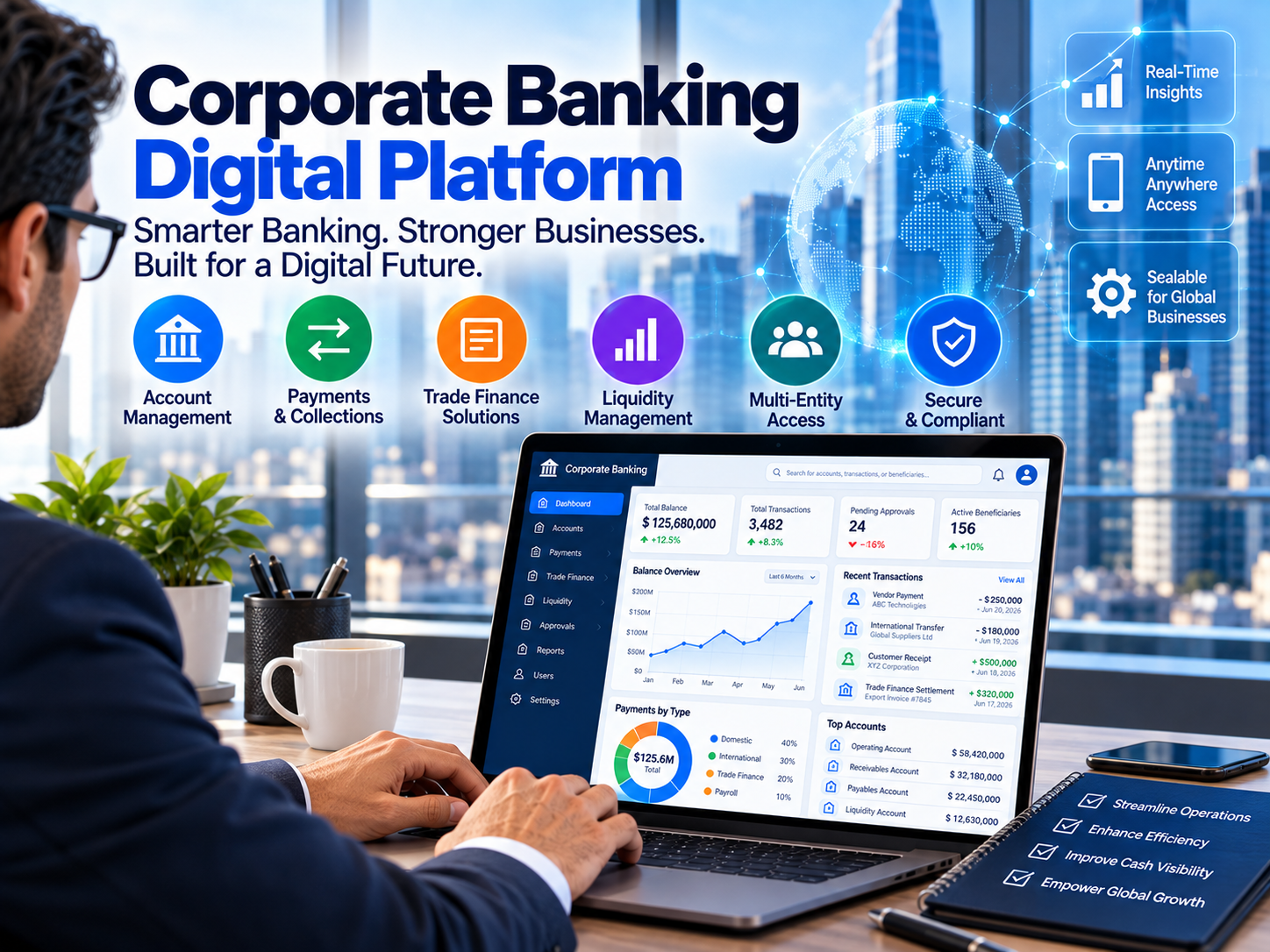
Managing corporate finances becomes increasingly complex as businesses expand across multiple accounts, currencies, banking relationships, subsidiaries, and markets. Treasury teams need accurate visibility into cash, liquidity, payments, investments, and financial risks to make informed decisions.
Corporate treasury software solutions help centralize these activities through digital platforms that automate treasury processes, improve financial visibility, and support better cash and liquidity management. For financial institutions and businesses looking to modernize treasury operations, technology can also improve connectivity between banking systems, enterprise applications, and financial workflows.
Intellect Design offers financial technology solutions designed to support banking and treasury requirements, helping organizations build more connected and digitally enabled financial operations.
What Are Corporate Treasury Software Solutions?
Corporate treasury software solutions are digital platforms designed to manage and automate treasury-related activities within an organization. They can provide a centralized view of cash positions, liquidity, payments, investments, financial risks, and banking relationships.
Instead of relying on spreadsheets and disconnected systems, treasury teams can use a unified platform to access financial information and manage workflows.
Depending on the solution, capabilities may include cash management, liquidity forecasting, payment management, bank account management, reconciliation, foreign exchange management, risk monitoring, and reporting.
Why Businesses Need Treasury Software
Treasury teams are responsible for maintaining sufficient liquidity while ensuring that available funds are used efficiently. As organizations grow, managing this manually can become difficult.
Multiple bank accounts can make cash visibility challenging. Different currencies can introduce foreign exchange exposure. Large payment volumes can increase operational workloads, while fragmented financial data can slow down decision-making.
Corporate treasury software can address these challenges by connecting financial information and automating repetitive processes.
Key Features of Corporate Treasury Software
Cash and Liquidity Management
Cash visibility is one of the most important treasury requirements. Treasury software can consolidate account balances and transaction information to provide a broader view of available liquidity.
This can help teams identify surplus cash, upcoming funding requirements, and potential liquidity gaps.
Cash Flow Forecasting
Cash flow forecasting allows treasury teams to estimate future inflows and outflows. Software can use historical transaction data, planned payments, receivables, and other financial information to support forecasting.
Advanced solutions can also incorporate analytics and AI-based capabilities to identify patterns and improve forecasting accuracy.
Bank Account Management
Large organizations may maintain accounts across several banks and regions. Treasury software can centralize account information and provide better visibility into banking relationships.
It can also help organizations maintain information about account structures, signatories, permissions, and related documentation.
Payment Management
Treasury platforms can support payment initiation, approval workflows, scheduling, and transaction tracking.
Automated approval processes can help organizations maintain financial controls while reducing the manual effort associated with routine payment activities.
Reconciliation
Reconciliation involves matching financial transactions with corresponding records. Manual reconciliation can become time-consuming when transaction volumes increase.
Treasury software can automate matching processes and identify exceptions for review, helping finance teams reduce repetitive work.
Foreign Exchange Management
Businesses operating across international markets may have exposure to multiple currencies. Treasury software can provide visibility into currency positions and support monitoring of foreign exchange activity.
Some platforms also provide tools for managing foreign exchange transactions and related workflows.
Financial Risk Management
Treasury teams need to monitor risks associated with liquidity, interest rates, currencies, investments, and counterparties.
A centralized treasury platform can bring relevant information together and support risk monitoring through dashboards, analytics, alerts, and reporting.
Benefits of Corporate Treasury Software Solutions
One of the main benefits of treasury software is improved visibility. Centralized financial information allows treasury professionals to understand cash positions and liquidity across accounts and entities.
Automation can also reduce manual workloads. Repetitive activities such as data collection, reconciliation, reporting, and approval routing can be handled through configurable workflows.
Another benefit is improved control. User permissions, approval hierarchies, transaction controls, and audit trails can provide greater oversight of treasury activities.
Treasury software can also support faster decision-making because finance teams have access to more structured and timely financial information.
Treasury Software and Corporate Banking
Corporate treasury management increasingly overlaps with digital banking. Businesses expect their banks to provide more than traditional account services and payment facilities.
Modern corporate banking platforms can integrate treasury capabilities such as cash visibility, liquidity management, payments, collections, and reporting.
For banks, offering connected treasury capabilities can make corporate banking services more useful for businesses with complex financial operations.
Intellect Design focuses on financial technology solutions that support digital banking and transaction requirements, including capabilities relevant to corporate and treasury banking environments.
The Role of APIs and Integration
Integration is an important consideration when implementing treasury software. Treasury teams often work with ERP systems, accounting platforms, banks, payment networks, and other financial applications.
API-based connectivity can allow data to move between these systems with less manual intervention. This can help improve data consistency and reduce duplicate data entry.
A well-integrated treasury environment can also provide a more complete view of financial activity across different systems.
How AI Is Changing Treasury Management
Artificial intelligence is becoming increasingly relevant to treasury operations. AI can analyze large volumes of financial data and support tasks such as cash forecasting, anomaly detection, transaction analysis, and liquidity planning.
For example, AI-powered forecasting can identify patterns in historical cash flows and use them to support future projections. Automated monitoring can also help identify transactions or cash-flow patterns that differ from expected behavior.
Organizations should still maintain appropriate human oversight, governance, security controls, and validation when using AI in financial operations.
How to Choose Corporate Treasury Software
Choosing treasury software requires more than comparing feature lists. Organizations should first identify their treasury processes, banking relationships, transaction volumes, currencies, entities, and integration requirements.
Scalability should also be considered. A platform should be capable of supporting additional accounts, subsidiaries, currencies, users, and transactions as the organization grows.
Security is another important factor. Organizations should evaluate authentication, access controls, authorization workflows, audit trails, data protection, and transaction security.
Ease of integration is equally important. Treasury software that can connect with existing ERP, accounting, banking, and payment systems can reduce implementation complexity and improve operational efficiency.
Future of Corporate Treasury Technology
Corporate treasury is moving toward increasingly connected and automated financial operations. Real-time data, APIs, cloud technology, advanced analytics, and AI are changing how treasury teams monitor and manage financial resources.
Future treasury environments are likely to place greater emphasis on real-time liquidity visibility, automated forecasting, intelligent financial controls, and integrated banking experiences.
For organizations modernizing their treasury infrastructure, solutions from providers such as Intellect Design can support the transition toward digitally connected financial operations.
Conclusion
Corporate treasury software solutions provide organizations with tools to manage cash, liquidity, payments, bank accounts, reconciliation, financial risks, and reporting through a centralized digital environment.
By reducing manual processes and connecting financial data, treasury software can help organizations improve visibility and operational control. As businesses become more global and financial operations become more complex, integrated treasury technology can become an important part of modern corporate finance infrastructure.

 English
 Arabic
 French
 Spanish
 Portuguese
 Deutsch
 Turkish
 Dutch
Dutch
 Italiano
 Russian
 Portuguese (Brazil)
 Greek
Greek
