


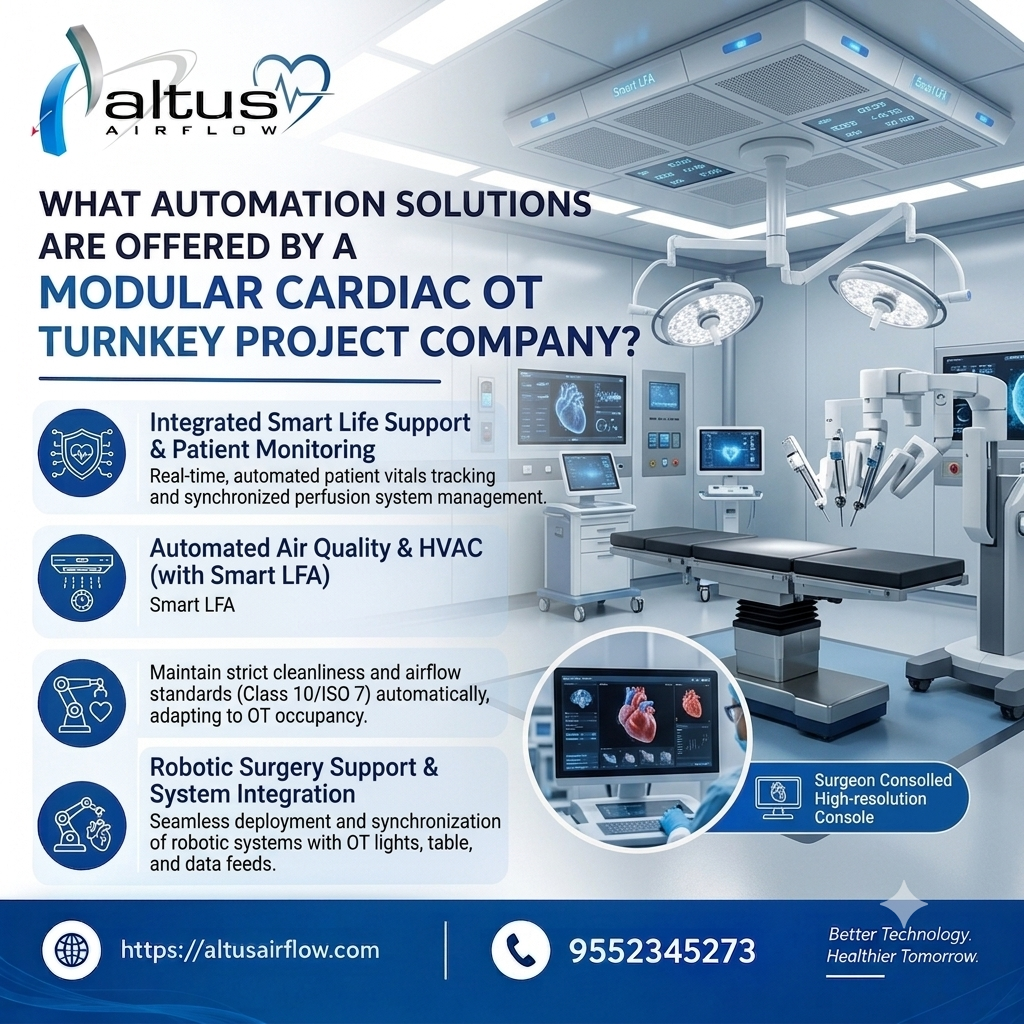
What Automation Solutions Are Offered by a Modular Cardiac OT Turnkey Project Company?
Introduction
Altus Airflow focuses on developing coordinated operating theatre infrastructure where HVAC, electrical systems, medical gases, monitoring, and other critical services work together. Modern cardiac operating theatres increasingly use automation to monitor environmental conditions, manage building services, improve system visibility, and support efficient facility operations. A Modular Cardiac OT Turnkey Project Company can integrate automation into the operating theatre during the design and installation stages, allowing different systems to be coordinated rather than added independently after construction. Automation can support monitoring of temperature, humidity, pressure, airflow, filtration, electrical systems, alarms, and equipment status.
Automation in a cardiac OT can range from basic digital monitoring to integrated control platforms connected with the hospital's Building Management System. Depending on the project scope, automation may include HVAC controls, environmental sensors, differential pressure monitoring, alarm systems, energy management, lighting controls, access systems, equipment monitoring, and centralized dashboards. The appropriate solution depends on the OT's design, clinical requirements, equipment specifications, hospital infrastructure, and applicable standards. A properly engineered automation system should also include testing, commissioning, documentation, and maintenance provisions so that hospital engineering teams can understand and manage the installed systems effectively.
1. Automated HVAC Control
HVAC automation is one of the most important automation solutions for a cardiac operating theatre. Automated controls can monitor and regulate temperature, humidity, airflow, pressure, and HVAC equipment status.
Sensors provide real-time information to the control system, while programmed sequences can operate fans, dampers, valves, and other components. This can provide facility teams with greater visibility of environmental conditions and HVAC performance.
2. Temperature Monitoring
Automated temperature sensors can continuously monitor the operating theatre environment. Readings can be displayed on a local interface or centralized monitoring platform.
Alarm limits can also be configured so that authorized personnel receive notifications when temperature moves outside the defined operating range. Historical data can help identify recurring environmental variations.
3. Humidity Monitoring
Humidity can be monitored through integrated environmental sensors. Depending on the HVAC design, automated controls can coordinate humidification or dehumidification functions.
Monitoring historical humidity data can help engineering teams identify HVAC performance issues and investigate recurring deviations.
4. Differential Pressure Monitoring
Operating theatres may require defined pressure relationships with adjacent areas depending on the facility's design and applicable requirements. Automated differential pressure sensors can continuously measure these relationships.
Digital displays and alarms can provide information when pressure moves outside predefined limits. The monitoring system should be calibrated and commissioned appropriately.
5. Airflow Monitoring
Airflow monitoring can provide information about the performance of the operating theatre's ventilation system. Sensors can monitor selected airflow parameters and transmit information to the automation platform.
Airflow monitoring can be coordinated with HVAC controls, pressure monitoring, and commissioning procedures to provide a broader view of environmental performance.
6. HEPA Filter Monitoring
Where HEPA filtration is installed, differential pressure monitoring can provide information about filter loading and system performance.
Automation can alert maintenance teams when pressure differences reach defined thresholds. However, automated pressure monitoring does not replace required physical inspections or HEPA filter integrity testing.
7. Laminar Airflow Control
Where a laminar airflow system is included, automation can support monitoring and control of related HVAC functions. Airflow parameters, temperature, pressure, and equipment status can be displayed through a centralized interface.
The automation design should account for surgical lights, medical pendants, ceiling services, and other elements that may affect airflow distribution.
8. Centralized Environmental Monitoring
A centralized monitoring platform can bring together temperature, humidity, pressure, airflow, and other environmental parameters.
This allows hospital engineering teams to view multiple conditions from one interface. Depending on the system, historical data, alarms, and trend information can also be accessed through the platform.
9. Automated Alarm Systems
Alarm systems can notify personnel about selected abnormal conditions. Possible alarm categories include temperature deviations, humidity changes, pressure problems, HVAC faults, power interruptions, and communication failures.
Alarm priorities should be clearly defined so that critical events receive appropriate attention. Alarm testing should be included during commissioning.
10. Building Management System Integration
A cardiac OT automation system can potentially be integrated with the hospital's Building Management System (BMS).
BMS integration can allow selected HVAC, environmental, and equipment parameters to be monitored from the hospital's wider facility management platform. Network architecture, user access, cybersecurity, and communication protocols should be considered during design.
11. Automated Lighting Controls
Lighting controls can be automated for selected areas of the operating theatre. Depending on the requirements, systems may include centralized switching, occupancy sensing, scheduling, or dimming.
Surgical lighting should be treated separately according to clinical requirements. Automation should never interfere with the availability or required performance of surgical lighting.
12. Medical Pendant Monitoring
Medical pendants may include electrical outlets, medical gas terminals, data connections, and equipment support systems. Where appropriate, their status can be incorporated into broader monitoring arrangements.
Automation can help facility teams identify selected equipment or service conditions, although the exact monitoring capabilities depend on the pendant manufacturer's design.
13. Electrical System Monitoring
Automation can monitor selected electrical parameters such as power status, voltage, current, load conditions, or equipment status.
Electrical monitoring can provide facility teams with information about critical infrastructure and help identify certain abnormalities. Integration with UPS and generator systems may also provide information about backup-power status.
14. UPS and Backup Power Monitoring
Cardiac operating theatres depend on reliable power for critical systems and equipment. Automated monitoring can provide information about UPS status, battery conditions, generator operation, and power transfer where the systems support such connectivity.
Alerts can notify authorized personnel about power interruptions or backup-system conditions, allowing appropriate response procedures to be initiated.
15. Equipment Status Monitoring
Some OT equipment can provide status information through compatible communication interfaces. Where manufacturer-supported integration is available, selected equipment parameters or operating states can be displayed through a centralized platform.
Equipment integration should be carefully planned to avoid compromising manufacturer requirements, safety functions, or independent alarm systems.
16. Automated Access Control
Access control can be integrated into the operating theatre infrastructure to manage entry into controlled areas.
Card-based, biometric, PIN-based, or other approved systems may be used depending on hospital policy. Access automation should be coordinated with emergency exits, fire-safety systems, and hospital security procedures.
17. Digital Data Logging
Automation systems can record selected environmental and infrastructure parameters over time. Digital data logging can provide a historical record of temperature, humidity, pressure, airflow, equipment status, or alarms.
Historical information can support operational reviews, maintenance planning, troubleshooting, and documentation requirements.
18. Remote Monitoring
Some automation systems provide secure remote monitoring for authorized personnel. Facility teams may be able to view environmental conditions, alarms, and selected equipment status without being physically present in the OT.
Remote access should be protected through appropriate authentication, authorization, network controls, and cybersecurity measures.
19. Energy Management
Automation can support energy management by controlling HVAC operating schedules, lighting, and other building services according to defined requirements.
Variable-speed drives, occupancy-based controls, automated scheduling, and system monitoring can help manage energy use. However, energy optimization must remain compatible with the environmental conditions required for cardiac surgical procedures.
20. Automated Fault Detection
Automation platforms can identify selected system faults and generate alerts. HVAC failures, abnormal pressure readings, sensor faults, communication problems, and power conditions can be monitored.
Automated fault detection can help reduce the time between a problem occurring and staff becoming aware of it. Response procedures should be established for each important alarm category.
21. Smart Maintenance Monitoring
Automation can support preventive maintenance by providing information about equipment runtime, filter pressure, system alarms, and component status.
Maintenance teams can use this information alongside manufacturer recommendations and established maintenance schedules. This can provide better visibility of equipment condition and service requirements.
22. Integrated Dashboard
An integrated dashboard can display multiple operating theatre parameters on a single interface. Temperature, humidity, pressure, airflow, HVAC status, alarms, and selected equipment conditions can be presented together.
A clear dashboard can help engineering personnel identify abnormal conditions quickly while providing access to historical trends and detailed system information.
23. Sensor-Based Environmental Control
Strategically placed sensors can provide continuous information to the automation system. Sensor locations should be selected based on room geometry, airflow patterns, equipment heat loads, occupancy, doors, and other factors that can influence measurements.
Proper sensor placement and calibration are important for obtaining meaningful readings.
24. Automation Testing and Commissioning
Automation systems should be tested after installation. Commissioning can include sensor verification, alarm testing, control sequence checks, communication testing, HVAC response verification, and monitoring-system checks.
Test results should be documented and any identified deficiencies should be corrected before final handover.
25. Future-Ready Automation Infrastructure
A Modular Cardiac OT Turnkey Project Company can consider future automation requirements during the initial engineering stage. Expandable monitoring architecture, accessible service routes, additional network capacity, spare electrical provisions, and flexible control arrangements can support future upgrades.
Planning for future technologies can reduce the need for extensive modifications when new surgical equipment or facility-management systems are introduced.
Conclusion
Automation can improve the visibility and management of critical operating theatre infrastructure. HVAC controls, temperature and humidity monitoring, differential pressure monitoring, airflow monitoring, HEPA-related monitoring, centralized dashboards, alarms, electrical monitoring, backup-power monitoring, access control, equipment connectivity, data logging, and BMS integration can all contribute to a more organized facility-management approach. The exact automation package should be based on the OT's clinical requirements, engineering design, equipment, hospital infrastructure, and applicable standards.
Altus Airflow can incorporate automation planning into turnkey cardiac OT projects by coordinating HVAC, electrical infrastructure, environmental monitoring, control systems, and other services during design and installation. Altus Airflow can also support testing, commissioning, documentation, and handover activities according to the agreed project scope.
Frequently Asked Questions
1. What automation solutions are offered by a Modular Cardiac OT Turnkey Project Company?
A Modular Cardiac OT Turnkey Project Company may offer HVAC automation, temperature and humidity monitoring, pressure and airflow monitoring, alarms, digital data logging, BMS integration, electrical monitoring, energy management, access control, and centralized dashboards.
2. Can automation monitor OT temperature and humidity?
Yes. Digital sensors can continuously monitor temperature and humidity and generate alerts when defined limits are exceeded.
3. Can a cardiac OT automation system integrate with a BMS?
Yes. Compatible HVAC and environmental monitoring systems can be integrated with a hospital's BMS when the required communication and network infrastructure is available.
4. Can automation monitor HEPA filtration?
Automation can monitor differential pressure across filter sections where appropriate, but this does not replace required HEPA integrity testing and physical inspections.
5. Does automation help with energy management?
Yes. Automated HVAC schedules, variable-speed controls, lighting controls, and monitoring can support energy management while maintaining required OT conditions.
Read Our Previous Blog --------------->What accessories are supplied by a Modular IVF Lab Setup Company?

 English
 Arabic
 French
 Spanish
 Portuguese
 Turkish
 Dutch
Dutch
 Italiano
 Russian
 Romaian
 Portuguese (Brazil)
 Greek
Greek
