


Why Does Interior Mould Precision Matter in Car Parts?
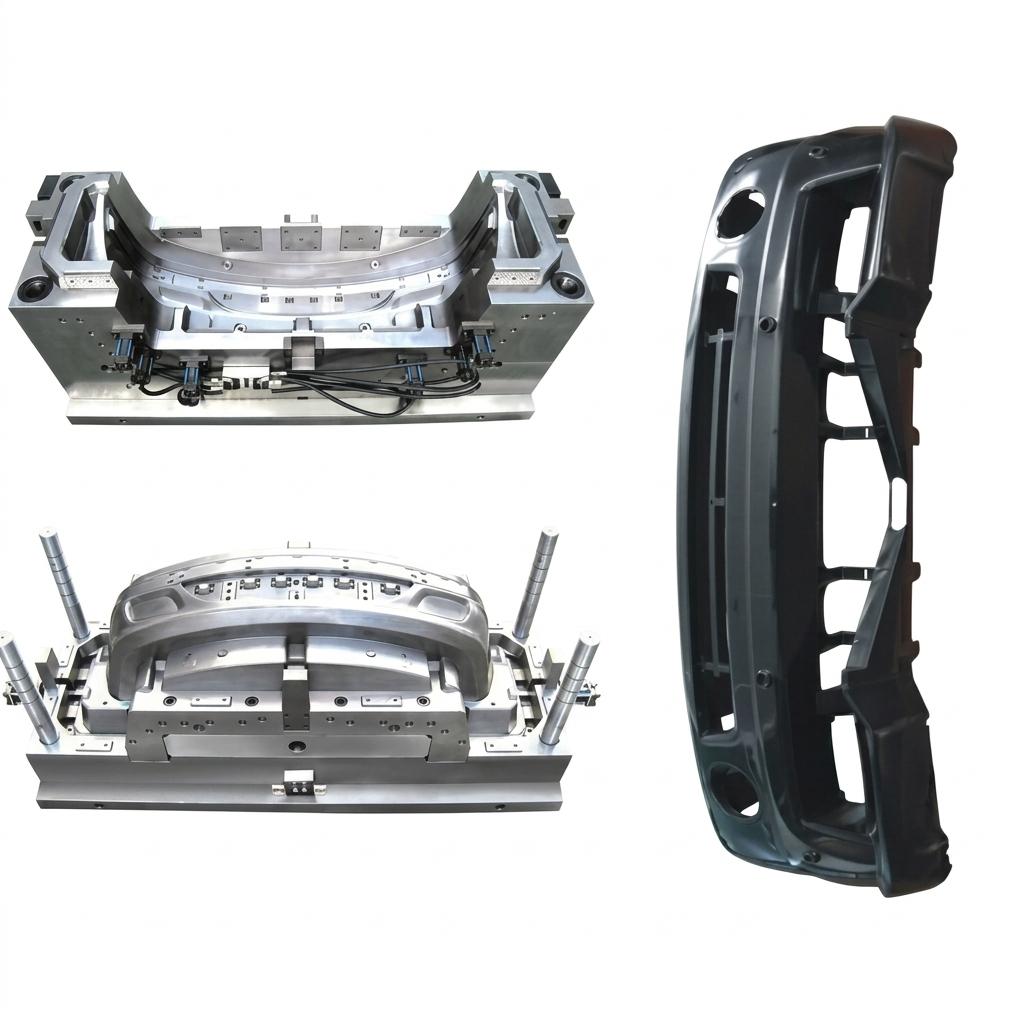
Automotive interior components combine appearance, fit, structural function, and assembly requirements. Dashboard panels, door trims, center-console components, pillar covers, air-vent surrounds, and other cabin parts often contain clips, ribs, mounting points, openings, and textured surfaces. Each detail has to work together after injection molding. This is where a High Precision Car Interior Mould becomes an important part of the manufacturing process.
For automotive tooling projects, precision is not limited to machining the cavity and core accurately. Gate position, cooling layout, draft angles, ejection mechanisms, material shrinkage, surface texture, and part geometry can all influence the final molded component. Industry references also identify part geometry, resin characteristics, gating, cooling, and ejection as interconnected elements in automotive injection mold design.
A related example of automotive bumper tooling can be found through the modified bumper mould, where complex automotive plastic geometry also requires careful control of cavity structure and molding conditions.
How Does Dimensional Precision Affect Interior Assembly?
Interior components rarely work as isolated plastic pieces. A door trim may need to connect with clips and brackets, while a center-console component may need to align with switches, storage structures, decorative panels, and electronic modules.
Small dimensional deviations around these interfaces can create assembly difficulties. Accurate mold geometry helps maintain the position of mounting holes, snap-fit structures, locating features, ribs, and other functional details.
A High Precision Car Interior Mould can therefore support repeatable production of parts with controlled dimensions. This is particularly important for components that are installed next to other visible interior parts. Consistent dimensions help maintain appropriate gaps and alignment during assembly.
Why Is Surface Quality Also Important?
Automotive interiors contain many passenger-facing surfaces. A molded component can have the required dimensions while still showing unwanted surface differences.
Texture, gloss, weld-line visibility, gate marks, ejector marks, and flow-related appearance can affect the final visual result. Research on injection-molded surface quality identifies molding conditions and other process variables as important factors affecting the appearance of plastic parts.
The mold cavity is responsible for transferring the required surface texture to the plastic. Textured areas also require suitable draft design because deeper textures can make demolding more difficult. A mismatch between texture depth and draft design may increase the possibility of surface damage during ejection.
For this reason, mold design needs to consider both functional dimensions and visible surfaces from the beginning.
Can Cooling Design Influence Dimensional Stability?
Cooling is another important factor for automotive interior tooling. After molten plastic enters the cavity, the material needs to cool and solidify in a controlled manner. Uneven thermal conditions can contribute to different shrinkage behavior across the component.
Large interior panels can be particularly challenging because their cavity surfaces may cover a substantial area while incorporating ribs, openings, bosses, and different wall sections. A suitable cooling layout can help maintain more consistent thermal conditions during repeated molding cycles.
Cooling design should therefore be considered alongside the part material, wall thickness, gate arrangement, and expected production conditions rather than treated as a separate tooling detail. Automotive mold design references similarly connect cooling with cycle stability, warpage control, and dimensional consistency.
What Role Does Ejection Design Play?
A finished interior part needs to leave the mold without damage. This sounds straightforward, but interior components can include deep ribs, clips, undercuts, textured surfaces, and thin sections.
Ejector pins, lifters, sliders, and other mechanisms need to be positioned according to the component geometry. Ejection force that is concentrated in a cosmetic area may leave marks, while insufficient support can cause deformation during demolding.
A carefully engineered High Precision Car Interior Mould considers these factors during the initial design stage. The objective is to create a mold structure that supports stable filling, controlled cooling, reliable ejection, and repeatable part dimensions.
Why Does Precision Matter Across Production Runs?
Automotive interior programs usually require repeatable parts rather than a single successful sample. A mold therefore needs to maintain its intended geometry during repeated production.
Tool steel, machining accuracy, cavity alignment, surface treatment, cooling design, and maintenance access all contribute to the practical performance of the tooling. Material selection also depends on the plastic resin, expected production volume, surface requirements, and tooling conditions.
For buyers and engineering teams, this means evaluating a mold according to the complete production requirement rather than focusing only on a single dimensional tolerance.
A High Precision Car Interior Mould brings together these engineering considerations to support accurate automotive interior components. From mounting clips and locating structures to textured cosmetic surfaces, the mold influences how reliably each feature is reproduced.
As automotive interiors continue to combine decorative surfaces with functional and electronic features, precision mold engineering remains closely connected with fit, appearance, and production consistency.

 English
 Arabic
 French
 Spanish
 Portuguese
 Deutsch
 Dutch
Dutch
 Italiano
 Russian
 Romaian
 Portuguese (Brazil)
 Greek
Greek
