


Sustainable Bottling Technologies Transforming the Beverage Sector
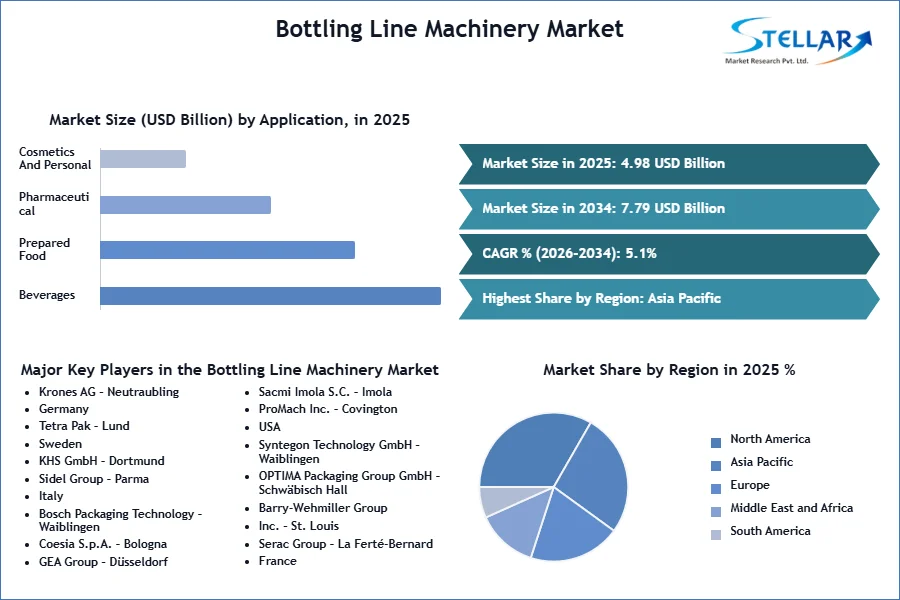
The Bottling Line Machinery Market is experiencing a profound technological overhaul, according to a comprehensive new market intelligence report published by Stellar Market Research. Driven by surging consumer demand for packaged beverages, pharmaceuticals, and liquid foods, manufacturers are accelerating capital investments into high-speed, automated, and energy-efficient packaging lines to eliminate downtime and ensure compliance with strict environmental standards.
The global packaging ecosystem is undergoing a structural paradigm shift. Traditional mechanical bottling lines are rapidly being replaced by smart, IoT-enabled, and modular machinery that minimizes changeover times and optimizes resource consumption. Beverage brands, dairy processors, and pharmaceutical giants face mounting pressure to reduce their carbon footprints while scaling output. This dual mandate of high-speed productivity and absolute sustainability has positioned advanced bottling line machinery as a mission-critical asset, shifting buyer priorities from low initial capital expenditure to total cost of ownership (TCO), energy efficiency, and predictive maintenance capabilities.
Key Findings from the Report
-
Market Valuation & Growth: The global Bottling Line Machinery Market is valued at USD 6.85 billion and is projected to reach USD 10.74 billion by 2032, expanding at a compound annual growth rate (CAGR) of 5.8%.
-
Dominant Segment: Washing and rinsing machinery commands the largest market share, driven by stringent hygiene protocols across beverage and pharmaceutical packaging lines.
-
Fastest-Growing Segment: Automated labeling and inspection systems represent the fastest-growing segment, expanding at a 7.2% CAGR due to rising demands for anti-counterfeiting serialization and dynamic digital labeling.
-
Leading Region: Asia-Pacific leads the global landscape, accounting for nearly 41% of total market revenue, powered by rapid urbanization, expanding middle-class consumption, and high-volume beverage bottling hubs in China, India, and Southeast Asia.
-
Emerging Region: North America and Europe are witnessing significant retrofit cycles, fueled by stringent circular economy mandates and corporate net-zero commitments.
-
End-Use Industry Dominance: The beverage sector (carbonated soft drinks, bottled water, craft beer, and functional drinks) remains the primary revenue contributor, closely followed by the pharmaceutical liquid packaging sector.
-
Investment Relevance: Venture capital and private equity firms are actively funding engineering innovators specializing in hygienic design, AI-driven sorting, and plug-and-play modular robotics.
For further information, click the following link:https://www.stellarmr.com/report/req_sample/bottling-line-machinery-market/2604
Market Drivers and Restraints
Drivers:
-
Surging Demand for Packaged Beverages & Functional Drinks: Exponential growth in ready-to-drink (RTD) beverages, craft beer, and functional wellness waters requires high-throughput, versatile bottling lines that handle diverse bottle shapes and materials without extensive recalibration.
-
Adoption of Industry 4.0 and Predictive Maintenance: Integration of IoT sensors, machine learning, and edge computing allows operators to monitor machine health in real-time, drastically reducing unexpected line stoppages and maintenance costs.
-
Stringent Hygiene and Product Safety Mandates: Strict regulatory frameworks governing food and pharmaceutical packaging compel manufacturers to upgrade to sanitary, clean-in-place (CIP) automated machinery to prevent contamination.
Restraints:
-
High Initial Capital Expenditure (CapEx): The substantial upfront cost of procuring, integrating, and programming advanced, high-speed automated bottling lines can deter small and medium-scale enterprises (SMEs).
-
Complex Maintenance and Skilled Labor Shortages: Operating state-of-the-art smart packaging machinery requires specialized technical expertise, creating operational bottlenecks for manufacturers facing engineering talent gaps.
Technology, Regulation, and Sustainability Trends
The modernization of bottling lines is heavily anchored in sustainability and digital compliance. Manufacturers are aggressively adopting lightweighting technologies, servo-driven energy-saving motors, and water-recycling rinsing systems to meet corporate ESG targets. On the regulatory front, stringent government directives regarding single-use plastics and recycling traceability are forcing equipment makers to build modular systems capable of handling eco-friendly rPET, biodegradable polymers, and reusable glass bottles interchangeably. Furthermore, artificial intelligence (AI) and computer vision are becoming standard for real-time defect detection, ensuring zero-waste quality control.
Regional Insights
-
Asia-Pacific (Leading Region): Dominated by massive manufacturing investments in China and India, the region benefits from low production costs, expanding urban consumer bases, and massive scaling by domestic and multinational beverage giants.
-
Europe: Driven by stringent EU directives on packaging waste and circular economy frameworks, European bottlers are leading the transition toward energy-efficient, low-carbon machinery lines and closed-loop recycling integration.
-
North America (Emerging Growth Hub): Focuses heavily on smart factory automation, high-speed line integration, and labor-saving robotics to counter domestic workforce shortages in manufacturing plants.
-
Latin America and Middle East & Africa: Emerging markets experiencing steady expansion supported by foreign direct investments in local bottling plants and brewing facilities.
Recent Industry Developments
-
Krones AG (2025): Launched the ErgoBloc L modular wet-end block system, reducing carbon emissions across bottling lines by 18% and cutting floor space requirements by 30% for high-volume beverage manufacturers.
-
Sidel Group (2025): Partnered with a major European dairy cooperative to deploy AI-powered aseptic bottling lines, successfully achieving a 25% reduction in water consumption and zero-chemical sterilization downtime.
-
Tetra Pak (2024): Introduced a next-generation connected packaging inspection module utilizing machine vision, boosting defect-detection accuracy to 99.9% for high-speed liquid food production lines.
-
GEA Group (2024): Completed the strategic acquisition of a specialized automation software provider to bolster its digital twin capabilities, enabling clients to simulate and optimize bottling line performance prior to physical installation.
-
KHS Group (2024): Expanded its manufacturing capacity in North America with a multi-million-dollar plant upgrade dedicated to producing eco-friendly, energy-optimized bottle washers and conveyors.
Competitive Landscape
The global bottling line machinery market is moderately consolidated, featuring established global heavyweights alongside agile regional engineering firms. Industry leaders are focusing on strategic mergers, collaborative R&D in automation, and comprehensive after-sales service contracts (including digital remote diagnostics).
-
Key Market Players: Krones AG, Sidel Group, GEA Group, KHS Group, Tetra Pak, SIDEL, SMI S.p.A., Zhangjiagang Reliable Machinery, and ProMach.
Analyst Commentary
"The competitive edge in packaging no longer rests solely on speed, but on adaptive intelligence and sustainability compliance," said Aarav Mehta, Senior Research Analyst at Stellar Market Research. "Manufacturers that integrate modular, AI-driven machinery capable of adapting to sustainable packaging substrates will dominate the next decade of operational efficiency."
Future Outlook
Through the forecast period, the bottling line machinery market will experience accelerated convergence between mechanical engineering and digital software. Demand will increasingly favor flexible, reconfigurable lines that accommodate rapid SKU changes, seasonal product variations, and eco-friendly packaging shifts. As automation costs decrease and predictive AI matures, automated bottling solutions will transition from high-end investments to standard baseline requirements across global processing industries.
For further information, click the following link:https://www.stellarmr.com/report/req_sample/bottling-line-machinery-market/2604
About Stellar Market Research
Stellar Market Research is a multifaceted market research and consulting company with professionals from several industries. Some of the industries we cover include medical devices, pharmaceutical manufacturers, science and engineering, electronic components, industrial equipment, technology and communication, cars and automobiles, chemical products and substances, general merchandise, beverages, personal care, and automated systems. To mention a few, we provide market-verified industry estimations, technical trend analysis, crucial market research, strategic advice, competition analysis, production and demand analysis, and client impact studies.
Address
Phase 3, Navale IT Zone, S.No. 51/2A/2, Office No. 202, 2nd floor, Near, Navale Brg, Narhe, Pune, Maharashtra 411041
Email
sales@stellarmr.com
Mobile
+91 9607365656

 English
 Arabic
 French
 Spanish
 Portuguese
 Turkish
 Dutch
Dutch
 Italiano
 Russian
 Romaian
 Portuguese (Brazil)
 Greek
Greek
