


How to Choose the Right Trailer for Transporting Construction Materials
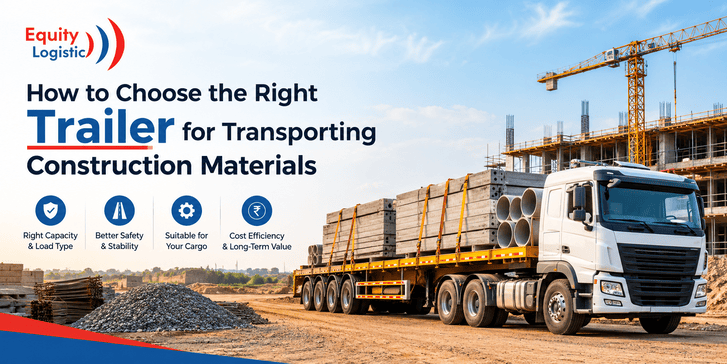
Construction projects run on tight schedules, and few things derail a timeline faster than a transportation failure, whether that’s a damaged load, a trailer that can’t handle the weight, or a truck that simply can’t reach the site. Choosing the right trailer for transporting construction materials isn’t a minor logistics detail; it’s a decision that directly affects safety, cost, and how smoothly your project moves from foundation to finish.
From steel beams and precast concrete panels to earthmoving equipment and bulk aggregates, construction materials come in an enormous range of shapes, weights, and handling requirements. The wrong trailer choice can mean overloaded axles, unstable loads, permit violations, or equipment that simply doesn’t fit the job. This guide walks through everything you need to know to make the right call, and where a professional trailer and transportation partner adds real value.
Why Trailer Selection Matters So Much in Construction Logistics
Unlike general freight, construction materials are often heavy, oversized, irregularly shaped, or a combination of all three. A load of structural steel behaves very differently in transit than a stack of bricks or a hydraulic excavator. Selecting the wrong trailer type can lead to:
- Load instability during transit, increasing accident risk
- Axle overloading, which damages roads, risks fines, and voids insurance in some cases
- Delivery delays if a trailer can’t access the site or navigate the route
- Cargo damage, especially for fragile or high-value materials
- Compliance issues with state transport regulations and permit requirements
Getting trailer selection right the first time isn’t just about efficiency, it’s about protecting your project’s budget, timeline, and safety record.
Step 1: Understand Your Cargo Before You Choose a Trailer
Before you can select the right trailer, you need a clear picture of what you’re actually moving. This means going beyond “it’s heavy” and getting specific about:
Weight and Dimensions
Total weight, length, width, and height determine which trailer types are even viable options. A load that’s within standard dimensions has far more flexibility than one that pushes into oversized or over-dimensional territory.
Load Shape and Rigidity
Is the material rigid (like a steel girder) or does it shift (like loose aggregate or gravel)? Rigid loads need secure tie-down points and a stable deck; loose materials need enclosed or high-sided trailers to prevent spillage.
Centre of Gravity
Materials like precast concrete panels or heavy machinery often carry weight unevenly. A trailer that doesn’t account for this can become unstable on turns, inclines, or uneven road surfaces.
Fragility and Sensitivity
Some construction materials, like glass panels, finished stone, or electrical equipment, are sensitive to vibration and impact and need extra protection during loading and transit.
Loading and Unloading Requirements
Will the material be lifted by crane, driven on under its own power, or side-loaded? This affects whether you need a low-height deck, ramps, or a specific trailer configuration.
Once you’ve mapped out these factors, choosing between trailer types becomes far more straightforward.
Common Trailer Types for Construction Materials
Flatbed Trailers
The workhorse of construction logistics. Flatbed trailers are ideal for materials that don’t need to be enclosed, such as steel beams, pipes, timber, fabricated structures, and palletized building materials. Their open design makes loading and unloading with cranes or forklifts straightforward from any angle.
Best for: Structural steel, lumber, pipes, precast concrete elements, general building materials
Low Bed Trailers
When you’re moving construction machinery, earthmovers, cranes, or tall equipment, a low bed trailer’s reduced deck height keeps the overall load height within legal limits while maintaining ground clearance and stability. This is one of the most common trailer choices on active construction sites.
Best for: Excavators, bulldozers, cranes, compactors, and other heavy construction machinery
Semi Low Bed Trailers
A practical middle ground between standard flatbeds and full low bed trailers, semi low bed configurations suit medium-height industrial machinery that doesn’t require the extreme deck clearance of a full low bed, while still maintaining road stability.
Best for: Mid-sized construction equipment and machinery that doesn’t qualify as oversized
Multi-Axle Trailers
For genuinely heavy loads, distributing weight across multiple axles isn’t optional, it’s what keeps the load within legal axle-weight limits and ensures safer handling on the road. Multi-axle trailers are essential when a single or double-axle configuration simply can’t carry the load safely.
Best for: Heavy machinery, large concrete elements, and bulk material loads that exceed standard axle limits
Hydraulic Modular Trailers
For the heaviest and most complex construction cargo, think large transformers, industrial plant components, or oversized precast structures, hydraulic trailers allow precise load distribution and can be configured (combined or split) to match the exact weight and dimensions of the cargo.
Best for: Extremely heavy, wide, or complex loads that standard trailers cannot safely carry
Tipper and Bulk Trailers
For loose materials like sand, gravel, crushed stone, or soil, tipper trailers allow for quick loading and unloading directly at the site without manual handling.
Best for: Aggregates, sand, gravel, and other bulk construction materials
If your project involves cargo that exceeds standard trailer dimensions, weight limits, or height restrictions, it likely falls under over-dimension consignment transportation, which requires additional route planning, permits, and often escort vehicles.

 English
 Arabic
 French
 Spanish
 Portuguese
 Deutsch
 Turkish
 Italiano
 Russian
 Romaian
 Portuguese (Brazil)
 Greek
Greek
