


Market Orders vs Limit Orders: Which One Fits Your Trading Style?
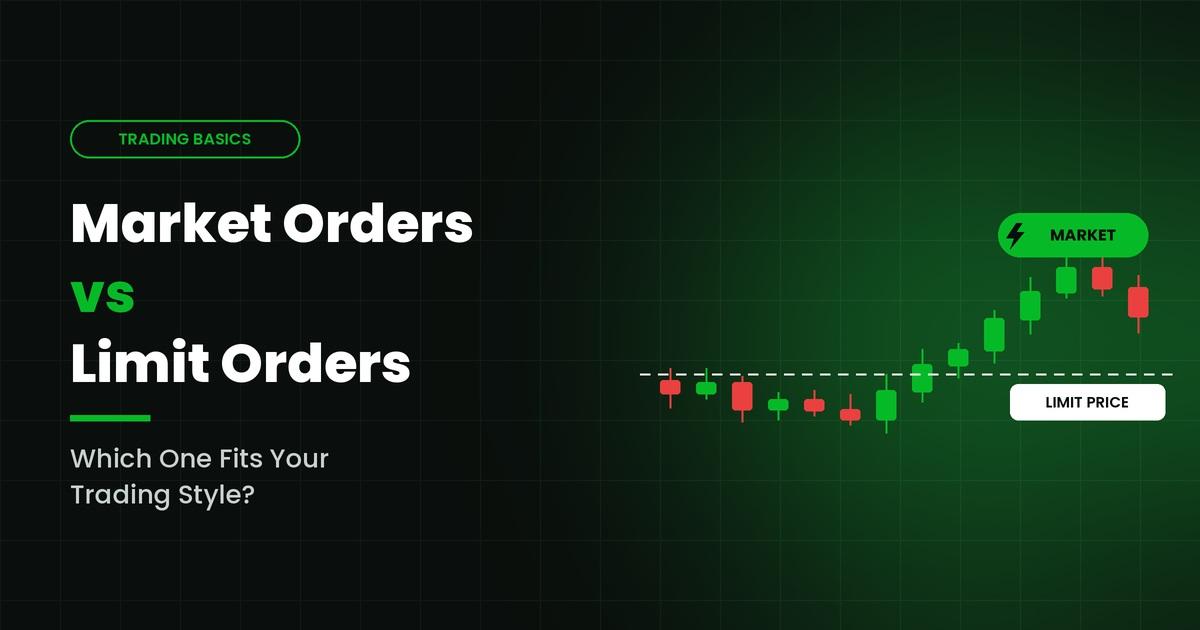
Every trade starts with a single decision. Before you think about indicators, targets, or risk, you must choose how your order reaches the market. That choice sounds simple. However, it quietly shapes your entry price, your costs, and even your stress level.
Over two decades of watching traders learn the ropes, I have seen the same pattern again and again. New traders obsess over what to buy. Experienced traders care just as much about how they buy it. The debate of market orders vs limit orders sits right at the center of that skill.
In this guide, you will learn how each order type works, where each one shines, and where each one can hurt you. By the end, you will know which fits your trading style.
What Is a Market Order?
A market order tells your broker to buy or sell immediately at the best price currently available. You do not set a price. Instead, you accept whatever the market offers at that moment.
Here is a simple example. Say a stock shows a bid of $50.00 and an ask of $50.02. If you place a market buy order, you will most likely pay around $50.02. If you place a market sell order, you will most likely receive about $50.00.
The key word is "likely." Prices move constantly. By the time your order arrives, the best available price may have shifted.
Advantages of Market Orders
- Speed: Your order fills almost instantly in liquid markets.
- Certainty of execution: As long as buyers and sellers exist, your trade goes through.
- Simplicity: You do not need to calculate an entry price.
Disadvantages of Market Orders
- No price control: You get the available price, not a chosen one.
- Slippage: In fast or thin markets, your fill can land far from the price you saw.
- Wider spread costs: In low-volume assets, the gap between bid and ask can quietly eat into returns.
What Is a Limit Order?
A limit order lets you set the exact price at which you are willing to trade. A buy limit order fills only at your price or lower. Similarly, a sell limit order fills only at your price or higher.
Let's go back to that $50 stock. Suppose you believe it will dip to $49.50 before moving higher. You can place a buy limit order at $49.50. If the price reaches that level, your order may fill. If it never gets there, you simply do not buy.
In other words, a limit order trades speed for control.
Advantages of Limit Orders
- Price control: You never pay more or receive less than your set price.
- Protection from slippage: Sudden spikes cannot push your fill to a bad level.
- Planning: You can set orders in advance and let the market come to you.
Disadvantages of Limit Orders
- No guaranteed fill: The price may never reach your level.
- Missed opportunities: A strong move can leave you watching from the sidelines.
- Partial fills: Sometimes only part of your order executes at your price.
Market Order vs Limit Order: The Core Difference
At its heart, the market order vs limit order choice comes down to one trade-off. Do you value certainty of execution, or certainty of price?
A market order guarantees that you get in or out. Yet it does not guarantee your price. On the other hand, a limit order guarantees your price. Still, it does not guarantee that you get in or out.
Neither is better in every case. Each is a tool, and good traders know when to reach for which one. Think of it like driving. Sometimes you need to merge into traffic right now. Other times, you can wait for the perfect gap.
Understanding Slippage and Liquidity
To make smart choices between market orders vs limit orders, you need to understand two forces: liquidity and slippage.
Liquidity describes how easily an asset trades without moving its price. Major currency pairs, large-cap stocks, and popular index futures are usually very liquid. Many buyers and sellers stand ready at every moment.
Slippage is the difference between the price you expect and the price you actually get. It grows when liquidity is low or when news hits the market.
Consider a small-cap stock with only a few thousand shares trading per day. A large market order could eat through several price levels in the order book. As a result, your average fill price might be noticeably worse than the quote you saw.
Now compare that with a heavily traded stock like a major tech name. Here, a market order for a few hundred shares usually fills within a cent of the quote.
So the rule of thumb is clear. The more liquid the market, the safer a market order becomes. The thinner the market, the more a limit order protects you.
When to Use a Market Order
Market orders work best when speed matters more than a few cents of price. Here are the most common situations:
- Highly liquid markets: Spreads are tight, so slippage is usually minimal.
- Urgent exits: If a trade turns against you sharply, getting out fast matters more than the exact exit price.
- Breakout entries: When price bursts through a key level, waiting for a pullback can mean missing the move entirely.
- Small position sizes: Smaller orders rarely move the market, even in moderately liquid assets.
One word of caution, though. Avoid market orders right at the market open or during major news releases. Spreads often widen during these moments, and fills can surprise you.
When to Use a Limit Order
Knowing when to use a limit order is one of the most valuable habits a trader can build. Limit orders are ideal whenever price precision matters more than immediate execution.
Here are the key situations:
- Illiquid or thinly traded assets: Small caps, some altcoins, and certain options contracts often have wide spreads. A limit order stops you from overpaying.
- Volatile conditions: During sharp swings, a limit order shields you from sudden price spikes.
- Planned entries: If your analysis points to a support level, you can place a buy limit there and wait patiently.
- Taking profit: Sell limit orders at your target levels help you lock in gains without watching the screen all day.
- Large orders: Bigger positions can move the market. Limit orders help control your average fill.
Options traders, in particular, should learn when to use a limit order early. Options spreads are often wide, and market orders can cost far more than expected.
Matching Order Types to Your Trading Style
Your trading style should guide your default order type. Below is how the choice usually plays out across common approaches.
Scalpers
Scalpers aim to capture tiny price moves, often within seconds or minutes. For them, speed is everything. Therefore, many scalpers rely on market orders to enter and exit quickly. That said, skilled scalpers also watch spreads closely. A wide spread can wipe out their small edge.
Day Traders
Day traders often use a mix of both. They may enter breakouts with market orders but set profit targets with limit orders. This blend offers speed where it counts and precision where it pays.
Swing Traders
Swing traders hold positions for days or weeks. Because they are not racing the clock, limit orders suit them well. They can plan entries near support or resistance and let the market come to them. Missing one trade is rarely a disaster in this style.
Long-Term Investors
Long-term investors buy and hold for months or years. A few cents rarely matter over such a long horizon. Even so, limit orders remain a sensible default, especially for less liquid holdings. They prevent unpleasant surprises during volatile sessions.
A Real-World Scenario
Let's make the market order vs limit order decision concrete. Imagine two traders watching the same stock at $100 after an earnings report.
The first trader places a market buy order. The order fills at $100.40 because the price jumped while the order was routing. She is in the trade, but she paid 40 cents more than expected.
The second trader sets a buy limit at $99.50. The stock dips briefly, and his order fills at his price. Had the stock kept climbing, though, he would have missed the move completely.
Both outcomes are reasonable. This is why the market orders vs limit orders question always depends on your goals, not on a fixed rule.
Common Mistakes to Avoid
Even experienced traders slip up with order types. Watch out for these frequent errors:
- Using market orders in thin markets: This is the fastest way to suffer heavy slippage.
- Setting limit prices too far away: If your price is unrealistic, your order may never fill.
- Chasing price with repeated limit changes: Constantly moving your limit upward is really just a slow market order with extra stress.
- Forgetting open orders: A forgotten limit order can fill days later, long after your plan has changed.
- Ignoring after-hours conditions: Liquidity drops outside regular sessions, so market orders become riskier.
Moreover, always double-check order details before you submit. A misplaced decimal on a limit price is a costly and surprisingly common mistake.
A Quick Word on Stop Orders
While comparing market orders vs limit orders, it helps to know about stop orders too. A stop order becomes a market order once price hits a trigger level. Meanwhile, a stop-limit order becomes a limit order at that trigger.
Stop orders help traders manage risk automatically. However, they carry the same trade-offs you have already learned. A stop-market order guarantees an exit but not the price. A stop-limit order guarantees the price but not the exit. Understanding the base order types makes these advanced tools far easier to use.
Final Thoughts: Choosing the Right Order Type
The choice between market orders vs limit orders is not about finding a winner. Instead, it is about matching the tool to the moment. Use market orders when speed and certainty of execution matter most. Use limit orders when price precision and cost control come first.
Start by looking at your style, your market, and the current conditions. A scalper in a liquid market and a swing trader in a thin one will make very different choices, and both can be right. Over time, this decision becomes second nature, and your execution quality improves with it.
Many traders also pair sound order execution with signal tools to time their entries better. If you are researching options like GainzAlgo, you may come across the question "is gainzalgo legit" while you compare platforms. That kind of due diligence is healthy. Look for transparent information, realistic claims, and genuine user experiences before trusting any tool. Above all, remember that no indicator replaces a solid grasp of fundamentals like market orders vs limit orders.

 Arabic
 French
 Spanish
 Portuguese
 Deutsch
 Turkish
 Dutch
Dutch
 Italiano
 Russian
 Romaian
 Portuguese (Brazil)
 Greek
Greek
