


Smart Stadium Market CAGR Supported by Connected Venues
Market Overview
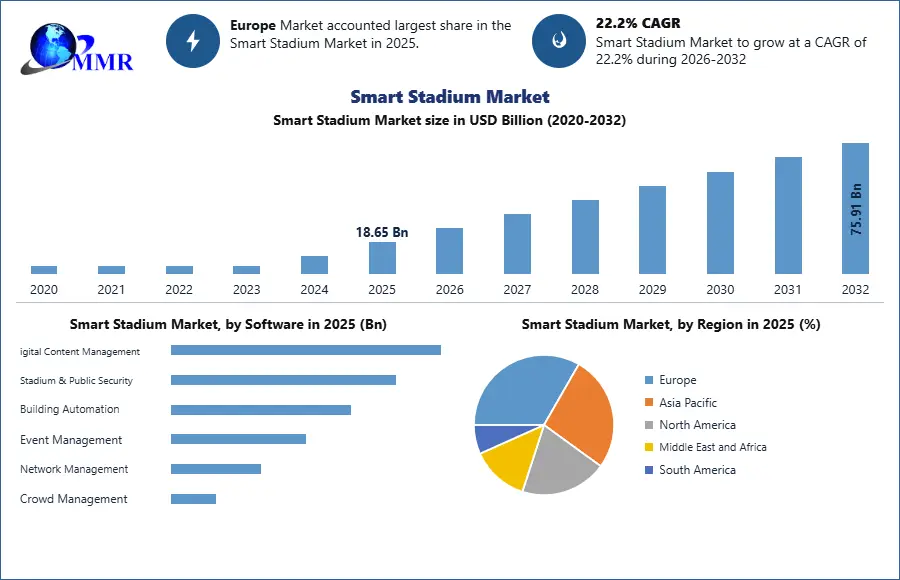
The Smart Stadium Market was valued at approximately USD 18.65 billion in 2025 and is projected to reach nearly USD 75.89 billion by 2032, expanding at a CAGR of 22.2% from 2026 to 2032. Smart stadiums integrate wired and wireless networks, sensors, cameras, digital signage, cloud platforms, artificial intelligence (AI), Internet of Things (IoT), security systems and data analytics to improve venue operations and spectator experiences.
The market is being driven by the growing demand for data-driven stadium operations, improved safety, energy efficiency, digital ticketing, cashless transactions, real-time crowd management and personalized fan engagement. Stadium owners and operators are increasingly adopting connected technologies to reduce operating and maintenance costs while generating additional revenue through targeted advertising, premium services, mobile applications and digital experiences. The growing popularity of live sports and entertainment events is also encouraging investment in modern venue infrastructure. AI-powered analytics, 5G connectivity, cloud computing, facial recognition, smart parking, digital twins and predictive maintenance are creating additional opportunities. Deloitte noted in its 2025 technology outlook that stadiums are increasingly being designed as digitally integrated environments focused on personalization and fan engagement.
U.S. Market Trends and Investment in 2025
The United States remained an important market for smart-stadium technologies in 2025, supported by significant investment in sports and entertainment venues and rapid adoption of AI-driven fan experiences. Intel highlighted in 2025 how modern venues are using connectivity, compute, AI and data technologies to improve fan journeys, security and venue operations. Its venue research also noted substantial investment flowing into sports and stadium assets, with technology becoming an important component of new and upgraded venues. IBM expanded AI applications at the 2025 US Open through its partnership with the USTA, including AI-generated commentary, insights and large-scale data processing across the tournament. IBM reported that technology supporting the event processed millions of data points to deliver digital experiences to fans. Cisco also emphasized in August 2025 that smart-stadium infrastructure was increasingly incorporating Wi-Fi, digital signage, crowd-flow monitoring, environmental controls and data-driven operations.
Request To Free Sample of This Strategic Report ➤ https://www.maximizemarketresearch.com/request-sample/3771/
Market Segmentation – Largest Market Share
-
By Component
-
Software
-
Hardware
-
Services
-
-
By Technology
-
Internet of Things (IoT)
-
Artificial Intelligence (AI)
-
Cloud Computing
-
Big Data Analytics
-
Augmented Reality (AR) & Virtual Reality (VR)
-
5G Connectivity
-
-
By Application
-
Security & Surveillance
-
Ticketing & Access Control
-
Digital Signage
-
Crowd Management
-
Building Automation
-
Energy Management
-
Event Management
-
Fan Experience Management
-
Other Applications
-
-
By Stadium Type
-
Indoor Stadiums
-
Outdoor Stadiums
-
-
By Deployment
-
On-Premises
-
Cloud-Based
-
-
By Geography
-
North America
-
Europe
-
Asia Pacific
-
Latin America
-
Middle East & Africa
-
Competitive Analysis
The competitive landscape includes global technology, networking, AI, cybersecurity and stadium-management companies. Based on MMR's identified key players, five major companies include IBM, Tech Mahindra, NEC, Cisco and Huawei. MMR identifies these companies among the leading participants in the smart-stadium market; the publicly accessible report page does not disclose individual global market-share percentages for each company.
IBM is expanding AI and data capabilities across major sporting events. During the 2025 US Open, IBM and the USTA introduced AI-powered features using watsonx, while its Wimbledon partnership added AI-driven fan engagement capabilities. These developments demonstrate how generative AI, hybrid cloud and large-scale sports data can create personalized digital experiences.
Tech Mahindra participates in digital transformation and technology services for sports and entertainment environments, positioning cloud, analytics, connectivity and digital experience capabilities as important tools for connected venues. Its broader enterprise technology portfolio supports opportunities arising from the integration of multiple stadium systems.
NEC continues to develop smart-venue technologies around biometrics, digital experiences, security and integrated venue management. In 2025, NEC deployed advanced facial-recognition technology at Expo 2025 Osaka-Kansai, demonstrating the scalability of biometric identification and cashless digital experiences for large visitor environments.
Cisco is strengthening the networking foundation of smart venues through high-density Wi-Fi, security, data-center infrastructure and venue-management technologies. Its 2025 smart-stadium guidance highlighted the integration of connectivity, digital signage, crowd monitoring and environmental controls to improve both fan experience and operational efficiency.
Huawei is advancing intelligent stadium infrastructure through 5G, AI, cloud, IoT, intelligent security and energy-management technologies. At Hong Kong's Kai Tak Sports Park, opened in 2025, Huawei technologies support an intelligent operations center, high-density wireless connectivity, AI-enabled security and energy optimization.
Regional Analysis
United States: The U.S. market is supported by major professional and collegiate sports investments, advanced digital infrastructure and strong demand for premium fan experiences. The country's large stadium ecosystem creates opportunities for AI, high-density connectivity, digital ticketing, smart security and analytics.
United Kingdom: The UK benefits from a mature sports and entertainment industry and continued adoption of digital fan-engagement technologies. Major venues are increasingly integrating mobile services, connectivity, data analytics and security technologies.
Germany: Germany's strong football culture, modern sports infrastructure and emphasis on efficient building operations support demand for smart-stadium technologies, particularly automation, security, connectivity and energy-management solutions.
France: France benefits from major sporting events and investment in modern venue infrastructure. The requirement for efficient crowd management, digital services and improved visitor experiences creates opportunities for connected stadium platforms.
Japan: Japan has strong capabilities in robotics, AI, biometrics, networking and automation. These technologies provide a foundation for smart-venue development. NEC's advanced biometric deployments and the country's continued investment in digitally enabled public and sports infrastructure support market development.
China: China represents an important growth market because of large-scale sports infrastructure development and government-supported digital transformation. China's General Administration of Sport has introduced smart-stadium standards covering information-system configuration and smart-venue evaluation, with implementation beginning in January 2025. The government's 2025 policy direction also supports upgrading public sports venues toward green, low-carbon and intelligent operations.
MMR projects Europe to hold the largest regional share, approximately 38% by 2032, supported by strong public-safety standards, demand for improved viewing experiences and integration of digital technologies. MMR's publicly available report page does not provide separate global market-share percentages for the individual countries listed above.
Request To Free Sample of This Strategic Report ➤ https://www.maximizemarketresearch.com/request-sample/3771/
Key Players
-
IBM
-
Tech Mahindra
-
NEC
-
Cisco
-
Huawei
-
Intel
-
Fujitsu
-
Johnson Controls
-
NTT
-
Ericsson
-
GP Smart Stadium
-
NXP Semiconductors
-
Vix Technology
-
Intechnology
-
Hawk-Eye Innovations
-
Locbee
-
Insprid
-
Byrom
-
Volteo
Conclusion
The smart stadium market is entering a period of rapid technological transformation as venue operators move beyond basic connectivity toward fully integrated, intelligent environments. The combination of AI, IoT, 5G, cloud computing, building automation, digital twins, advanced security and real-time analytics is expected to remain a major catalyst for market expansion. Building automation represents a particularly important opportunity because stadiums need to control energy, facilities, parking and other infrastructure while maintaining a high-quality spectator experience.
Going forward, the strongest opportunities are likely to emerge from integrated platforms that connect fan applications with security, ticketing, transportation, concessions, energy systems and venue operations. The ability to use real-time data for personalized services, predictive maintenance, crowd management and energy optimization can help stadium operators improve efficiency while creating new digital revenue streams. As major sporting events and venue modernization projects continue, investment in intelligent infrastructure is expected to remain a key factor supporting the long-term expansion of the global smart stadium market.
About Maximize Market Research
Maximize Market Research Pvt. Ltd. (MMR) is a global market research and consulting company that provides reliable, data-focused, and practical business insights. The firm serves a wide range of industries, including healthcare, pharmaceuticals, technology, automotive, electronics, chemicals, personal care, and consumer goods. Through market forecasts, competitive analysis, strategic consulting, and industry impact assessments, MMR helps organizations understand changing market conditions, identify growth opportunities, and make informed business decisions for long-term success.
Contact Us
Maximize Market Research Pvt. Ltd.
2nd Floor, Navale IT Park Phase 3
Pune Banglore Highway, Narhe
Pune, Maharashtra 411041, India
Phone: +91 9607365656
Email: sales@maximizemarketresearch.com

 English
 Arabic
 French
 Spanish
 Portuguese
 Deutsch
 Turkish
 Dutch
Dutch
 Italiano
 Russian
 Romaian
 Greek
Greek
