


White Label Food Delivery App: Build Around the Demand Gaps Others Overlook
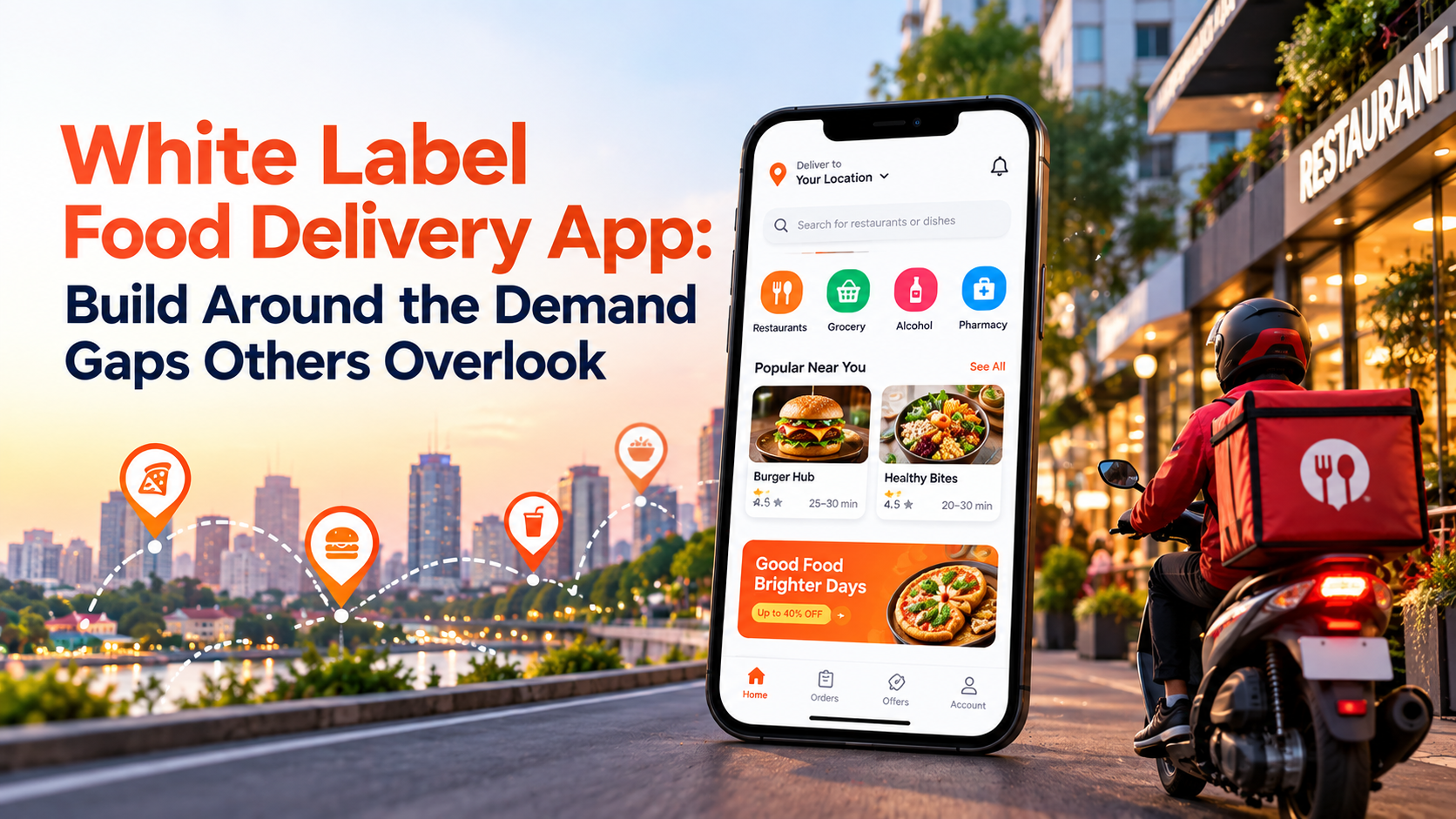
The next opportunity in food delivery may not come from adding more restaurants to another crowded marketplace. It can come from identifying the customers, restaurants, and delivery zones that existing platforms are not serving efficiently.
This is where a white label food delivery app becomes interesting for startups and food businesses. Instead of entering the market with a copy of an established platform, entrepreneurs can create a focused ordering ecosystem around a specific geographic area, cuisine category, restaurant segment, or customer group.
The technology becomes the foundation. The real differentiation comes from the market being built on top of it.
Find the Friction Between Restaurants and Customers
Food delivery demand is no longer limited to customers ordering dinner from popular restaurants. Businesses are exploring office meals, scheduled food orders, specialty cuisines, cloud kitchens, local food brands, healthy meal plans, and neighborhood-based delivery.
Yet many smaller restaurants still face challenges with digital visibility, customer retention, delivery coordination, and dependence on external marketplaces.
A startup can position its platform around these gaps.
For example, instead of attempting to list every restaurant in an entire city, a new marketplace could initially concentrate on a particular neighborhood or restaurant category. Building density in a smaller service area can make delivery operations easier to manage while creating stronger connections between restaurants and nearby customers.
This creates a different growth strategy: depth before breadth.
A white-label platform can support that approach while giving the business freedom to shape its ordering model according to local demand.
Turn Local Supply Into a Digital Network
Many food businesses already have the supply. What they may lack is an efficient digital channel for converting that supply into recurring orders.
Restaurants have menus. Cloud kitchens have production capacity. Delivery partners have availability. Customers have recurring food requirements.
The opportunity lies in connecting these elements more intelligently.
A branded food delivery platform can bring restaurants, customers, delivery partners, and administrators into one operating environment. Restaurant partners can update menus and availability, receive orders, monitor preparation, and manage their storefronts. Customers can discover nearby options, place orders, track deliveries, and receive personalized offers.
Meanwhile, operators gain visibility into where demand is coming from and how the marketplace is performing.
That information can become particularly valuable when expanding into new locations.
The Real Differentiator Is Marketplace Design
A food delivery platform does not necessarily need to compete through discounts alone.
Startups can build differentiation through marketplace design.
Consider a platform dedicated to regional cuisine. Another could focus on healthy meals for working professionals. Another might connect local cloud kitchens with customers seeking scheduled meal deliveries. A B2B-focused platform could target office food ordering rather than individual consumers.
These models create specific reasons for customers and merchants to use the platform.
A white label food delivery app allows the business to maintain its own branding, marketplace structure, customer journey, and commercial model while using an established technological foundation.
This can make experimentation easier.
A startup can test a niche market, evaluate ordering behavior, identify high-performing locations, and gradually expand instead of committing immediately to a city-wide operation.
Delivery Efficiency Is Becoming a Growth Factor
As food delivery markets mature, simply generating orders is not enough. Businesses also need to consider what happens between checkout and doorstep.
Poor delivery coordination can increase delays, customer complaints, cancellations, and operating costs.
This makes features such as delivery-zone management, automated order assignment, live tracking, driver availability, route visibility, and real-time status updates increasingly important.
For marketplace operators, these capabilities can help connect demand with available delivery capacity.
The result is a platform designed not only to capture orders but also to coordinate the movement of those orders.
Build a Direct Customer Relationship
Another market shift is the growing importance of customer ownership.
Restaurants want to know who their customers are, what they order, and when they are likely to return. A branded marketplace can create additional opportunities for customer engagement through loyalty programs, personalized promotions, push notifications, memberships, and targeted campaigns.
Instead of treating every transaction as a one-time order, the platform can be structured around repeat behavior.
This is especially relevant for businesses operating in smaller geographic markets, where customer relationships can become a significant competitive asset.
Expand When the Market Proves Itself
A startup does not have to launch every possible service on day one.
The initial marketplace could focus entirely on restaurant delivery. Once customer demand and operational capabilities are established, the business could explore grocery delivery, meal subscriptions, corporate ordering, catering, or other adjacent services.
This creates a more controlled expansion path.
The white label food delivery app becomes a flexible commercial foundation rather than the entire business strategy. The business can evolve its marketplace as customer behavior, restaurant participation, and local competition change.
Build the Market, Not Just the App
The strongest food delivery opportunities may exist in the spaces between large marketplaces and underserved local demand.
For startups, restaurant groups, and regional entrepreneurs, the objective can be to identify that gap, build sufficient supply around it, and create a delivery experience designed specifically for the target market.

 English
 Arabic
 French
 Spanish
 Portuguese
 Deutsch
 Turkish
 Dutch
Dutch
 Italiano
 Russian
 Portuguese (Brazil)
 Greek
Greek
