


Biostimulants Market Development Analysis, Key Insights, and Growth Opportunities
Biostimulants Market to Reach USD 13.81 Billion by 2034, Driven by Sustainable Agriculture and Crop Resilience
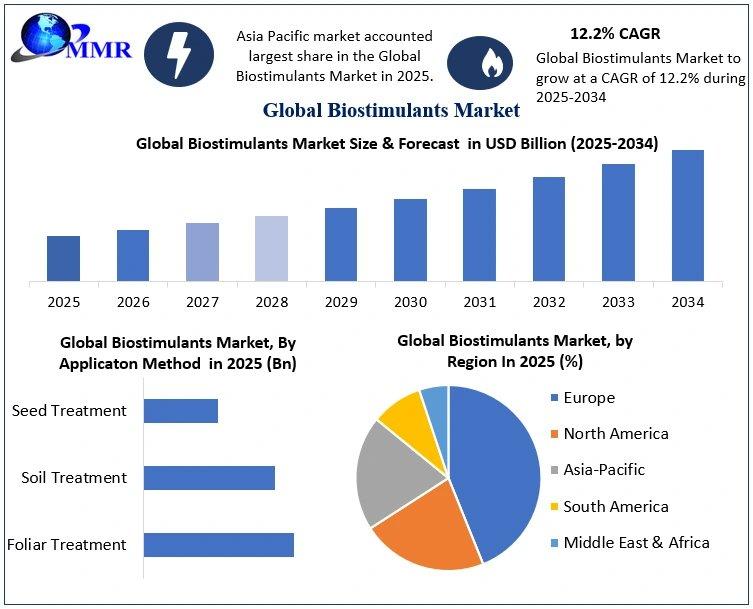
The Biostimulants Market is entering a high-growth phase as farmers, agricultural companies, and policymakers increasingly focus on sustainable crop production, nutrient-use efficiency, soil health, and resilience against environmental stress. According to Maximize Market Research, the global Biostimulants Market was valued at USD 4.90 billion in 2025 and is projected to reach USD 13.81 billion by 2034, expanding at a CAGR of 12.2% during 2026–2034.
Biostimulants are increasingly being incorporated into modern crop-management programs because they can support plant growth, nutrient uptake, crop quality, and tolerance to drought, salinity, heat, and other environmental stresses. Rising demand for sustainable agriculture, increasing adoption of organic farming, growing pressure to improve farm productivity, and the need to optimize fertilizer use are creating significant opportunities for manufacturers. Product innovation combining seaweed extracts, humic substances, amino acids, microorganisms, and other bio-based ingredients is also opening opportunities for crop-specific and stress-management formulations.
The market is additionally benefiting from the expansion of biostimulant applications across cereals and grains, fruits and vegetables, oilseeds and pulses, and other high-value crops. Multiple application methods, including foliar, soil, and seed treatments, allow producers to integrate biostimulants into different agricultural systems. However, variable field performance, regulatory differences between countries, limited farmer awareness, and the need for consistent product efficacy remain important industry considerations.
Get Your Free Sample Report Link : https://www.maximizemarketresearch.com/request-sample/604/
U.S. Market Trends and Investment
The United States is becoming an important innovation and investment center for biostimulants. In May 2025, bipartisan legislation known as the Plant Biostimulant Act of 2025 was introduced in both chambers of Congress to establish a consistent federal definition and regulatory pathway for plant biostimulants while encouraging research into soil health and crop production. The development reflects growing industry interest in regulatory clarity and commercialization of biological agricultural technologies.
Corporate investment is also strengthening the U.S. market. In 2025, Syngenta opened a 22,000-square-meter biologicals production facility in Orangeburg, South Carolina, designed to produce up to 16,000 tons of biostimulants annually. The company also reported continued growth in demand for biocontrols, biostimulants, and nutrient-efficiency products during 2025. These developments are supporting domestic manufacturing capacity and expanding access to biological crop solutions.
Market Segmentation: Leading Segments
By active ingredient, seaweed extracts held the largest market share in 2025. Their broad use is associated with plant growth, root development, nutrient uptake, crop quality, and tolerance to environmental stresses.
By crop type, cereals and grains accounted for the largest share, supported by extensive cultivation of corn, wheat, rice, barley, oats, and other staple crops.
By source, natural-source biostimulants dominated the market, reflecting extensive use of seaweed extracts, humic substances, fulvic acids, amino acids, and plant-derived formulations.
By farming practice, conventional farming represented the largest segment as growers increasingly use biostimulants alongside fertilizers and crop-protection products.
By application method, foliar treatment held the largest share because it enables rapid delivery of active compounds to plant tissues and is widely used during periods of crop stress.
By form, liquid biostimulants led the market due to their ease of mixing, compatibility with foliar spraying and fertigation, and suitability for precision agricultural applications.
Competitive Analysis
The competitive landscape includes major agricultural and biological-input companies investing in product development, manufacturing capabilities, partnerships, and biological technologies.
Syngenta Group is expanding its biologicals capabilities through strategic collaborations, natural-product research, bioengineering, fermentation, and analytics. Its Orangeburg facility represents a major expansion of U.S. biostimulant manufacturing capacity.
BASF SE continues developing its BioSolutions portfolio, including seaweed-based biostimulant technologies. Its partnership with Acadian Plant Health has expanded access to seaweed-derived solutions designed to improve crop resilience under drought and heat stress.
Bayer AG expanded its biologicals portfolio in 2025 with the introduction of Yoalo, a biostimulant designed to support nutrient availability and plant performance. The product is being incorporated into Acceleron seed-treatment combinations, demonstrating the increasing integration of biostimulants with seed technologies.
UPL Limited continues strengthening its Natural Plant Protection and BioSolutions portfolio. Its FY2024–25 activities included the development and commercialization of biological and biostimulant solutions, including its collaboration with Croda on BANZAI, a biostimulant foliar solution for cocoa.
Corteva Agriscience continues investing heavily in biological innovation. Its portfolio includes BlueN, a nutrient-efficiency biostimulant based on nitrogen-fixing bacteria, and Kinsidro Grow+, designed to support plant physiological performance and resilience. Corteva’s broader biological strategy combines internal R&D, external collaborations, licensing, and acquisitions.
Regional Analysis
Europe dominated the global Biostimulants Market with a 43.9% share in 2025. Strong adoption of sustainable agriculture, organic farming, and environmentally focused agricultural regulations supports regional demand. The European Union’s Fertilising Products Regulation formally recognizes plant biostimulants as a category of fertilising products when they improve nutrient-use efficiency, abiotic-stress tolerance, quality traits, or nutrient availability.
France is supporting agricultural transition through initiatives focused on sustainable farming, alternative crop-protection technologies, and bio-input development. Its France 2030 strategy specifically identifies biocontrol, biostimulants, and biofertilization among agricultural innovation areas.
Germany is also contributing to sustainable agricultural development through initiatives supporting the bioeconomy and climate-resilient farming. These policies and investments provide a favorable environment for biological agricultural inputs.
In the United Kingdom, government sustainability programs continue emphasizing productivity and environmentally beneficial farming practices, while Defra has been reviewing evidence surrounding the safety and efficacy of plant biostimulants.
Key Players
Key players covered in the Biostimulants Market include BASF SE, Syngenta Group, Bayer AG, UPL Limited, Corteva Agriscience, FMC Corporation, Sumitomo Chemical Co., Ltd., Novonesis, Yara International, Koppert Biological Systems, Acadian Plant Health, Biolchim S.p.A., Nufarm Limited, PI Industries Ltd., and SEIPASA S.A.
Why This Market Matters Now
The Biostimulants Market matters now because agriculture is being challenged by climate variability, water stress, soil degradation, rising input costs, and increasing expectations for sustainable food production. Biostimulants offer growers complementary tools that can support nutrient efficiency, crop quality, plant resilience, and productivity.
As regulatory frameworks become clearer and companies expand research, manufacturing, partnerships, and biological technology platforms, the industry is moving toward more standardized and application-specific solutions. The projected increase from USD 4.90 billion in 2025 to USD 13.81 billion by 2034 highlights the expanding commercial opportunity for manufacturers, agricultural technology companies, distributors, and investors.
Explore More Related Reports:
Fiber Reinforced Plastic Composites Market https://www.maximizemarketresearch.com/market-report/glass-fiber-reinforced-plastic-gfrp-composites-market/2291/
Global Specialty Gases for Electronics Application Market https://www.maximizemarketresearch.com/market-report/global-specialty-gases-for-electronics-application-market/81551/
About Maximize Market Research
Maximize Market Research Pvt. Ltd. (MMR) is a global market research and consulting company that provides reliable, data-focused, and practical business insights. The firm serves a wide range of industries, including healthcare, pharmaceuticals, technology, automotive, electronics, chemicals, personal care, and consumer goods. Through market forecasts, competitive analysis, strategic consulting, and industry impact assessments, MMR helps organizations understand changing market conditions, identify growth opportunities, and make informed business decisions for long-term success.
Contact Us
Maximize Market Research Pvt. Ltd.
2nd Floor, Navale IT Park Phase 3
Pune Banglore Highway, Narhe
Pune, Maharashtra 411041, India
Phone: +91 9607365656
Email: sales@maximizemarketresearch.com

 English
 Arabic
 Spanish
 Portuguese
 Deutsch
 Turkish
 Dutch
Dutch
 Italiano
 Russian
 Romaian
 Portuguese (Brazil)
 Greek
Greek
