


From Short-Duration Batteries to LDES: Europe’s Storage Evolution
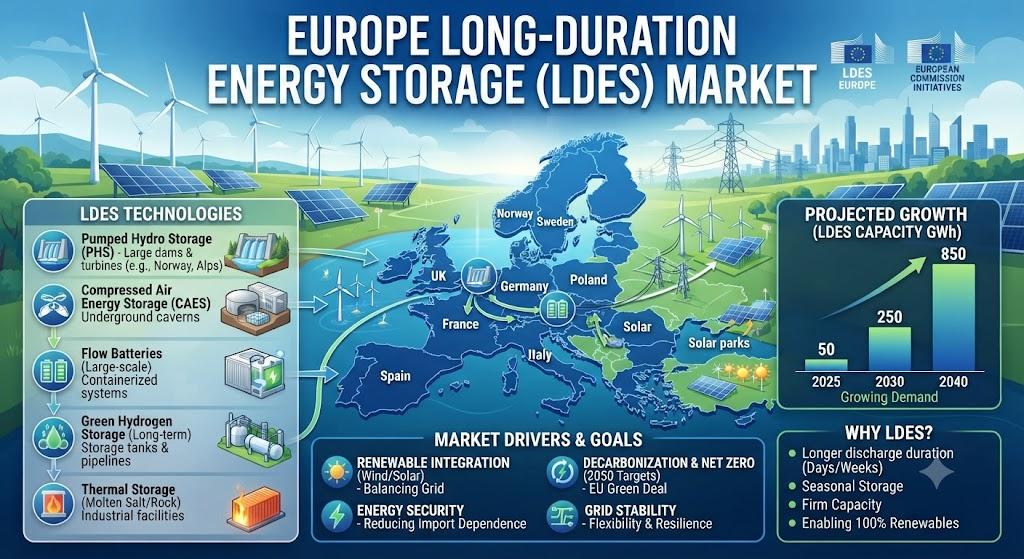
Europe Long-Duration Energy Storage (LDES) Market
Europe Long-Duration Energy Storage (LDES) Market is entering a period in which system flexibility is becoming as important as renewable generation capacity. Europe’s decarbonization plans require more wind, solar, electrification, and flexible demand, but renewable output can fluctuate across hours and weather conditions. Long-duration storage can help manage these timing differences and strengthen the reliability of low-carbon electricity systems.
The market opportunity extends beyond traditional battery applications. LDES can support renewable firming, energy arbitrage, capacity adequacy, balancing, congestion management, and resilience. Its ability to discharge for longer periods can become valuable when a grid experiences extended renewable shortfalls rather than brief fluctuations. This makes duration an important planning variable alongside power capacity and response speed.
Technology selection will vary by geography and application. Pumped hydro remains relevant for large projects where elevation differences, reservoirs, and suitable environmental conditions exist. Flow batteries can provide scalable energy capacity and potentially long operating cycles. Thermal storage can serve electricity or industrial heat applications, while compressed-air and gravity-based systems offer mechanical alternatives. Emerging technologies may also compete where specific project requirements favor different physical characteristics.
The Europe Long-Duration Energy Storage (LDES) Market Size discussion needs to consider both existing assets and the pipeline of planned projects. Market size can be measured through installed megawatts, megawatt-hours, investment value, annual additions, or project capacity under development. Measures can differ for early-stage projects.
A major challenge is creating bankable revenue structures. LDES assets can deliver several services, but not all are contracted for long periods. Merchant revenues may fluctuate with wholesale prices, while ancillary-service markets can change as more flexible resources enter the system. Capacity mechanisms and long-term contracts may improve financing certainty, but their availability differs between European markets.
Grid connection is another critical factor. Storage developers increasingly compete for limited network capacity alongside renewable generators and large electricity consumers. Projects that can connect at strategic substations may gain advantages in congested regions. Clear rules for storage connection, network charging, and participation in electricity markets can reduce uncertainty and encourage investment.
The rise of electrification could strengthen the case for LDES. Electric vehicles, heat pumps, industrial electrification, and data centers can increase electricity demand and create new peaks. Long-duration storage can help shift supply toward these periods, particularly when combined with renewable generation and flexible demand. In industrial settings, storage can also support resilience during network disturbances or price spikes.
Data and digital controls will become increasingly important. Advanced forecasting can predict renewable production and electricity prices, while automated energy-management systems can optimize charging and discharging. Operators may use artificial intelligence and market analytics to coordinate multiple services without compromising asset availability. Better controls can therefore increase the economic value of the same physical storage system.
Supply-chain development will influence deployment. Equipment manufacturing, engineering, construction, software, and maintenance capabilities must scale alongside project demand. Investors may place greater emphasis on warranties, performance guarantees, service infrastructure, and technology bankability. Demonstrated projects with transparent operating results can help establish confidence and accelerate replication.
The competitive environment will not be determined by one universal technology. Each project will require an assessment of duration, efficiency, degradation, safety, footprint, permitting, resource availability, and total lifetime cost. Developers that can match technology characteristics with specific market needs may secure opportunities across different European regions.
Ultimately, LDES can become a connective layer between renewable generation and flexible electricity consumption. Its contribution will depend on effective market design, suitable locations, reliable technology, and commercially viable revenue models. As Europe builds a more renewable power system, long-duration storage can provide an additional tool for managing the periods when generation and demand are separated by time.

 English
 Arabic
 French
 Spanish
 Portuguese
 Deutsch
 Turkish
 Italiano
 Russian
 Romaian
 Portuguese (Brazil)
 Greek
Greek
