


The Essential Guide to Data Center Security in Qatar
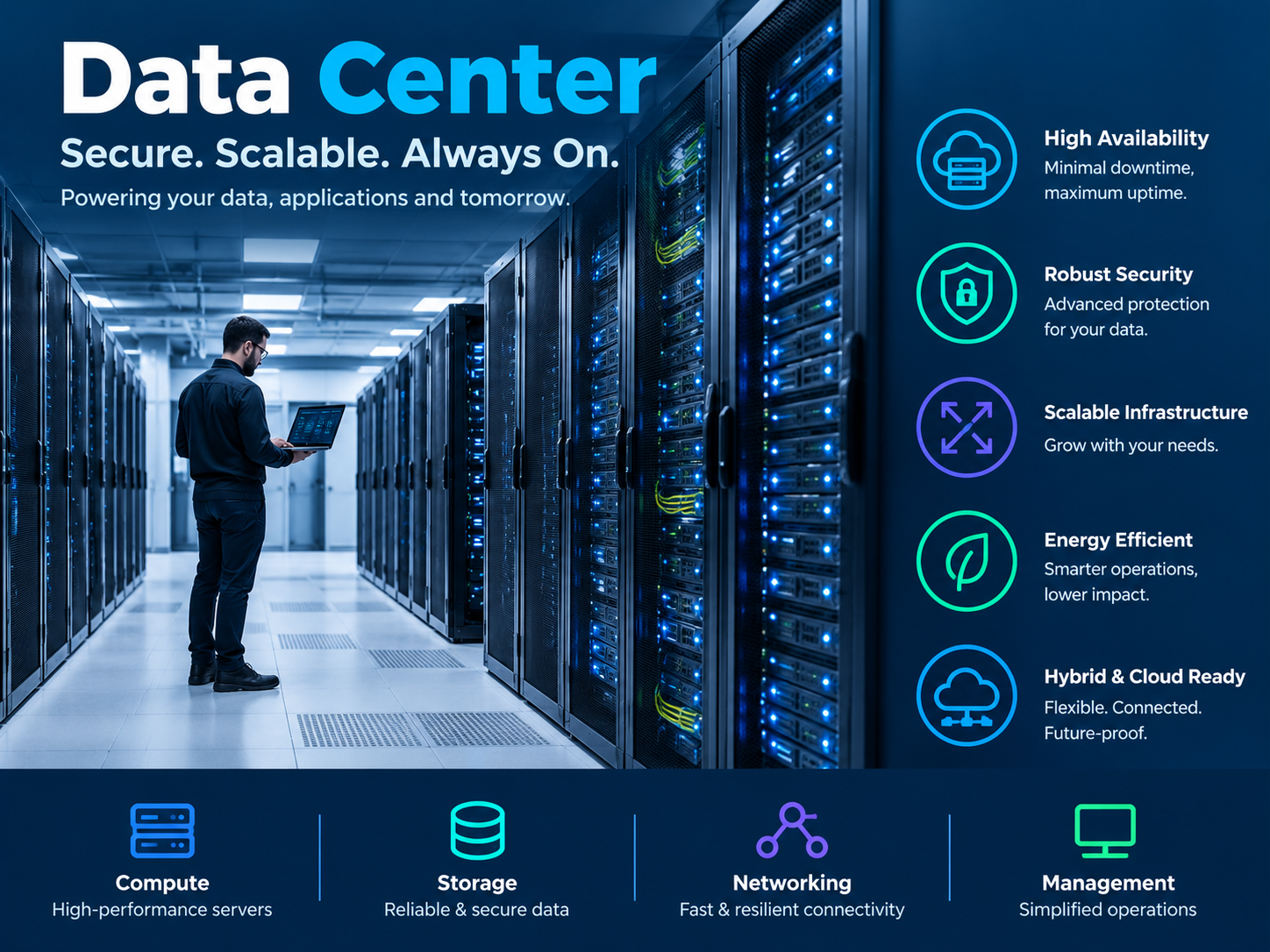
As Qatar accelerates its digital transformation under the National Vision 2030 roadmap, Data Center Security has emerged as one of the most critical and complex challenges facing enterprises, telecommunications providers, government agencies, and cloud hosting operators across the country. The exponential growth of hyperscale and colocation facilities in Doha, Lusail, and Qatar's emerging technology parks has created vast physical and digital attack surfaces that demand a layered, intelligence-driven security strategy.
Expedite IoT delivers comprehensive Data Center Solutions engineered for Qatar's unique regulatory environment, extreme climate conditions, and rapidly evolving threat landscape — protecting critical infrastructure from both physical intrusion and sophisticated cyber threats with equal rigour.
Why Data Center Security Is a Strategic Priority in Qatar
Qatar's data centers underpin the nation's banking and financial sector, oil and gas operational technology networks, government digital services, and a rapidly expanding cloud infrastructure ecosystem. A single successful breach — whether physical or cyber — can trigger cascading service outages, data exfiltration events, and regulatory sanctions under Qatar's Personal Data Protection Privacy Law (PDPPL) and the National Cybersecurity Framework (NCSA).
International standards including Uptime Institute Tier classifications, ISO 27001, SOC 2 Type II, and PCI DSS all mandate documented, tested, and auditable security controls as prerequisites for certification. Qatar's data center operators face the dual imperative of meeting these global benchmarks while navigating locally specific threat vectors — including sandstorm-related environmental vulnerabilities, high geopolitical risk profiles, and a diverse contractor workforce requiring stringent access governance.
The Layered Security Model: Physical and Cyber Converged
Effective Data Center Security is never a single-product solution. It is a converged, defence-in-depth architecture that integrates physical perimeter controls, environmental monitoring, cybersecurity hardening, and intelligent threat detection into a unified operational picture. Expedite IoT architects and deploys each layer in seamless coordination, ensuring there are no gaps between physical and digital security boundaries.
The converged model encompasses six core pillars:
• Data Center Threat Detection — behavioural analytics and AI-powered anomaly identification
• Cybersecurity for Data Center — network hardening, vulnerability management, and zero-trust architecture
• Data Center Encryption — data-at-rest and data-in-transit cryptographic protection
• Data Center Firewalls — next-generation perimeter and micro-segmentation network controls
• Data Center Access Control — multi-factor physical and logical identity governance
• Data Center Surveillance — intelligent CCTV, thermal imaging, and AI video analytics
Each pillar is described in detail in the sections that follow, and each maps directly to the Data Center Intrusion Detection and response capabilities that define a mature, audit-ready security posture.
Pillar 1: Data Center Threat Detection — Seeing Attacks Before They Succeed
Data Center Threat Detection is the intelligence engine of the entire security architecture. Traditional signature-based detection tools are no longer sufficient against modern advanced persistent threats (APTs), insider attacks, and zero-day exploits targeting critical infrastructure. Expedite IoT deploys AI-driven Security Information and Event Management (SIEM) platforms combined with User and Entity Behaviour Analytics (UEBA) that establish baseline behavioural profiles for every user, device, and workload — flagging deviations in real time before they escalate into incidents.
Key detection capabilities include:
• Network traffic deep packet inspection and east-west lateral movement detection
• File integrity monitoring (FIM) for critical system and configuration files
• Privileged account monitoring with session recording and real-time alert triggers
• Dark web monitoring for credential exposure relevant to the organisation's domains
• Automated threat intelligence feed ingestion (MITRE ATT&CK framework-aligned)
Mean time to detect (MTTD) reduction is a core KPI for every Data Center Security Qatar engagement — because in cybersecurity, speed of detection is directly correlated with breach impact containment.
Pillar 2: Cybersecurity for Data Center — Hardening Every Layer of the Stack
Cybersecurity for Data Center environments requires a fundamentally different approach from standard enterprise IT security. The attack surface is broader, the consequences of breach are more severe, and the operational constraints — uptime requirements, change management rigour, and compliance obligations — are significantly more demanding.
Expedite IoT's cybersecurity hardening framework for Qatar's data centers encompasses:
• Zero-trust network architecture implementation — no implicit trust for any user, device, or workload
• Hypervisor and container security hardening for virtualised and cloud-native environments
• Patch and vulnerability management with risk-ranked remediation workflows
• Secure remote access via ZTNA (Zero Trust Network Access) replacing legacy VPN infrastructure
• API security gateway deployment protecting management plane and automation interfaces
• Penetration testing and red team exercises aligned with CREST and PTES methodologies
Pillar 3: Data Center Encryption — Making Stolen Data Worthless
Data Center Encryption is the last line of defence when all other controls fail. Even if an attacker gains access to storage media, backup tapes, or intercepted network traffic, strong encryption renders that data completely unusable without the corresponding cryptographic keys. Expedite IoT implements encryption at every tier of the data center stack:
• Data-at-rest encryption using AES-256 for storage arrays, backup systems, and database volumes
• Data-in-transit encryption via TLS 1.3 for all management, application, and replication traffic
• Hardware Security Module (HSM) deployment for cryptographic key lifecycle management
• Encrypted hypervisor memory for sensitive virtual machine workloads
• Quantum-resistant cryptography readiness assessment and migration planning for long-lifecycle infrastructure
For Qatar's financial services and government data center operators, Data Center Encryption aligned with Qatar Central Bank (QCB) guidelines and NCSA cryptographic standards is a mandatory compliance requirement, not an optional enhancement.
Pillar 4: Data Center Firewalls — Next-Generation Perimeter and Micro-Segmentation
Data Center Firewalls have evolved far beyond simple packet-filtering appliances. Today's next-generation firewall (NGFW) platforms combine deep packet inspection, application-layer visibility, SSL/TLS decryption, and integrated intrusion prevention system (IPS) capabilities into a single, high-throughput security enforcement point.
Expedite IoT designs and deploys multi-tier firewall architectures for Qatar's data centers, including:
• Internet edge NGFW clusters with active-active high availability and sub-millisecond failover
• Internal micro-segmentation firewalls enforcing zero-trust east-west traffic policies between server zones
• Out-of-band management network firewalls protecting IPMI, iDRAC, and infrastructure management interfaces
• Web Application Firewalls (WAF) protecting customer-facing APIs and management portals
• Distributed Denial of Service (DDoS) mitigation — both on-premise scrubbing and upstream cloud-based volumetric attack absorption
Pillar 5: Data Center Access Control — Governing Who Enters Every Zone
Physical Data Center Access Control is as critical as its digital counterpart. Unauthorised physical access to server racks, network equipment, or power infrastructure can cause damage that no cybersecurity tool can prevent. Expedite IoT implements multi-factor physical access control across every security perimeter of the data center — from the outer fence to the individual cabinet lock.
Our access control architecture for Qatar data centers includes:
• Biometric multi-factor authentication (facial recognition + PIN or fingerprint + card) at each security zone boundary
• Man-trap (airlock) vestibule deployment between public reception and secure data hall areas
• Individual cabinet-level electronic locking with per-access audit logging
• Time-based access schedules and role-based zone permissions for contractors and third-party maintenance staff
• Visitor and contractor management with escort policy enforcement and real-time occupancy tracking
• Integration with HR systems for automatic access revocation upon employee offboarding
Pillar 6: Data Center Surveillance — Intelligent Video Analytics for Critical Facilities
Data Center Surveillance in a modern, high-security facility goes far beyond traditional CCTV recording. Expedite IoT deploys AI-powered video analytics platforms that transform passive camera footage into an active, real-time threat detection tool.
Surveillance capabilities deployed across Qatar data center clients include:
• 4K resolution IP cameras with low-light and IR imaging for data hall, loading bay, and perimeter coverage
• AI video analytics for tailgating detection, loitering alerts, and object left or removed detection
• Thermal imaging perimeter cameras detecting human intrusion regardless of visibility conditions
• License plate recognition (LPR/ANPR) at all vehicle entry and exit points
• 90-day minimum video retention with tamper-evident audit logging, compliant with Qatar's NCSA incident response requirements
• Video Management System (VMS) integration with access control and SIEM platforms for correlated incident response
Data Center Intrusion Detection: Physical and Network Layers Combined
Data Center Intrusion Detection operates across two dimensions — physical and digital — and both must be equally mature for a truly resilient security posture. On the physical side, Expedite IoT deploys dual-technology perimeter sensors (combining passive infrared and microwave detection), vibration sensors on perimeter fencing and walls, and glass-break detectors on all external glazing. On the digital side, Network Intrusion Detection Systems (NIDS) and Host-based Intrusion Detection Systems (HIDS) provide continuous traffic and endpoint monitoring, feeding alerts to the Security Operations Centre (SOC) in real time.
All intrusion events — whether a fence vibration alert at 2 a.m. or a lateral movement anomaly detected within the server fabric — are correlated within a unified Data Center Security Doha operations dashboard, enabling security teams to triage, investigate, and respond to threats with full situational context rather than isolated, disconnected alerts.
Why Expedite IoT Is Qatar's Trusted Data Center Security Partner
Expedite IoT brings a rare combination of physical security engineering expertise and cybersecurity depth to every data center engagement in Qatar:
• Proven Regional Track Record: Designed and deployed security architectures for hyperscale, colocation, and enterprise data centers across Qatar, UAE, and Saudi Arabia.
• Certified Security Engineers: In-house team holding CISSP, CISM, CCDP, and Uptime Institute certifications — ensuring designs meet global tier compliance requirements.
• Regulatory Alignment: Solutions designed to satisfy Qatar PDPPL, NCSA frameworks, QCB cybersecurity directives, and international standards including ISO 27001, SOC 2, and PCI DSS.
• Vendor-Agnostic Architecture: We select the best-fit technology from leading vendors including Palo Alto Networks, Fortinet, Genetec, Lenel, Suprema, and Axis Communications — rather than pushing a single-vendor agenda.
• 24/7 Qatar SOC Support: Our Doha-based Security Operations Centre provides round-the-clock monitoring, incident response, and threat hunting services for data center clients operating critical national infrastructure.
Conclusion
Qatar's data centers are the digital backbone of a nation in transformation — and protecting them demands a security strategy that is equally sophisticated, layered, and forward-looking. From AI-powered Data Center Threat Detection and rigorous Cybersecurity for Data Center hardening, to enterprise-grade Data Center Firewalls, bulletproof Data Center Access Control, intelligent Data Center Surveillance, and converged Data Center Intrusion Detection — every element of Expedite IoT's framework is engineered to eliminate security gaps and deliver the compliance-ready, audit-proof posture that Qatar's regulatory environment demands.
Whether you are building a new facility or hardening an existing one, Expedite IoT's end-to-end Data Center Solutions ensure your infrastructure is protected today and resilient against tomorrow's threats. Contact our Doha-based team today to schedule a security assessment and discover how we are raising the standard of Data Center Security Qatar — one critical facility at a time.
FAQs
1. What regulatory standards govern Data Center Security in Qatar?
Qatar's Data Center Security landscape is governed by several overlapping frameworks. The National Cybersecurity Agency (NCSA) issues binding cybersecurity directives applicable to critical infrastructure operators. The Qatar Personal Data Protection Privacy Law (PDPPL) mandates data security controls and breach notification obligations. The Qatar Central Bank (QCB) publishes sector-specific cybersecurity guidelines for financial services data centers. Internationally, Uptime Institute Tier standards, ISO 27001, SOC 2 Type II, and PCI DSS are widely required by enterprise tenants and cloud customers. Expedite IoT's security architecture is designed to satisfy all applicable frameworks simultaneously.
2. How does Data Center Threat Detection differ from standard enterprise security monitoring?
Data Center Threat Detection must operate at significantly higher scale, speed, and precision than standard enterprise monitoring. Data centers process billions of network events per day across thousands of devices and workloads. Effective detection requires dedicated SIEM platforms with purpose-built data center correlation rules, UEBA baselines calibrated to infrastructure-specific behaviour patterns, and integration with physical security events — such as after-hours badge access correlated with network anomalies — that standard enterprise SOC tooling does not typically handle. Expedite IoT's converged detection platform is engineered specifically for this environment.
3. Why is Data Center Encryption mandatory even with strong perimeter security?
Perimeter security reduces the probability of unauthorised access — but it can never reduce it to zero. Insider threats, supply chain compromises, stolen backup media, and sophisticated APT campaigns can all result in data exposure despite strong perimeter controls. Data Center Encryption ensures that even if an attacker successfully exfiltrates data — from storage arrays, backup tapes, or intercepted network traffic — the information remains cryptographically protected and unusable. Under Qatar's PDPPL, encryption is also a recognised mitigating factor that can significantly reduce regulatory liability in the event of a confirmed breach.
4. What makes Data Center Surveillance in Qatar different from standard commercial CCTV?
Data Center Surveillance for critical facilities requires capabilities that go far beyond standard commercial CCTV deployments. Data center surveillance must provide complete, gap-free coverage of all physical security zones — including data halls, raised floor voids, roof plant areas, loading bays, and perimeter fencing — with video retention typically mandated at 90 days or more. AI video analytics must actively detect security events in real time rather than simply recording for post-incident review. All footage must be stored with tamper-evident integrity controls and be readily exportable in formats acceptable to Qatari law enforcement and regulatory investigations.
5. How quickly can Expedite IoT deploy Data Center Solutions in Doha?
Deployment timelines for Data Center Solutions in Doha depend on project scope and existing infrastructure maturity. A security assessment and gap analysis can typically be completed within 5 to 7 business days, producing a prioritised remediation roadmap. Targeted interventions — such as Data Center Firewalls replacement, SIEM deployment, or surveillance system upgrades — can be executed within 4 to 8 weeks. Full converged physical and cyber security architecture programmes for new-build or major retrofit facilities follow structured 3 to 6-month delivery programmes with phased go-live milestones. Our Data Center Security Doha team is available for immediate consultation — contact Expedite IoT to discuss your specific requirements and timeline.

 English
 Arabic
 French
 Spanish
 Portuguese
 Deutsch
 Dutch
Dutch
 Italiano
 Russian
 Romaian
 Portuguese (Brazil)
 Greek
Greek
