


How Toppers Use CAT Previous Year Question Papers to Crack IIMs
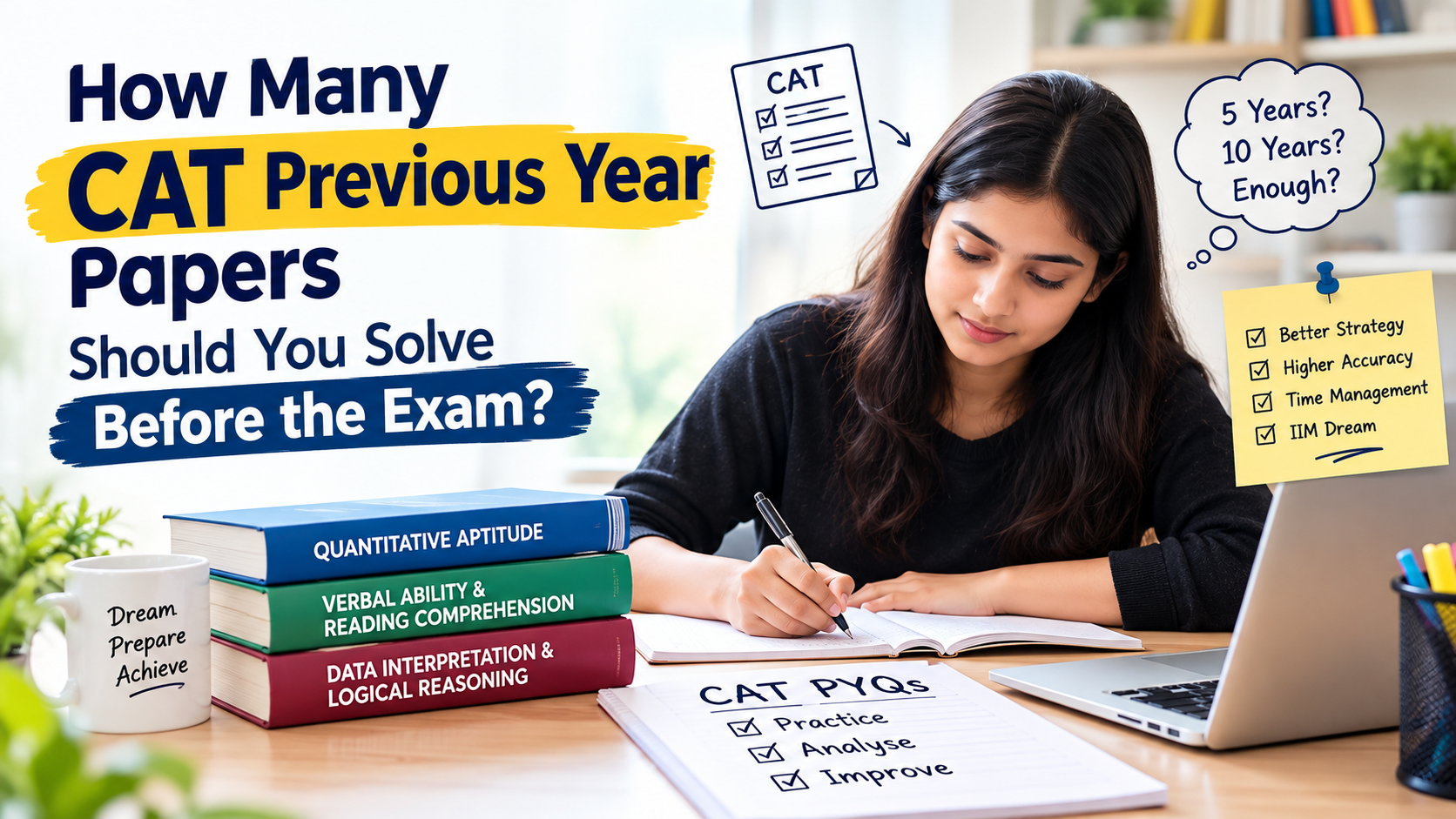
Cracking the CAT exam requires more than completing the syllabus. Successful candidates understand the exam pattern, practice strategically, and regularly analyse their performance. One of the most useful resources for this preparation is CAT Previous Year Question Papers.
CAT PYQs help aspirants understand the types of questions asked, difficulty levels, important topics, and time pressure of the actual examination. Toppers do not simply solve these papers—they use them to improve their overall preparation strategy.
Why CAT Previous Year Question Papers Are Important
CAT Previous Year Question Papers provide a realistic idea of what to expect in the examination. They can help students:
- Understand the CAT exam pattern
- Identify important topics
- Analyse question difficulty
- Improve speed and accuracy
- Develop better time-management skills
- Identify weak and strong areas
- Become familiar with different question formats
Regular PYQ practice can also help reduce exam anxiety because students become more comfortable with the actual style of CAT questions.
How Toppers Use CAT PYQs
1. They Start with Topic-Wise Practice
Instead of immediately solving complete papers, toppers often begin with topic-wise questions. For example, students preparing for Quantitative Aptitude can practise Arithmetic, Algebra, Geometry, and Number System questions separately.
This approach helps build conceptual clarity before moving to full-length papers.
2. They Solve Papers Under Exam Conditions
Once their concepts are strong, toppers attempt previous year papers in a timed environment.
They try to:
- Sit in a quiet place
- Follow the actual exam time limit
- Avoid unnecessary breaks
- Attempt questions strategically
- Record their score and accuracy
This turns PYQ practice into a realistic CAT simulation.
3. They Analyse Every Mistake
Simply checking the answer is not enough.
After completing a paper, toppers analyse:
What went wrong?
- Conceptual mistake?
- Calculation error?
- Misreading the question?
- Poor time management?
- Wrong question selection?
This analysis helps prevent the same mistake from occurring again.
4. They Maintain an Error Log
An error log is one of the simplest ways to improve CAT preparation.
Students can maintain a notebook or spreadsheet containing:
| Question | Topic | Mistake | Correct Approach | Revision Needed |
|---|---|---|---|---|
| Q1 | Arithmetic | Calculation error | Recheck percentage calculation | Yes |
| Q2 | RC | Incorrect inference | Read context carefully | Yes |
| Q3 | Algebra | Concept gap | Revise equations | Yes |
Reviewing this log regularly can significantly improve accuracy.
5. They Identify Important Topics
CAT PYQs allow students to identify recurring concepts and question types.
For example:
Quantitative Aptitude
- Arithmetic
- Algebra
- Geometry
- Number System
VARC
- Reading Comprehension
- Para-based questions
- Verbal Ability
DILR
- Data Interpretation
- Logical Reasoning
- Tables and arrangements
- Case-based sets
Rather than spending equal time on every topic, aspirants can prioritise areas that require more practice.
Also Read: CAT mock test 2027
6. They Focus on Question Selection
CAT is not only about solving questions quickly. Choosing which questions to attempt is equally important.
While solving PYQs, students should learn to identify:
- Easy questions
- Moderate questions
- Time-consuming questions
- Questions better left for later
This skill becomes particularly valuable during the actual CAT examination.
7. They Repeat Difficult Questions
Toppers don't consider a difficult question a failure. They use it as a learning opportunity.
After attempting a PYQ, they may revisit it after a few days and try to solve it again without looking at the solution.
The goal is to understand why the solution works, rather than memorising the answer.
8. They Combine PYQs with Mock Tests
CAT Previous Year Question Papers and mock tests serve different purposes.
PYQs help understand the actual nature of CAT questions, while mock tests help develop exam strategy, stamina, and time management.
A strong preparation plan should therefore include both.
Suggested Approach
Concept Building → Topic Practice → CAT PYQs → Mock Tests → Analysis → Revision
This creates a systematic preparation cycle.
Common Mistakes Students Make While Using CAT PYQs
Avoid these common mistakes:
- Solving PYQs without a timer
- Looking at solutions too quickly
- Not analysing incorrect answers
- Practising only favourite topics
- Ignoring difficult questions
- Not revising mistakes
- Solving papers without tracking performance
Remember, the objective is not simply to complete more papers. The objective is to learn from every paper.
How to Create a CAT PYQ Practice Plan
A simple weekly strategy can look like this:
| Day | Activity |
|---|---|
| Monday | Quantitative Aptitude PYQs |
| Tuesday | VARC PYQs |
| Wednesday | DILR PYQs |
| Thursday | Weak-topic practice |
| Friday | Mixed PYQ practice |
| Saturday | Full-length PYQ |
| Sunday | Paper analysis and revision |
Students can modify this schedule according to their preparation level.
Final Thoughts
CAT Previous Year Question Papers are among the most valuable resources for MBA aspirants preparing for the CAT exam. However, simply solving PYQs is not enough. The real advantage comes from analysing mistakes, identifying important topics, improving question selection, and revising repeatedly.
Toppers use cat syllabus as a learning and analysis tool, not just as another set of practice questions. With consistent practice and proper performance analysis, CAT aspirants can improve their speed, accuracy, confidence, and overall exam strategy.

 English
 Arabic
 French
 Portuguese
 Deutsch
 Turkish
 Dutch
Dutch
 Italiano
 Russian
 Romaian
 Portuguese (Brazil)
 Greek
Greek
