


What Are Football Betting Odds, and How Do You Read Them?
-
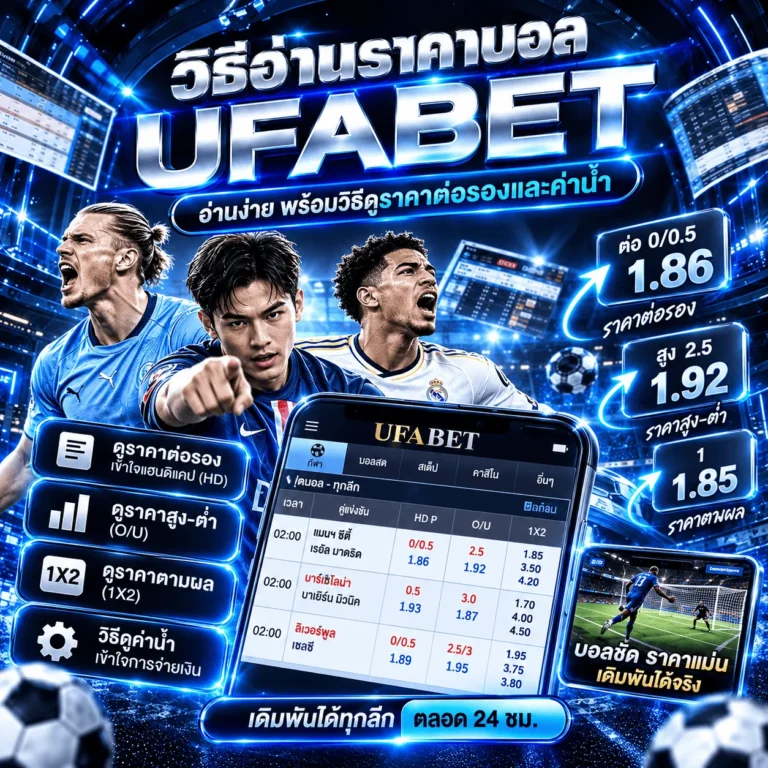
Football betting odds are more than just numbers displayed beside a team or match. They show the potential return from a wager and, indirectly, how a bookmaker assesses the likelihood of an outcome. Understanding those numbers is essential if you want to interpret football markets rather เว็บแทงบอลฝากวอเลทใช้งานอย่างไร than simply pick a team you expect to win.
The first thing to know is that betting odds can be displayed in different formats. The most common are decimal, fractional, and American odds. The underlying idea is the same: the odds indicate the potential payout attached to a particular selection.
How Football Betting Odds Work
Suppose a bookmaker lists a football match with decimal odds of 2.50 for a team to win. A $10 stake would return $25 if that selection wins, including the original $10 stake. The potential profit would therefore be $15.
Decimal odds are particularly straightforward because you can multiply your stake by the odds to calculate the total return. Odds of 1.50 on a $20 stake, for example, would produce a $30 total return if successful.
Fractional odds express potential profit rather than total return. Odds of 3/2 mean that a $10 stake would generate $15 in profit, plus the original $10 stake.
American odds use positive or negative numbers. Positive odds indicate the potential profit from a $100 stake, while negative odds indicate how much you would need to stake to make $100 in profit.
Reading Odds in a Football Match
Football betting markets go well beyond simply choosing the winner. The 1X2 market, for instance, covers three possible results: the home team wins, the match is drawn, or the away team wins.
You might see something like 2.00 for the home team, 3.40 for a draw, and 3.75 for the away team. The lower price suggests that the bookmaker considers that outcome more likely than the alternatives, although odds are not guarantees.
Other common markets include both teams to score, over or under a specified number of goals, correct score, and handicap or spread markets. Each market uses odds to attach a potential return to a different prediction about the match.
What Implied Probability Means
One useful way to understand betting odds is to convert them into implied probability.
For decimal odds, the basic calculation is 1 divided by the decimal odds, multiplied by 100. So odds of 2.00 imply a probability of 50%, while odds of 4.00 imply 25%.
This doesn't mean the bookmaker is declaring that an event has exactly that probability. Bookmakers build a margin into their markets, commonly known as the overround or vig. As a result, adding the implied probabilities across all outcomes in a market can produce a total greater than 100%.
Why Odds Move Before Kickoff
Football odds can change between the opening of a market and kickoff. Injuries, suspensions, team news, weather, changes in expected lineups, and betting activity can all influence prices.
A shorter price doesn't necessarily mean a team has suddenly become certain to win. It simply means the market price has changed to reflect updated information and bookmaker risk.
This is why comparing odds at different points in time can be useful, but the movement itself shouldn't be treated as proof that one particular outcome will happen.
Common Mistakes When Reading Betting Odds
One frequent mistake is assuming that shorter odds represent a guaranteed result. They don't. A team priced at 1.30 can still lose, while a team at 5.00 can still win.
Another mistake is looking only at the possible payout. Higher odds offer a larger potential return, but they also correspond to a less likely outcome according to the market.
The more useful approach is to understand what the odds represent, compare the available prices, and consider whether the potential return makes sense relative to the perceived probability and risk.
The Practical Takeaway
Learning to read football betting odds starts with understanding the format, calculating the potential return, and recognizing the probability implied by the price. From there, it becomes easier to compare markets and understand why odds change.
Most importantly, odds are a way of expressing price and probability—not predictions that guarantee a particular result. A clear understanding of that distinction helps readers approach football betting markets with more realistic expectations.
ChatGPT is AI and can make mistakes.

 Arabic
 French
 Spanish
 Portuguese
 Deutsch
 Turkish
 Dutch
Dutch
 Italiano
 Russian
 Romaian
 Portuguese (Brazil)
 Greek
Greek
