


How to Decide Between Battery Repair, Rebuilding, and Replacement
Industrial and forklift batteries are essential to keeping warehouses, distribution centers, manufacturing facilities, and other operations moving. But like any piece of equipment, batteries eventually develop problems. When a battery starts losing power, charging poorly, or showing signs of damage, the immediate question is often: Should you repair it, rebuild it, or replace it?
The right answer depends on the battery's condition, age, performance, and overall value. In many cases, a professional forklift battery repair service can identify a relatively small issue and restore the battery without the cost of a full replacement. However, repair is not always the best option. Sometimes rebuilding provides a better balance between cost and performance, while severely damaged batteries may be safer and more economical to replace.
Understanding the difference between these three options can help you make a practical decision instead of automatically purchasing a new battery.
What Is the Difference Between Repair, Rebuilding, and Replacement?
Before deciding what to do, it helps to understand what each option involves.
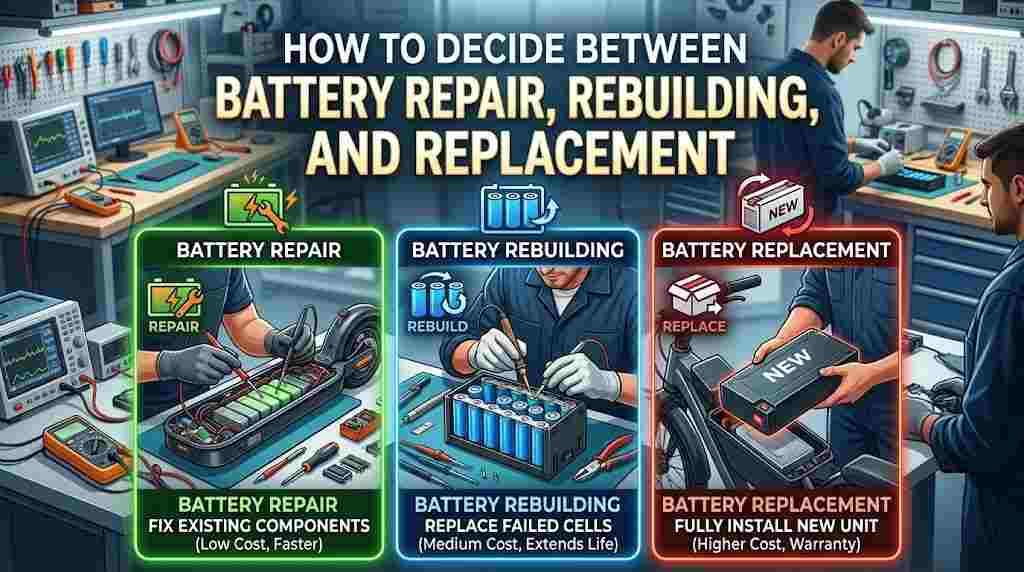
Battery Repair
Battery repair generally focuses on fixing a specific problem without rebuilding the entire battery. The issue might involve a damaged connection, loose terminal, faulty cable, corroded component, or another repairable problem.
Repair is usually the least invasive option. If the battery's main components are still in good condition, correcting one problem may restore reliable operation.
Battery Rebuilding
Rebuilding goes further than a basic repair. Depending on the battery type and condition, rebuilding may involve replacing worn or damaged internal components while retaining usable parts of the original battery.
The goal is to restore performance and extend the useful life of the battery. A rebuild can be especially useful when the battery has experienced significant wear but still has a solid foundation.
Battery Replacement
Replacement means removing the existing battery and installing a new one. This is generally the most expensive option, but it may be the most sensible choice when the existing battery has extensive damage, reached the end of its useful life, or cannot be economically restored.
The cheapest option upfront is not always the best long-term choice. You need to consider reliability, expected lifespan, downtime, and total operating costs.
When Battery Repair Makes Sense
Repair is often appropriate when the underlying battery remains healthy and the problem is limited to a specific component or connection.
For example, a battery may have:
- Loose or damaged connections
- Corroded terminals
- Damaged cables
- A faulty connector
- A problem with charging connections
- Minor physical damage
- Other isolated issues that affect performance
In these situations, replacing the entire battery could be unnecessary.
A professional inspection can help determine whether the battery's internal condition is still strong enough to justify a repair. If most of the battery is performing normally, fixing the individual problem may restore dependable operation at a fraction of the cost of replacement.
Watch for Performance Changes
A battery that suddenly performs poorly may not necessarily be worn out. If it previously provided good runtime and recently developed a problem, investigate the cause before assuming the battery needs to be replaced.
Sudden changes can sometimes point to a specific repairable issue.
When Rebuilding Is the Better Option
Rebuilding can be a middle ground between repairing a small problem and purchasing a completely new battery.
It may make sense when the battery has experienced substantial wear but still contains components that are suitable for continued use. Instead of discarding the entire battery, rebuilding focuses on restoring the parts that have become worn or damaged.
This can offer several potential benefits.
Lower Cost Than Replacement
Depending on the battery and the work required, rebuilding can cost less than purchasing a new battery. This can be particularly important for businesses operating several forklifts or other battery-powered equipment.
Even a small difference in the cost of each battery can have a significant effect when multiplied across an entire fleet.
Extending Useful Life
A successful rebuild can give an aging battery additional useful service life. This may allow a business to postpone the expense of purchasing a replacement while continuing to use existing equipment.
However, rebuilding should not be treated as a way to keep every battery running indefinitely. The battery must be evaluated to determine whether rebuilding is technically and economically worthwhile.
Reducing Waste
Keeping usable battery components in service can also reduce unnecessary waste. Rather than immediately disposing of a battery because some components have deteriorated, rebuilding may allow suitable parts to continue serving a purpose.
For businesses trying to make more responsible purchasing and maintenance decisions, this can be another factor to consider.
When Replacement Is the Right Choice
There are situations where repair or rebuilding simply does not make sense.
Replacement may be the better option when the battery has extensive internal damage, severe physical deterioration, repeated failures, or has reached the end of its practical service life.
Consider replacement if:
- The battery consistently fails despite previous repairs
- Runtime has declined dramatically
- The battery has severe physical damage
- Multiple major components are deteriorated
- Repair costs are approaching the cost of a replacement
- The battery no longer meets operational requirements
- Continued use creates unacceptable reliability or safety concerns
A battery that requires frequent attention can become more expensive than it appears. Every breakdown can interrupt work, delay orders, reduce equipment availability, and create additional labor costs.
Consider the Battery's Age and History
Age alone should not determine the decision, but it is an important part of the bigger picture.
A relatively new battery with one isolated problem may be an excellent candidate for repair. An older battery with several recurring issues may be a better candidate for rebuilding or replacement.
You should also consider the battery's maintenance history.
Ask questions such as:
- Has the battery been properly charged?
- Has it received regular maintenance?
- Has it been exposed to excessive heat?
- Has it been deeply discharged repeatedly?
- Has it experienced physical damage?
- Has it required multiple repairs?
- How has its performance changed over time?
A battery's history can help explain its current condition and provide clues about how much useful life remains.
Look at Total Cost, Not Just the Initial Price
One of the biggest mistakes businesses make is comparing repair and replacement based only on the immediate invoice.
Instead, consider the total cost of ownership.
For example, an inexpensive repair might seem attractive, but if the battery fails again shortly afterward, you could end up paying for several repairs while also dealing with equipment downtime.
On the other hand, a higher-cost rebuild might provide significantly longer service life and better reliability.
When comparing your options, consider:
- Cost of the repair or rebuild
- Cost of a replacement battery
- Expected remaining service life
- Maintenance requirements
- Potential downtime
- Labor costs
- Impact on productivity
- Reliability of the battery after service
This broader comparison often produces a better business decision than simply choosing the lowest upfront cost.
Think About Your Equipment's Workload
How your equipment is used also matters.
A forklift operating occasionally in a small facility may have very different battery requirements from one working multiple shifts every day in a busy distribution center.
Heavy-use operations place greater demands on batteries. If a battery is already struggling to provide adequate runtime, a minor repair may not solve the underlying capacity problem.
In a high-demand environment, reliability should be given significant weight. A battery that looks inexpensive on paper may become costly if it repeatedly interrupts operations.
Get a Professional Battery Assessment
When you are unsure which option is appropriate, a professional inspection can remove much of the guesswork.
A qualified technician can evaluate the battery's physical condition, connections, performance, and other relevant components. They can then explain whether repair, rebuilding, or replacement is likely to provide the best result.
This is particularly useful when the battery problem is not obvious. A battery that appears to be failing may have an issue that can be corrected without major work. Likewise, a battery that has already received several repairs may need a more comprehensive solution.
Getting an assessment before spending money can help prevent unnecessary replacement and avoid investing in a battery that is unlikely to provide reliable service.
Questions to Ask Before Making a Decision
Before approving repair, rebuilding, or replacement, ask a few practical questions:
What Exactly Is Wrong?
Don't settle for a general statement that the battery is "bad." Find out what is actually causing the problem.
How Much Useful Life Remains?
A repair makes more sense when the rest of the battery is in good condition.
What Will the Repair Cost?
Compare the expected repair cost with both rebuilding and replacement.
How Reliable Will It Be Afterwards?
Ask whether the proposed solution addresses the root cause or simply fixes a temporary symptom.
What Is the Expected Downtime?
For busy operations, downtime can be just as important as the service price.
Is the Solution Appropriate for the Equipment?
Make sure the battery will continue to meet the equipment's operational requirements after repair or rebuilding.
A Simple Way to Make the Decision
You can think of the decision as a three-step process.
Choose repair when the problem is isolated and the battery remains generally healthy.
Consider rebuilding when the battery has significant wear but still has a good foundation and can reasonably be restored.
Choose replacement when the battery is severely damaged, unreliable, near the end of its useful life, or too expensive to restore.
There is no universal answer because every battery and operating environment is different. The goal is not simply to spend the least money today. The goal is to choose the option that delivers dependable performance at a reasonable overall cost.
Conclusion
Deciding between battery repair, rebuilding, and replacement requires more than looking at the battery's age or the price of a new unit. Consider its current condition, maintenance history, performance, workload, repair costs, and expected remaining service life. A small problem may only require repair, while a heavily worn battery could benefit from rebuilding. When damage is extensive or reliability has become a persistent problem, replacement may be the smarter long-term choice. Working with an experienced provider such as Battery Rescue LLC can help you evaluate the battery's condition and make a practical decision based on performance, safety, and overall value.

 English
 Arabic
 French
 Spanish
 Portuguese
 Deutsch
 Turkish
 Dutch
Dutch
 Italiano
 Romaian
 Portuguese (Brazil)
 Greek
Greek
