


People Analytics Platforms in 2026: How to Turn HR Data into Business Results
Every CHRO eventually hears the same question from the CFO: "What is our workforce costing us, and what are we getting in return?" Too often, the answer is a spreadsheet stitched together from three HR systems, a payroll export, and an engagement survey nobody has had time to analyze.
That gap is why People Analytics Platforms have moved from an HR experiment to an enterprise priority. Labor is often one of the largest cost lines in any organization, yet the data that explains it usually sits in disconnected systems. This article covers what these platforms do, the challenges and trends shaping the market, and how buyers can evaluate vendors using QKS Group's SPARK Matrix™ research.
Market Overview: Why Workforce Data Is Now a Strategic Asset
According to QKS Group, a People Analytics Platform is an integrated solution that helps organizations make data-driven workforce decisions. It consolidates, analyzes, and visualizes employee data across the HR ecosystem.
Most People Analytics Platforms offer a common set of capabilities:
- Data integration across HRIS, payroll, recruiting, learning, and engagement systems
- Workforce analytics covering headcount, turnover, hiring, and productivity
- Predictive modeling to anticipate attrition, skills gaps, and hiring needs
- Organizational insights into structure, spans of control, and team performance
- Decision support that puts insights in front of managers and executives
The business relevance is direct. Talent strategy, productivity, and risk are now board-level topics, and leaders want evidence behind workforce decisions, not instinct.
QKS Group's SPARK Matrix analysis for this market includes vendors such as ADP, Crunchr, Dayforce, HiBob, HireRoad, iSolved, Nakisa, One Model, ProHance, SplashBI, UKG, and Visier. They come from different starting points, which makes structured comparison essential.
Key Challenges Businesses Face
Buying a platform is the easy part. These obstacles tend to slow adoption:
- Fragmented data. Employee data lives in many systems with inconsistent definitions. Two reports can show different headcount for the same week.
- Data quality and trust. If leaders doubt the numbers, they will not act on the insights.
- Limited analytical skills. Many HR teams have strong people expertise but few data specialists.
- Privacy and ethics. Workforce data is sensitive. Regulations and employee expectations demand careful governance.
- Proving value. HR leaders must connect insights to outcomes the business cares about, such as retention costs or revenue per employee.
Key Trends and Innovations
AI and predictive analytics. Machine learning is moving from descriptive reporting ("what happened") to forecasting ("what is likely to happen"). Attrition risk, hiring demand, and skills supply are common early use cases.
Generative AI interfaces. Natural language querying lets a business leader ask, "Where is turnover rising in our sales teams?" without waiting for an analyst. The test for buyers is accuracy and explainability, not novelty.
Cloud and embedded analytics. Analytics is increasingly built into HR and workforce platforms, bringing insights into the workflows managers already use.
Skills-based workforce planning. Organizations are looking beyond job titles to understand the skills they have, need, and can develop.
Governance by design. Role-based access, anonymization, and audit trails are becoming baseline expectations, not premium features.
Business-linked metrics. Leading teams tie people data to financial and operational outcomes so workforce conversations carry weight with the CFO.
Benefits and Business Impact
When implemented well, People Analytics Platforms can deliver:
- Efficiency. Less manual reporting and faster answers to leadership questions.
- Better talent decisions. Evidence-based hiring, promotion, and retention strategies.
- Risk reduction. Earlier visibility into attrition hotspots, compliance gaps, and pay equity issues.
- Productivity gains. Clearer insight into where teams are stretched or underused.
- Scalability. One consistent view of workforce data as the organization grows or restructures.
- Measurable ROI. Workforce investments can be tracked against business results.
Use Cases and Real-World Examples
These are illustrative scenarios of how organizations typically apply the technology:
- Attrition management. A services firm notices that resignations cluster among employees with long gaps between promotions. It adjusts career paths in those roles before more people leave.
- Workforce planning. A retailer models seasonal demand against current staffing and plans hiring weeks earlier.
- Pay equity. An enterprise analyzes compensation across roles and regions to find and correct unexplained gaps.
- Productivity insight. An operations team identifies where workload is uneven and rebalances capacity.
- Mergers and restructuring. HR combines data from two organizations to understand skills overlap and redundancy.
How Organizations Can Choose the Right Solution
Start with the decisions you want to improve, then evaluate vendors against them. A practical checklist:
- Integration depth. How easily does it connect to your HRIS, payroll, ATS, and survey tools?
- Analytics breadth. Does it cover descriptive, predictive, and prescriptive needs?
- Usability. Can managers and business leaders use it without analyst support?
- AI transparency. Can the platform explain how predictions are produced?
- Security and privacy. Does it support granular access control and regional compliance needs?
- Scalability and performance at your data volume.
- Total cost and time to value, including implementation effort.
- Vendor viability, meaning roadmap, customer base, and support quality.
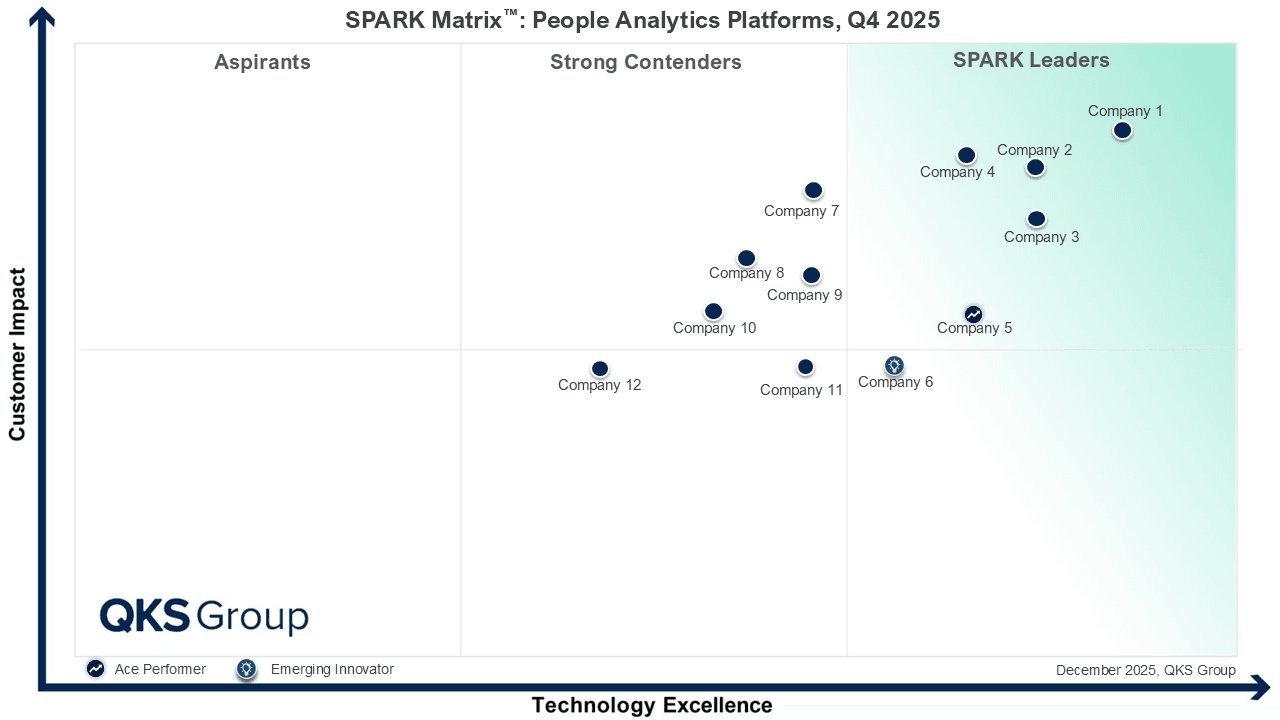
QKS Group's SPARK Matrix™ for People Analytics Platforms helps here. It ranks and positions vendors with global impact on technology excellence and customer impact, giving buyers an independent shortlisting reference. Vendors can use it to benchmark against competitors and refine strategy.
Future Outlook: 2026–2029
Expect the next few years to bring four shifts:
- AI assistants that summarize workforce trends and recommend actions for managers
- Tighter integration between people analytics, workforce planning, and talent management
- Stronger regulation and ethical expectations around employee data and automated decisions
- A shift from HR-only reporting to enterprise-wide decision support, where people data sits alongside financial and operational data
Vendors that pair advanced analytics with trust, explainability, and ease of use are likely to be best positioned.
Conclusion
Workforce decisions are too consequential to rest on fragmented data. People Analytics Platforms give organizations a reliable, connected view of their people, along with the predictive insight to act early. The right platform depends on your data landscape, your analytical maturity, and the business questions you need answered.
QKS Group's SPARK Matrix™ research offers a vendor-neutral view of the market to support that choice.

 English
 Arabic
 French
 Spanish
 Portuguese
 Deutsch
 Turkish
 Dutch
Dutch
 Russian
 Romaian
 Portuguese (Brazil)
 Greek
Greek
