


Generative AI Workloads Drive China Semiconductor Memory Past USD 53 Billion Mark
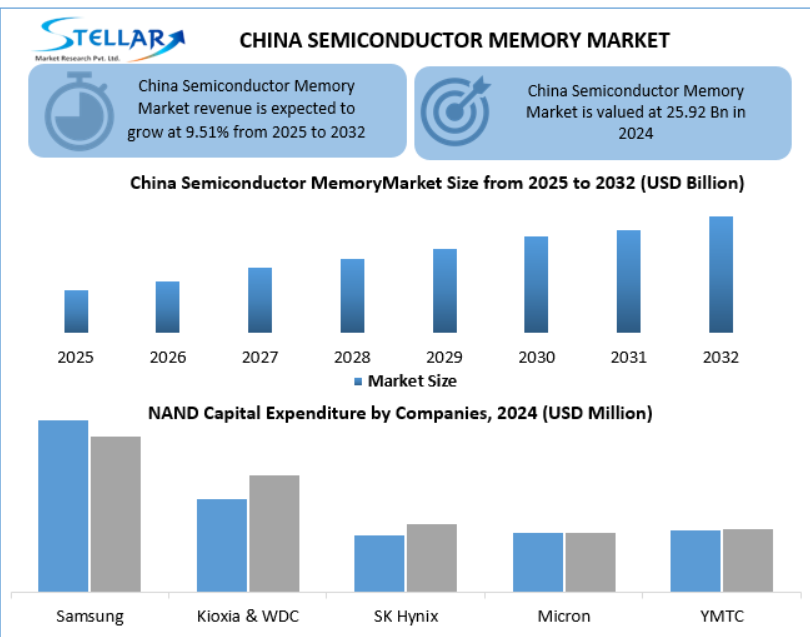
The China Semiconductor Memory Market is undergoing a profound structural evolution. According to the latest comprehensive market intelligence report published by Stellar Market Research, the market was valued at USD 25.92 Billion in 2024 and is projected to reach USD 53.61 Billion by 2032, expanding at a robust CAGR of 9.51% during the forecast period (2025–2032).
While China currently consumes over 50% of gloal sebmiconductor chips, domestic production meets less than 30% of internal demand. This pronounced supply-demand mismatch, coupled with escalating international export controls, has catalyzed an unprecedented capital deployment into local DRAM and NAND production capabilities, fundamentally reshaping global electronics supply chains.
China’s semiconductor memory sector is rapidly transitioning from downstream electronics assembly to high-end memory architecture innovation. The rapid implementation of national technology initiatives, including the renewed strategic framework following multi-billion-dollar state chip funds, has accelerated domestic fab builds and yield-rate advancements.
Key Findings from the Stellar Market Research Report
-
Market Valuation & Trajectory: The China Semiconductor Memory Market will expand from USD 25.92 Billion in 2024 to USD 53.61 Billion by 2032, registering a 9.51% CAGR.
-
Dominant Product Segment: Dynamic Random-Access Memory (DRAM) holds the largest market share, driven by enterprise server upgrades, AI cluster deployments, and premium smartphone architectures.
-
Fastest-Growing Segment: High-density flash memory (NAND Flash / EEPROM) is witnessing the highest growth velocity, propelled by data center SSD adoption and local industrial automotive expansion.
-
Leading Application Segment: Consumer Electronics remains the largest revenue contributor due to high smartphone production volumes and smart home device proliferation.
-
High-Growth Application Sector: The IT & Telecommunications and Data Center segment is the fastest-growing end-use sector, accelerated by national 5G buildouts and edge computing hubs.
-
Export-Import Dynamics: In 2022, China exported USD 70.2 billion worth of semiconductor devices globally (led by shipments to Hong Kong, Germany, and Brazil) while importing USD 23 billion, demonstrating its role as a key memory assembly and testing crossroads.
-
Localization Target Gap: With domestic manufacturing fulfilling under 30% of internal memory demand, local fab expansions present a massive USD 25+ billion import substitution opportunity for local chipmakers over the next eight years.
For further information, click the following link:https://www.stellarmr.com/report/req_sample/China-Semiconductor-Memory-Market/2579
Market Drivers and Restraints
Primary Market Drivers
-
National Self-Sufficiency & State Subsidies: The "Made in China 2025" and Big Fund phase expansions are providing capital to bridge the technological gap with global memory suppliers, driving domestic fab construction and tool procurement.
-
Exponential Data Center and AI Compute Growth: The rapid scaling of domestic LLMs and cloud computing requires vast arrays of server DRAM and enterprise PCIe SSDs, directly elevating memory content per server.
-
Pervasive 5G and Automotive Electronics Integration: The roll-out of Smart EV platforms and 5G network nodes across Tier-1 and Tier-2 Chinese cities is generating continuous demand for automotive-grade NOR, NAND, and LPDDR memory.
Key Market Restraints
-
Geopolitical Trade Friction & Equipment Sanctions: Severe international export restrictions on advanced lithography tools (EUV/deep-UV) and EDA software continue to hamper rapid process node transitions (e.g., sub-12nm DRAM and 200+ layer 3D NAND).
-
Cyclical Oversupply and Global Price Volatility: Sharp fluctuations in global memory spot prices, combined with domestic overcapacity in mature nodes, periodically compress gross margins for domestic memory chipmakers.
Technology, Regulation, and Sustainability Trends
-
3D Stacking & Advanced Packaging: To circumvent lithography limits, Chinese chipmakers are increasingly focusing on advanced packaging technologies, hybrid bonding, and 3D NAND architecture scaling to boost memory density.
-
Strict Data Governance (CSL & PIPL Compliance): Regulations such as the Cybersecurity Law (CSL) and Personal Information Protection Law (PIPL) require localized data storage, forcing cloud providers to construct dedicated local data centers outfitted with high-density SSD arrays.
-
Energy-Efficient Memory for ESG Compliance: With green data center mandates taking effect across Chinese megacities, demand is surging for low-voltage LPDDR5 and energy-efficient enterprise SSDs that reduce Power Usage Effectiveness (PUE) ratios.
Regional Insights: Domestic Hubs and Trade Corridors
-
Eastern & Central China (Leading Hubs): Key semiconductor manufacturing clusters in Wuhan (Hubei), Hefei (Anhui), Shanghai, and Shenzhen (Guangdong) command the vast majority of memory manufacturing, R&D, and packaging operations. Hefei and Wuhan remain ground zero for domestic DRAM and NAND mass production.
-
Western China (Emerging Region): Regions such as Chengdu-Chongqing and Xi'an are rapidly emerging as key assembly, testing, and edge data center hubs, supported by lower operational costs and inland tech corridor incentives.
-
International Export Footprint: Top export destinations for China-assembled memory and semiconductor devices continue to include Hong Kong (USD 9.49B), Germany (USD 4.57B), and Brazil (USD 4.54B), with rapid growth noted across Southeast Asian supply chains including Malaysia and Vietnam.
Recent Industry Developments (12-18 Months)
-
CXMT (ChangXin Memory Technologies) (2024): Unveiled its multi-layer LPDDR5 memory chips for high-end mobile devices, marking a major milestone in narrowing the node gap with global DRAM tier-one suppliers.
-
YMTC (Yangtze Memory Technologies Co.) (2024): Expanded production capacity for its Xtacking 3.0 architecture 3D NAND flash, boosting local high-density SSD yields despite ongoing tool import limitations.
-
GigaDevice Semiconductor (2024): Launched ultra-low-power SPI NOR Flash memory tailored for industrial IoT and automotive smart cockpits, expanding market share in domestic EV supply chains.
-
SMIC / Local Memory Alliances (2024): Formed strategic joint ventures with domestic packaging and testing firms to establish localized advanced packaging ecosystems for High Bandwidth Memory (HBM) alternatives.
-
China National Integrated Circuit Industry Investment Fund Phase III (2024): Capitalized with over USD 47 billion (344 billion yuan) to target critical bottlenecks in domestic semiconductor equipment, materials, and advanced memory fabrication.
Competitive Landscape
The China Semiconductor Memory Market exhibits a dual-structure competitive environment. Global giants such as Samsung Electronics, SK Hynix, Micron Technology, and Intel retain significant market presence in high-end segments. However, leading domestic players are rapidly expanding their market share:
-
Yangtze Memory Technologies Co., Ltd. (YMTC) — Dominates domestic 3D NAND developments and enterprise SSD solutions.
-
ChangXin Memory Technologies (CXMT) — Spearheads domestic DRAM design and mass production.
-
GigaDevice Semiconductor Inc. — Leads in NOR/SRAM specialty memory for consumer and automotive applications.
-
Macronix International & Xinxin Semiconductor Manufacturing (XMC) — Key contenders in specialty flash and wafer foundry services.
Domestic players are leveraging localized customer support, state-backed R&D subsidies, and domestic supply chain preferences to solidify their positioning.
Analyst Commentary
"The China Semiconductor Memory Market is approaching a pivotal inflection point," stated a Senior Research Analyst at Stellar Market Research. "While external trade restrictions pose structural operational hurdles, they have simultaneously created an unprecedented, guaranteed domestic customer base for local memory manufacturers. Over the next decade, the convergence of AI infrastructure buildouts, national automotive electrification, and massive capital injections into advanced packaging will accelerate China's transition from an import-dependent market to a self-sustaining memory powerhouse."
Future Outlook
Through 2032, the market will witness intensified technological localization. High-bandwidth memory (HBM) alternatives, stack-density breakthroughs in NAND flash, and custom memory architectures for auto-piloting chips will dictate investment flows. While foreign suppliers will continue catering to specific high-end segments, domestic Chinese suppliers are positioned to capture over 40% of the local memory market by the end of the forecast period.
For further information, click the following link:https://www.stellarmr.com/report/req_sample/China-Semiconductor-Memory-Market/2579
About Stellar Market Research
Stellar Market Research is a multifaceted market research and consulting company with professionals from several industries. Some of the industries we cover include medical devices, pharmaceutical manufacturers, science and engineering, electronic components, industrial equipment, technology and communication, cars and automobiles, chemical products and substances, general merchandise, beverages, personal care, and automated systems. To mention a few, we provide market-verified industry estimations, technical trend analysis, crucial market research, strategic advice, competition analysis, production and demand analysis, and client impact studies.
Address
Phase 3, Navale IT Zone, S.No. 51/2A/2, Office No. 202, 2nd floor, Near, Navale Brg, Narhe, Pune, Maharashtra 411041
Email
sales@stellarmr.com
Mobile
+91 9607365656

 English
 Arabic
 French
 Portuguese
 Deutsch
 Turkish
 Dutch
Dutch
 Italiano
 Russian
 Romaian
 Portuguese (Brazil)
 Greek
Greek
