


Digital Transformation in Manufacturing Market Reaches USD 1,326.80 Billion by 2034
Market Overview
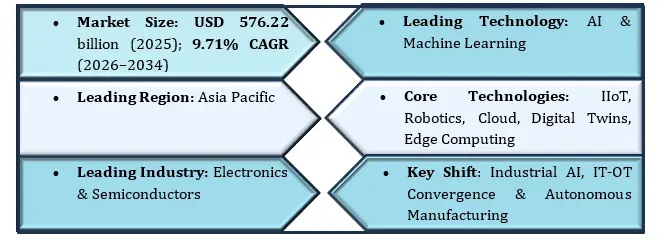
The Digital Transformation in Manufacturing Market is entering a major expansion phase as manufacturers accelerate the adoption of artificial intelligence (AI), Industrial Internet of Things (IIoT), robotics, cloud computing, digital twins, advanced analytics and connected automation. According to Maximize Market Research, the market was valued at approximately USD 576.22 billion in 2025 and is projected to grow at a CAGR of 9.71% from 2026 to 2034, reaching nearly USD 1,326.80 billion by 2034.
The market growth is being supported by manufacturers' increasing focus on production efficiency, predictive maintenance, quality improvement, workforce productivity and real-time operational visibility. Industrial automation is an important growth driver, with the expanding installed base of connected robots creating demand for machine vision, IIoT platforms, edge computing, industrial analytics and digital-twin technologies. The shift from basic automation toward intelligent and increasingly autonomous production is creating additional opportunities for software and technology providers. Emerging manufacturing economies also represent significant opportunities as new factories increasingly adopt digitally connected production systems rather than relying entirely on legacy infrastructure. However, integration of legacy equipment, fragmented operational technology and cybersecurity risks remain important challenges.
U.S. Market Trends and Investment
The United States remains one of the most important markets for manufacturing digital transformation, supported by advanced automation infrastructure, strong industrial software capabilities and significant investment in AI-enabled manufacturing. Deloitte's 2025 Smart Manufacturing Survey found that 88% of manufacturers expected smart-manufacturing investments to continue or increase in the following fiscal year, while 40% identified data analytics, 29% cloud computing, 29% AI and 27% IIoT among their priority investments. U.S. public and private investment is also strengthening the technology ecosystem. In January 2025, the U.S. Department of Commerce announced a $285 million CHIPS investment for the SMART USA digital-twin institute, bringing total planned investment above $1 billion and targeting digital twins for semiconductor design and manufacturing. In June 2025, Micron announced plans for approximately $200 billion in U.S. semiconductor manufacturing and R&D investment, including advanced memory manufacturing and R&D facilities. These developments are expected to increase demand for digital twins, AI, automation, industrial analytics and connected manufacturing infrastructure.
Request To Free Sample of This Strategic Report ➤ https://www.maximizemarketresearch.com/request-sample/319074/
Market Segmentation
By Technology: Artificial Intelligence & Machine Learning dominated the technology segment in 2025. AI and ML are increasingly used for predictive maintenance, machine vision, process optimization, automated quality inspection and autonomous decision-making. Their integration with IIoT, robotics and industrial analytics is expected to strengthen their position through 2034.
By End-Use Industry: Electronics & Semiconductors held the largest market share in 2025. High automation requirements, complex production processes, precision requirements and stringent quality standards are driving manufacturers in this industry to adopt AI-based process control, automated inspection, digital twins and real-time analytics.
Competitive Analysis
The leading competitive landscape includes Siemens, Rockwell Automation, Schneider Electric, ABB and Honeywell, with competition increasingly centered on integrated automation, industrial software, AI, IIoT, digital twins and cybersecurity solutions.
Siemens is strengthening its position through industrial AI, digital twins and software-defined automation. In 2025, Siemens expanded its partnership with NVIDIA to combine NVIDIA accelerated computing and AI with the Siemens Xcelerator platform. Siemens also introduced AI agents for industrial automation, designed to move beyond conventional assistants toward more autonomous industrial workflows.
Rockwell Automation is focusing on cloud-based automation, AI and IT-OT convergence. In 2025, Rockwell expanded its collaboration with AWS to connect factory-floor data with cloud analytics, AI and industrial software, while expanding FactoryTalk services through AWS Marketplace. Its FactoryTalk ecosystem also incorporates AI-assisted design, predictive analytics and digital-twin capabilities.
Schneider Electric is combining automation, IIoT, energy management and sustainability through its EcoStruxure ecosystem. In March 2025, the company announced plans to invest more than $700 million in U.S. operations through 2027, supporting digitalization, automation, manufacturing and AI-related energy infrastructure.
ABB is advancing AI-powered robotics and autonomous manufacturing. In 2025, ABB introduced new AI-enabled robotics capabilities and invested in LandingAI to strengthen vision-AI applications for robotics. Its RobotStudio AI Assistant is designed to simplify robot programming and accelerate commissioning.
Honeywell is shifting its industrial portfolio from automation toward autonomy. In 2025, it introduced AI-enabled digital technologies and cybersecurity solutions, while Honeywell Forge Production Intelligence gained a generative-AI assistant for production monitoring and troubleshooting.
Regional Analysis
United States: North America dominated the market in 2025, with the U.S. representing the region's key manufacturing technology hub. Growth is supported by AI investment, advanced automation, semiconductor reshoring, NIST smart-manufacturing initiatives and digital-twin development.
United Kingdom: The UK benefits from a strong manufacturing, engineering and technology ecosystem. Increasing adoption of industrial AI, automation and advanced analytics is supporting productivity-focused digital transformation.
Germany: Germany remains a major Industry 4.0 center because of its advanced automotive, machinery and industrial automation base. Siemens and other industrial technology companies are accelerating AI, digital-twin and software-defined manufacturing solutions.
France: France benefits from strong industrial automation and government-backed digital and technology modernization initiatives. Schneider Electric's global leadership in energy management and industrial automation further strengthens the country's role in digital manufacturing.
Japan: Japan's manufacturing strength in automotive, robotics, electronics and precision engineering creates strong demand for digital transformation. METI's 2025 manufacturing policy specifically identifies manufacturing DX as important for improving earning power and competitiveness, while Japan is also increasing public-private investment in AI and semiconductor technologies.
China: China represents a major manufacturing-driven adoption center, supported by large-scale electronics, machinery, automotive and industrial production. In 2025, Chinese authorities launched a smart-factory gradient cultivation program covering basic, advanced, excellent and leading smart factories, while a separate digital-transformation implementation plan targeted the electronic information manufacturing industry.
The accessible MMR report identifies North America as the leading regional market but does not publish individual country-level percentage shares on the public report page; therefore, country-specific percentage shares have not been fabricated.
Request To Free Sample of This Strategic Report ➤ https://www.maximizemarketresearch.com/request-sample/319074/
Key Players
North America
1. Rockwell Automation — U.S.
2. Honeywell — U.S.
3. Emerson Electric — U.S.
4. GE Vernova — U.S.
5. PTC — U.S.
6. Microsoft — U.S.
7. IBM — U.S.
8. Oracle — U.S.
9. Cisco Systems — U.S.
10. NVIDIA — U.S.
11. Amazon Web Services (AWS) — U.S.
12. Google Cloud — U.S.
13. Aspen Technology (AspenTech) — U.S.
14. Tulip Interfaces — U.S.
Europe
15. Siemens — Germany
16. Schneider Electric — France
17. ABB — Switzerland
18. Dassault Systèmes — France
19. Bosch — Germany
20. SAP — Germany
21. Hexagon — Sweden
22. KUKA — Germany
23. Krones — Germany
24. Beckhoff Automation — Germany
25. Festo — Germany
26. Endress+Hauser — Switzerland
27. IFS — Sweden
28. Celonis — Germany
29. AVEVA — UK
Asia Pacific — Japan
30. Hitachi — Japan
31. Mitsubishi Electric — Japan
32. FANUC — Japan
33. Omron — Japan
34. Yokogawa Electric — Japan
35. Fuji Electric — Japan
36. Yaskawa Electric — Japan
37. Keyence — Japan
38. Toshiba — Japan
39. NEC — Japan
40. Fujitsu — Japan
Asia Pacific — China
41. Huawei — China
42. Haier — China
43. Midea Group — China
44. Siasun Robot & Automation — China
45. Inovance Technology — China
46. China National Machinery Industry Corporation (Sinomach) — China
47. SUPCON — China
48. Hikvision — China
49. Lenovo — China
50. ZTE — China
Asia Pacific — South Korea
51. Samsung SDS — South Korea
52. LG CNS — South Korea
53. Samsung Electronics — South Korea
54. LG Electronics — South Korea
55. LS Electric — South Korea
56. Hyundai AutoEver — South Korea
57. Doosan Robotics — South Korea
Asia Pacific — India
58. Tata Consultancy Services (TCS) — India
59. Infosys — India
60. Wipro — India
61. Tech Mahindra — India
62. HCLTech — India
63. Larsen & Toubro — India
64. Tata Technologies — India
65. Persistent Systems — India
66. Cyient — India
South America
67. Stefanini — Brazil
68. Embraer — Brazil
69. WEG — Brazil
70. TOTVS — Brazil
71. Senior Sistemas — Brazil
72. TIVIT — Brazil
Middle East & Africa
73. Johnson Controls — U.S./MEA operations
Regional industrial technology and digital manufacturing providers — Middle East & Africa
Conclusion
The Digital Transformation in Manufacturing Market is moving from isolated automation projects toward integrated, AI-enabled and increasingly autonomous manufacturing ecosystems. In our view, the strongest long-term opportunity lies in combining AI with IIoT, robotics, digital twins, edge computing and industrial cybersecurity. The modernization of legacy factories is particularly attractive because manufacturers can obtain productivity improvements without completely replacing existing infrastructure. Continued investment in smart factories, semiconductor production, workforce development and resilient supply chains will further accelerate demand. Vendors that can provide interoperable, secure and scalable solutions while demonstrating measurable returns on investment are likely to capture the greatest opportunities as manufacturing evolves toward intelligent and autonomous production.
About Maximize Market Research
Maximize Market Research Pvt. Ltd. (MMR) is a global market research and consulting company that provides reliable, data-focused, and practical business insights. The firm serves a wide range of industries, including healthcare, pharmaceuticals, technology, automotive, electronics, chemicals, personal care, and consumer goods. Through market forecasts, competitive analysis, strategic consulting, and industry impact assessments, MMR helps organizations understand changing market conditions, identify growth opportunities, and make informed business decisions for long-term success.
Contact Us
2nd Floor, Navale IT Park Phase 3
Pune Banglore Highway, Narhe
Pune, Maharashtra 411041, India
+91 9607365656
sales@maximizemarketresearch.com

 English
 Arabic
 Spanish
 Portuguese
 Deutsch
 Turkish
 Dutch
Dutch
 Italiano
 Russian
 Romaian
 Portuguese (Brazil)
 Greek
Greek
