


PCB Encapsulation UAE: Process, Materials, Benefits and Choosing the Right Solution
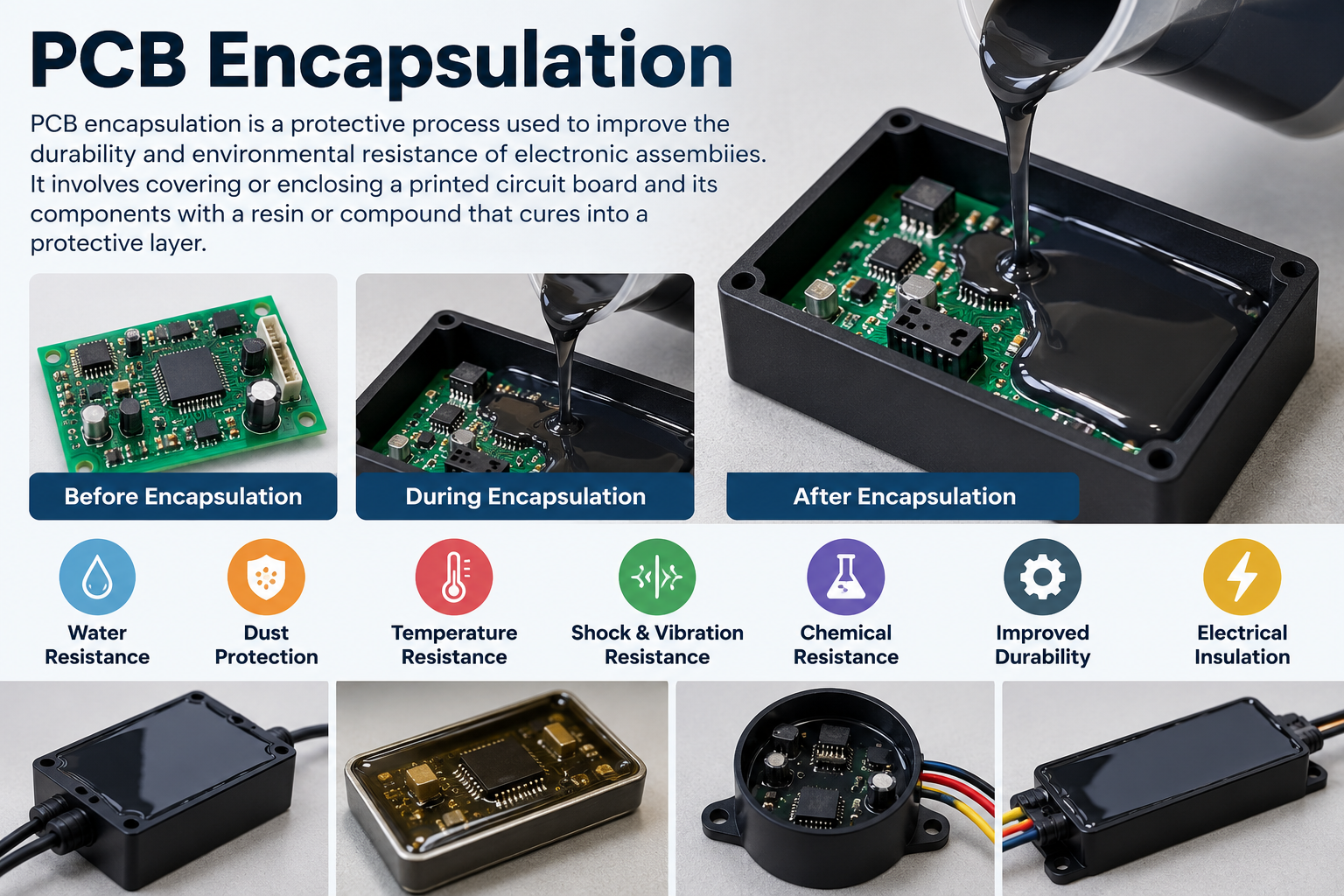
PCB encapsulation is a protective process used to improve the durability and environmental resistance of electronic assemblies. It involves covering or enclosing a printed circuit board and its components with a resin or compound that cures into a protective layer.
Businesses operating in the UAE often need additional protection for electronics exposed to heat, humidity, dust, moisture, chemicals, vibration, mechanical shock, and outdoor environments. The region's climate, with high temperatures and coastal humidity in cities like Dubai and Abu Dhabi, places real demands on electronic assemblies used in industrial, automotive, and outdoor applications. Potting and encapsulation are commonly used to protect sensitive electronic assemblies.
Quick Answer: What Is PCB Encapsulation?
PCB encapsulation is the process of covering or enclosing a printed circuit board and its electronic components with a protective resin or compound that cures into a solid or flexible protective layer. Common materials include epoxy, polyurethane, and silicone.
What Is PCB Encapsulation UAE?
In the UAE industrial and electronics context, PCB encapsulation refers to the use of protective resins and potting compounds to shield circuit boards from the country's demanding operating conditions. This includes high ambient temperatures, humidity, salt-laden coastal air, dust, and the vibration found in industrial and automotive environments.
PCB encapsulation in the UAE may be used for electronic control boards, industrial electronics, automotive electronics, sensors, power electronics, LED systems, communication equipment, control modules, outdoor electronics, and electrical assemblies. Not every application requires full encapsulation. The decision depends on the operating environment, the value of the assembly, and the consequences of failure.
PCB Encapsulation vs PCB Potting
Industry terminology can overlap, and the exact process can vary by manufacturer and application. Potting commonly involves filling a housing or cavity around the PCB, while encapsulation can refer more broadly to covering or enclosing electronic components.
| Factor | PCB Encapsulation | PCB Potting |
|---|---|---|
| Basic concept | Covering or enclosing the PCB and components with a protective compound | Filling a housing or cavity around the PCB with resin |
| Material application | Dispensed, poured, or applied over the assembly | Poured or dispensed into an enclosure |
| Coverage | Can be partial or complete | Usually complete within the housing |
| Protection | Environmental and mechanical protection | Environmental and mechanical protection |
| Typical use | Component-level protection, glob top, dam-and-fill | Module-level protection inside a case |
| Repairability | Depends on material and method | Often difficult, especially with rigid resins |
Why Is PCB Encapsulation Important in the UAE?
Heat and Temperature Variation
Operating temperature and thermal cycling can affect electronics and encapsulation materials. In the UAE, outdoor and industrial electronics may face high ambient temperatures and repeated heating and cooling cycles. A suitable encapsulant can help manage these stresses, but performance depends on the material's thermal properties and the PCB design.
Humidity and Moisture
Moisture can contribute to corrosion, electrical leakage, and other reliability problems. Coastal areas in the UAE experience high humidity, which increases the risk to unprotected electronics. Encapsulation can help isolate sensitive components from moisture, provided the material is correctly selected and applied.
Dust and Contaminants
Encapsulation can help isolate sensitive components from dust and contaminants. This matters in industrial, construction, and desert environments where airborne particles are common.
Vibration and Mechanical Shock
Suitable potting compounds can provide mechanical support and damping. This helps protect components and solder joints from vibration and shock in automotive, industrial, and transportation applications.
Chemical Exposure
Some resin systems can provide resistance to specific chemicals, depending on formulation. No encapsulant provides universal chemical resistance. The correct material must be matched to the chemicals the assembly will encounter.
PCB Encapsulation Materials
Epoxy PCB Encapsulation
Epoxy offers high hardness, strong adhesion, mechanical protection, chemical resistance, and electrical insulation. It suits applications where rigidity and durability are priorities. Limitations include difficult rework and potentially higher mechanical stress on components during thermal cycling.
Epoxy resin UAE suppliers typically stock a range of formulations for electronics, industrial, and structural applications. For bonding and sealing components on electronic assemblies, epoxy adhesive Dubai customers often select two-part systems that cure at room temperature or with heat.
Polyurethane PCB Encapsulation
Polyurethane is available in flexible formulations and offers good shock and vibration resistance. Different hardness options allow engineers to balance protection and flexibility. It provides environmental protection and suits applications where some movement or thermal expansion is expected.
Silicone PCB Encapsulation
Silicone offers flexibility, wide temperature performance, stress relief, and moisture protection. It suits applications with thermal cycling or where components are sensitive to mechanical stress. Silicone, epoxy, and polyurethane are commonly used for electronic potting and encapsulation, with different mechanical, thermal, and environmental characteristics.
Silicone and epoxy systems are also widely used for LED protection. A reliable LED potting resin supplier UAE option should be matched to the LED's thermal output, the operating environment, and the optical requirements of the fixture.
| Material | Flexibility | Mechanical Protection | Temperature Performance | Typical Applications |
|---|---|---|---|---|
| Epoxy | Low | High | Moderate to good | Power electronics, industrial modules |
| Polyurethane | Medium to high | Medium to high | Moderate | Automotive sensors, control units |
| Silicone | High | Medium | Wide range | LED systems, sensitive components |
No single material is universally best. Selection depends on the application.
PCB Encapsulation Process
-
PCB inspection
-
Cleaning and surface preparation
-
Masking or protection of areas that should remain accessible
-
Material selection
-
Resin and hardener preparation where applicable
-
Mixing
-
Degassing where required
-
Dispensing or pouring
-
Bubble and void control
-
Curing
-
Inspection
-
Functional testing
Correct mixing, dispensing, and curing are important for consistent encapsulation. Some complex geometries may require vacuum potting or degassing to reduce trapped air and voids.
PCB Encapsulation Methods
Full Potting
The assembly is surrounded by the protective compound within a housing or mold.
Partial Encapsulation
Only selected components or areas are protected. This is useful when some parts must remain accessible.
Dam-and-Fill
A boundary is created around a specific area before filling it with the encapsulation material. This limits the compound to a defined region.
Glob Top
A protective resin is applied over selected components, such as bare die or delicate parts, where appropriate.
The correct method depends on the PCB design and environmental requirements.
Benefits of PCB Encapsulation
PCB potting and encapsulation can provide protection from moisture, chemicals, vibration, mechanical shock, and electrical stresses when appropriately designed. Potential benefits include moisture protection, dust protection, electrical insulation, vibration resistance, mechanical protection, chemical protection, improved durability, tamper resistance, reduced movement of components, and protection from environmental contamination.
These benefits depend on the material and process. Encapsulation does not automatically make every PCB waterproof, heatproof, or indestructible.
PCB Encapsulation Applications in UAE
Automotive Electronics
Protection for sensors, control modules, and other electronic assemblies exposed to vibration and environmental conditions.
Industrial Automation
Protection for control electronics used in industrial environments, including factories and processing plants.
LED and Lighting Systems
Encapsulation can protect sensitive electronics used in lighting equipment, particularly outdoor and architectural lighting.
Renewable Energy
Applications in electronic control and power-management equipment used in solar installations.
Telecommunications
Protection of sensitive communication electronics, including outdoor units.
Consumer Electronics
Applications where additional environmental or mechanical protection is required.
Marine and Outdoor Electronics
Moisture and environmental exposure can increase protection requirements, especially in coastal and marine environments.
Not every product in these industries requires encapsulation.
PCB Encapsulation vs Conformal Coating
| Factor | PCB Encapsulation/Potting | Conformal Coating |
|---|---|---|
| Material thickness | Thick, fills volume | Thin, typically microns to a few mils |
| Environmental protection | High, depending on material | Good, but thinner barrier |
| Mechanical support | Significant | Minimal |
| Weight | Higher | Lower |
| Heat dissipation | Depends on material | Limited |
| Inspection | Difficult after cure | Easier |
| Repairability | Often difficult | More feasible |
| Cost considerations | Higher material and process cost | Lower material cost |
Conformal coating applies a relatively thin protective layer, while potting and encapsulation generally provide a thicker barrier and greater mechanical protection. Conformal coating may be preferable when repairability, weight, or component access is important.
How to Choose the Right PCB Encapsulation Material
-
Identify the operating temperature range.
-
Assess moisture exposure.
-
Evaluate chemical exposure.
-
Determine mechanical and vibration requirements.
-
Check electrical insulation requirements.
-
Consider thermal conductivity.
-
Evaluate flexibility requirements.
-
Consider repairability.
-
Review curing requirements.
-
Test material compatibility with PCB components.
Material selection should be based on the actual operating environment rather than choosing a resin only because it is commonly used.
PCB Encapsulation Services UAE
A professional PCB encapsulation service may provide material selection support, PCB preparation, masking, resin mixing, dispensing, vacuum degassing where required, potting, curing, inspection, functional testing, and production-scale processing. Not every UAE provider offers all these services.
Suppliers that focus on formulated systems for electronics position themselves around application-specific resin systems rather than a single generic product. When evaluating a supplier for PCB encapsulation services UAE, ask for technical data sheets, cure profiles, and compatibility information rather than relying on general marketing claims.
PCB Encapsulation Services in Dubai
Dubai-based electronics manufacturers and industrial businesses may look for PCB encapsulation solutions for prototypes, small production runs, high-volume manufacturing, industrial electronics, automotive components, and outdoor equipment. Local search intent for PCB protection services Dubai and electronics encapsulation Dubai reflects the concentration of electronics businesses in the emirate.
Quality Considerations for PCB Encapsulation
Material consistency, correct mixing ratio, resin viscosity, bubble and void control, surface preparation, cure temperature, cure time, adhesion, thermal performance, electrical insulation, and final inspection all affect the outcome. Process control is important for repeatable results.
Common PCB Encapsulation Problems
Potential issues include air bubbles, voids, poor adhesion, incomplete curing, resin cracking, excessive heat buildup, component stress, difficult rework, and incorrect material selection. Proper process design and material selection can reduce these risks.
Cost of PCB Encapsulation in UAE
There is no universal fixed price. Factors affecting cost include PCB size, PCB complexity, encapsulation material, resin quantity, production volume, manual versus automated dispensing, surface preparation, masking requirements, curing process, testing requirements, packaging, and custom process development.
Businesses should request a quotation based on the actual PCB design and required environmental performance.
How to Choose a PCB Encapsulation Provider in UAE
-
Relevant electronics experience
-
Suitable encapsulation materials
-
Material technical data sheets
-
Controlled mixing and dispensing
-
Degassing capabilities where required
-
Quality inspection
-
Testing capabilities
-
Production scalability
-
Clear documentation
-
Ability to meet project specifications
Ask for sample testing or prototype validation before moving to large-scale production when appropriate.
Frequently Asked Questions
1. What is PCB encapsulation UAE?
PCB encapsulation UAE refers to the process of protecting circuit boards with resin or compound in the United Arab Emirates. It is used to improve durability and environmental resistance for electronics operating in hot, humid, dusty, or industrial conditions.
2. What is PCB potting?
PCB potting is the process of filling a housing or cavity around a circuit board with a protective compound. It provides environmental and mechanical protection and is often used interchangeably with encapsulation.
3. Why is PCB encapsulation important?
PCB encapsulation is important because it can help protect electronics from moisture, dust, chemicals, vibration, and mechanical shock. The actual level of protection depends on the material, process, and operating conditions.
4. Which materials are used for PCB encapsulation?
Common materials include epoxy, polyurethane, and silicone. Each offers different flexibility, thermal performance, and mechanical protection characteristics.
5. Is epoxy good for PCB encapsulation?
Epoxy is suitable when high hardness, strong adhesion, and chemical resistance are needed. It is less suitable when flexibility or reworkability is important.
6. When should silicone be used for PCB potting?
Silicone should be considered when flexibility, wide temperature performance, and stress relief are priorities. It suits applications with thermal cycling or sensitive components.
7. What is the difference between PCB potting and conformal coating?
Potting generally provides a thicker barrier and greater mechanical protection, while conformal coating applies a thin protective layer. Conformal coating is easier to inspect and repair.
8. Does PCB encapsulation protect against moisture?
PCB encapsulation can help protect against moisture when the correct material and process are used. Performance depends on the resin formulation, application method, and operating environment.
9. Can encapsulated PCBs be repaired?
Repair depends on the material and method. Flexible materials may allow limited rework, while rigid epoxies often make repair difficult or impractical.
10. How much does PCB encapsulation cost in UAE?
There is no fixed price. Cost depends on PCB size, complexity, material, volume, and testing requirements. Request a quotation based on your specific design.
11. Where is PCB encapsulation used?
It is used in automotive electronics, industrial automation, LED systems, renewable energy, telecommunications, consumer electronics, and marine or outdoor electronics.
12. How do I choose a PCB encapsulation service in UAE?
Look for relevant experience, suitable materials, controlled processes, inspection and testing capabilities, and production scalability. Request sample validation before large-scale production.

 English
 Arabic
 French
 Spanish
 Portuguese
 Deutsch
 Turkish
 Dutch
Dutch
 Italiano
 Russian
 Romaian
 Portuguese (Brazil)
